
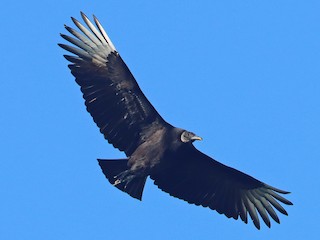
How to identify the Black Vulture
Coragyps atratus
Spotted a bird? Identify it instantly with the Birdby app
Open the appTo correctly identify the Black Vulture (Coragyps atratus), check each of these features. Birds can be tricky: habit, habitat, and call often confirm a sighting that a single photo cannot.
Size at a glance
- Length
- 56-74 cm (22-29 in)
- Wingspan
- 133-160 cm (52-63 in)
- Weight
- 1.6-3.0 kg (3.5-6.6 lbs)
Physical features to check
- 1
Plumage
Overall feather coloration and pattern.
Adults are entirely black, with a glossy sheen on the upperparts. The underside of the primary flight feathers has distinctive white patches, visible in flight. Juveniles are similar but may have a slightly paler head.
- 2
Beak shape
Shape and color of the bill: a key field mark.
Hooked, relatively short and stout, dark gray to black.
- 3
Eye color
Iris color and any distinctive eye markings.
Dark brown.
- 4
Leg color
Leg and foot color.
Grayish-white to pale gray, often stained with uric acid (urohidrosis).
- 5
Distinguishing features
Standout features that separate this species.
Featherless, wrinkled, dark gray head and neck; short, square-tipped tail; white patches at the base of the primary flight feathers (wingtips) visible from below in flight; heavy, powerful build.
- 6
Juvenile appearance
How young birds differ from adults.
Similar to adults, but the head may appear slightly less wrinkled and a bit paler gray. The white wing patches are present from a young age.
- 7
Seasonal changes
Plumage variation between breeding and non-breeding seasons.
No significant seasonal plumage changes.
- 8
Sexual dimorphism
How males and females differ.
None; sexes are monomorphic in plumage and size.
Key field marks
- Plumage. Look for an entirely black body and wings. The head is featherless and dark gray/black.
- Head. The dark, featherless head is a key feature, distinguishing it from the red-headed adult Turkey Vulture.
- Tail. Observe the short, square-tipped tail, which barely extends beyond the trailing edge of the wings in flight.
- Underwing Pattern. In flight, look for prominent white patches at the base of the primary flight feathers (wingtips), contrasting sharply with the otherwise dark underwing.
- Flight Style. Note the relatively flat wing profile (or very shallow dihedral) and more frequent, shallow wing beats compared to the teetering, deep-dihedral flight of the Turkey Vulture.
- Behavior. Often seen in groups, especially at carcasses or roosts. They are more aggressive at food sources than Turkey Vultures.
Explore the Black Vulture
Identify birds anywhere
Free on iOS, Android, and Web. Photo & sound identification, full species database, and your personal life list.