
Spotted a bird? Identify it instantly with the Birdby app
Open the appAbout
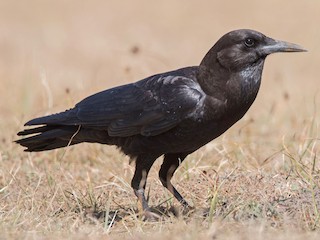
The Cape Crow is a medium-sized, all-black corvid found across much of Southern and Eastern Africa. It is characterized by its proportionately long, slender bill and relatively long legs, giving it an elegant, almost delicate appearance compared to other crows. Highly intelligent and adaptable, it thrives in a variety of open and semi-open habitats, often seen foraging on the ground.
Size & lifespan
- Length
- 48-52 cm (19-20.5 in)
- Wingspan
- 90-100 cm (35-39 in)
- Weight
- 360-600 g (12.7-21.2 oz)
- Lifespan
- Typically 10-15 years in the wild, up to 20 years recorded.
- Diet
- Omnivorous, with a diet comprising insects (especially beetles, grasshoppers, termites), other invertebrates (spiders, snails), small vertebrates (lizards, frogs, rodents), bird eggs and nestlings, carrion, seeds, fruits, and cultivated grains. It is a highly opportunistic feeder.
Physical characteristics
- Plumage
- Entirely glossy black plumage with a slight purple or blue-green sheen visible in good light. Feathers are dense and smooth.
- Beak shape
- Long, slender, and distinctly decurved (down-curved) black bill that is sharper than most other crow species. This is a key diagnostic feature.
- Eye color
- Dark brown
- Leg color
- Black
- Distinguishing features
- Its most distinguishing feature is the long, slender, and slightly decurved bill. Its overall build is more graceful and less robust than other large crows. When perched, it often holds its tail slightly raised, which is another useful field mark.
- Juvenile appearance
- Juveniles resemble adults but have a duller, less glossy black plumage and often a shorter, slightly less well-defined bill. Their eyes may appear a paler brown.
- Seasonal changes
- No significant seasonal changes in plumage. They maintain their all-black appearance throughout the year.
- Sexual dimorphism
- Males are generally slightly larger than females, but plumage is identical. Sexes are difficult to distinguish in the field without direct comparison or behavioral cues.
How to identify
- 1
Bill Shape
Look for the unusually long, slender, and slightly decurved black bill. This is the single most reliable field mark.
- 2
Plumage
Uniformly glossy black plumage distinguishes it from piebald crows or ravens with white markings.
- 3
Body Proportions
Note the relatively long legs and often slightly elevated tail, giving it a more elegant, less stocky appearance than other corvids.
- 4
Call
Listen for its characteristic nasal 'kraaaak' call, which differs from the deeper, harsher calls of other larger corvids.
- 5
Foraging Style
Observe its ground-foraging behavior, often probing the soil with its specialized bill.
Habitat & range
- Biomes
- Grasslands, savannas, agricultural lands, semi-arid regions, open woodlands, and edges of human settlements.
- Geographic range
- Widely distributed across Southern Africa (South Africa, Namibia, Botswana, Zimbabwe, Mozambique, Angola, Zambia, Malawi, DRC, Tanzania, Uganda, Kenya, Ethiopia, Eritrea, South Sudan, Sudan, Somalia). There are two disjunct populations: one in Southern Africa and another in East Africa.
- Elevation range
- Sea level up to approximately 3,000 meters (9,800 feet) in Eastern Africa.
- Preferred environments
- Prefers open country with scattered trees, cultivation, pastures, and savannahs. Less common in dense forests or true deserts. Often found near human activity and farms.
Behavior
- Activity time
- Diurnal. Active primarily during daylight hours.
- Feeding habits
- Primarily a ground feeder, walking with an elegant gait as it probes the soil with its long bill for invertebrates, particularly insect larvae. It also gleans insects from vegetation, catches flying insects, scavenges, and takes small prey. Will often follow ploughs to feed on exposed grubs. It can be seen 'hawking' for flying insects like a flycatcher.
- Social behavior
- Usually seen singly or in pairs, especially during the breeding season. Outside of breeding, they may gather in larger flocks at abundant food sources or communal roosts. Can be quite social with other corvids.
- Flight pattern
- Strong, direct flight with relatively slow, deliberate wing beats. Soars on thermals at times. Agile in the air, capable of aerial pursuits of insects.
- Migration pattern
- Generally resident throughout its range, but some local or seasonal movements occur in response to food availability or rainfall. Not considered a long-distance migrant.
- Territoriality
- Breeding pairs are territorial and will defend their nesting site. Non-breeding individuals may have larger home ranges or be more nomadic.
Song & calls
- Song
- The Cape Crow's song is not a true melodic song like passerines, but rather a series of varied caws, croaks, and guttural notes, often interspersed with mimicry. It's more of an elaborate vocal display than a song.
- Call
- The most common call is a distinctive, rather nasal 'kraaaak' or 'kaaaarrrr' which is often drawn out and somewhat higher pitched than other crows. They also utter a variety of softer 'kruk-kruk' notes, rattles, and guttural 'grrrr' calls. Alarm calls are sharper and more urgent.
- When they vocalize
- Vocalizes year-round, but calls are most frequent and varied during the breeding season as pairs communicate and defend territory.
Breeding & reproduction
- Breeding season
- Varies geographically: mainly August-December in Southern Africa, and generally after the rains (e.g., March-July) in East Africa. Can be variable based on local conditions.
- Nesting habits
- Nests are typically solitary, built in the fork or at the top of a tall tree, often an acacia or eucalyptus, or on utility poles or pylons. Both sexes construct a bulky cup-shaped nest of sticks, twigs, and thorny branches, lined with softer materials like hair, wool, grass, and sometimes even wire or plastic.
- Clutch size
- 3-5 eggs, occasionally 2 or 6.
- Egg description
- Typically 3-5 eggs, pale blue-green or greenish-white, heavily marked with brown, olive, or purple spots and blotches, often concentrated at the broader end.
- Incubation period
- Approximately 18-19 days, primarily by the female.
- Fledging period
- Young fledge at about 35-45 days after hatching. They remain dependent on parents for several weeks after leaving the nest.
- Parental care
- Both parents participate in feeding and caring for the young. The male often feeds the female during incubation.
Where to find
Agricultural Fields
Often seen in cultivated areas, especially after ploughing, where they feed on exposed invertebrates.
Open Grasslands and Savannas
Look for them foraging on the ground or perched on prominent trees, fences, or utility poles.
Roadsides
Frequently spotted along roadsides, feeding on roadkill or insects.
Tree Lines and Scattered Woodlands
They prefer open areas but utilize trees for nesting and roosting, so check woodland edges.
Field tips
- Scan Open Areas. Cape Crows are often conspicuous in open habitats. Use binoculars to scan fields, fence lines, and distant trees for perched birds.
- Listen for Calls. Their unique nasal 'kraaaak' call can often alert you to their presence before you see them.
- Observe Foraging Behavior. Watch for birds walking steadily on the ground, frequently probing with their long bills.
- Look for Perch Sites. They often perch on prominent elevated spots like telephone poles, tall trees, or even buildings, providing good viewing opportunities.
Similar species
Pied Crow
Corvus albus
The Pied Crow has a distinctive black and white plumage pattern, lacking the all-black appearance of the Cape Crow. While similar in size, the Pied Crow has a heavier, more standard crow bill, unlike the slender, decurved bill of the Cape Crow.
White-necked Raven
Corvus albicollis
Larger and chunkier than the Cape Crow, with a very thick bill and a prominent white patch on the nape and upper back (though not always visible). The Cape Crow is entirely black and much more slender-billed.
Fan-tailed Raven
Corvus rhipidurus
Smaller than the Cape Crow, with a proportionately shorter, stout bill and a distinctive short, square-tipped tail. The Cape Crow has a longer tail and its defining long, slender bill.
Quick facts
- Bill Distinctiveness:
- Longest and most slender bill of any African crow or raven.
- Foraging Specialization:
- Well-adapted for ground-probing for insect larvae.
- Geographic Separation:
- Two main populations: Southern African and East African.
- Taxonomic Status:
- No recognized subspecies; considered monotypic.
Fun facts
- Cape Crows are known to follow tractors and other farming machinery, taking advantage of disturbed soil to find food, exhibiting an intelligent adaptation to human activities.
- Their long, slender bill isn't just for probing; they are also adept at 'hawking' for flying insects, catching them mid-air with surprising agility.
- Despite being called 'Cape Crow', its range extends far beyond the Cape region, spanning much of East and Southern Africa.
Scientific classification
- Kingdom
- Animalia
- Phylum
- Chordata
- Class
- Aves
- Order
- Passeriformes
- Family
- Corvidae
- Genus
- Corvus
- Species
- C. capensis
Explore the Cape Crow
Identify birds anywhere
Free on iOS, Android, and Web. Photo & sound identification, full species database, and your personal life list.