
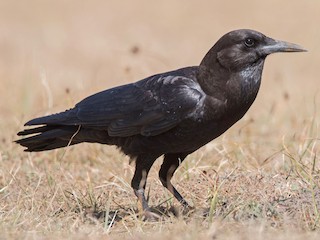
How to identify the Cape Crow
Corvus capensis
Spotted a bird? Identify it instantly with the Birdby app
Open the appTo correctly identify the Cape Crow (Corvus capensis), check each of these features. Birds can be tricky: habit, habitat, and call often confirm a sighting that a single photo cannot.
Size at a glance
- Length
- 48-52 cm (19-20.5 in)
- Wingspan
- 90-100 cm (35-39 in)
- Weight
- 360-600 g (12.7-21.2 oz)
Physical features to check
- 1
Plumage
Overall feather coloration and pattern.
Entirely glossy black plumage with a slight purple or blue-green sheen visible in good light. Feathers are dense and smooth.
- 2
Beak shape
Shape and color of the bill: a key field mark.
Long, slender, and distinctly decurved (down-curved) black bill that is sharper than most other crow species. This is a key diagnostic feature.
- 3
Eye color
Iris color and any distinctive eye markings.
Dark brown
- 4
Leg color
Leg and foot color.
Black
- 5
Distinguishing features
Standout features that separate this species.
Its most distinguishing feature is the long, slender, and slightly decurved bill. Its overall build is more graceful and less robust than other large crows. When perched, it often holds its tail slightly raised, which is another useful field mark.
- 6
Juvenile appearance
How young birds differ from adults.
Juveniles resemble adults but have a duller, less glossy black plumage and often a shorter, slightly less well-defined bill. Their eyes may appear a paler brown.
- 7
Seasonal changes
Plumage variation between breeding and non-breeding seasons.
No significant seasonal changes in plumage. They maintain their all-black appearance throughout the year.
- 8
Sexual dimorphism
How males and females differ.
Males are generally slightly larger than females, but plumage is identical. Sexes are difficult to distinguish in the field without direct comparison or behavioral cues.
Key field marks
- Bill Shape. Look for the unusually long, slender, and slightly decurved black bill. This is the single most reliable field mark.
- Plumage. Uniformly glossy black plumage distinguishes it from piebald crows or ravens with white markings.
- Body Proportions. Note the relatively long legs and often slightly elevated tail, giving it a more elegant, less stocky appearance than other corvids.
- Call. Listen for its characteristic nasal 'kraaaak' call, which differs from the deeper, harsher calls of other larger corvids.
- Foraging Style. Observe its ground-foraging behavior, often probing the soil with its specialized bill.
Explore the Cape Crow
Identify birds anywhere
Free on iOS, Android, and Web. Photo & sound identification, full species database, and your personal life list.