
Spotted a bird? Identify it instantly with the Birdby app
Open the appAbout
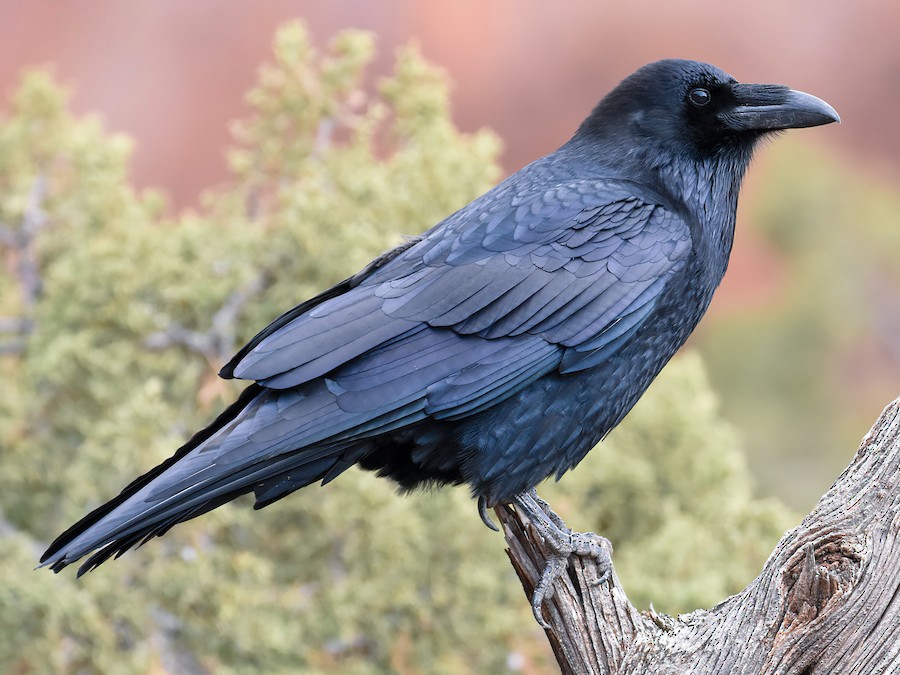
The Common Raven is a large, all-black passerine bird, renowned for its intelligence, adaptability, and complex vocalizations. It is one of the most widespread corvids globally, inhabiting a diverse range of environments across the Northern Hemisphere. Known for its opportunistic feeding habits and social complexity, it plays a significant ecological role as a scavenger and predator.
Size & lifespan
- Length
- 54-67 cm (21-26 in)
- Wingspan
- 115-150 cm (45-59 in)
- Weight
- 0.69-2 kg (1.5-4.4 lbs)
- Lifespan
- 10-15 years in the wild, up to 40 years in captivity
- Diet
- Omnivore (highly opportunistic, including carrion, small mammals, birds, eggs, insects, grains, fruits, and human refuse)
Physical characteristics
- Plumage
- Entirely glossy black plumage, often with a purplish-blue or greenish sheen visible in good light, especially on the head, neck, and wings. The feathers on the throat (hackles) are shaggy and often ruffled.
- Beak shape
- Large, heavy, and slightly decurved black beak. The upper mandible is noticeably thicker and longer than the lower.
- Eye color
- Dark brown to black in adults; blue-gray in juveniles, transitioning to brown.
- Leg color
- Black
- Distinguishing features
- Large size, shaggy throat feathers (hackles), wedge-shaped tail (especially noticeable in flight), and a deep, croaking call. In flight, the long, broad wings and stable, powerful flight are characteristic.
- Juvenile appearance
- Juveniles resemble adults but have duller, less glossy black plumage, a smaller and less robust beak, and blue-gray eyes that gradually darken to brown. Their hackles are also less developed.
- Seasonal changes
- No significant seasonal plumage changes. Plumage may appear duller when worn or during molt, but the overall coloration remains consistent.
- Sexual dimorphism
- Males and females are outwardly similar in plumage and size, though males tend to be slightly larger on average. This difference is not reliably discernible in the field.
How to identify
- 1
Size and Build
Look for a very large, all-black bird. Its robust build, large head, and heavy beak are distinctive. If seen next to a crow, the size difference is immediately apparent.
- 2
Plumage and Hackles
Observe the glossy black plumage. Crucially, look for the shaggy, often ruffled feathers on the throat (hackles), which are prominent in adults.
- 3
Tail Shape in Flight
In flight, pay close attention to the tail. A Common Raven's tail is wedge-shaped, tapering to a point, unlike the fan-shaped or rounded tail of a crow.
- 4
Flight Style
Ravens often soar and glide on thermals with minimal wing flapping, similar to a hawk or eagle. Their wing beats are deep and powerful. Crows typically have a more constant, shallower flapping flight.
- 5
Vocalizations
Listen for the deep, resonant 'kraa-kraa' or 'cronk-cronk' calls. Ravens have a wide repertoire of complex sounds, but these deep croaks are characteristic and distinct from the higher-pitched 'caws' of crows.
- 6
Beak Size
Note the large, thick, and slightly decurved black beak. It appears much more substantial than a crow's beak.
Habitat & range
- Biomes
- Forests (coniferous, deciduous, mixed), mountains, deserts, tundra, coastal areas, grasslands, agricultural lands, and increasingly, urban and suburban environments.
- Geographic range
- Holarctic distribution, found across North America, Europe, Asia, and North Africa. It is the most widely distributed corvid species.
- Elevation range
- Sea level to over 6,000 meters (20,000 feet) in mountainous regions.
- Preferred environments
- Highly adaptable, but often prefers areas with a mix of open country for foraging and tall structures (cliffs, large trees, human-made structures) for nesting and roosting. Remote, undisturbed areas are also favored.
Behavior
- Activity time
- Diurnal, active from dawn to dusk.
- Feeding habits
- Highly opportunistic and omnivorous. Primary diet includes carrion, small mammals (rodents, rabbits), birds, eggs, insects, mollusks, crustaceans, grains, fruits, berries, and human refuse. They are adept at caching food and often forage in pairs or small groups, sometimes cooperating to find or access food sources.
- Social behavior
- Highly intelligent and social birds. Breeding pairs are monogamous and territorial, but non-breeding birds often form large communal roosts. They exhibit complex social structures, cooperative behaviors, and problem-solving abilities. They can form alliances and engage in playful interactions.
- Flight pattern
- Powerful, direct flight with deep, deliberate wing beats. Known for soaring and gliding on thermals, often performing acrobatic displays, especially during courtship or territorial defense. The wedge-shaped tail is a key identification feature in flight.
- Migration pattern
- Generally resident throughout their range, though some northern populations may undertake short-distance, altitudinal, or irruptive movements in response to harsh weather or food scarcity. Juveniles may disperse widely from their natal areas.
- Territoriality
- Breeding pairs are highly territorial, defending their nesting and foraging areas from other ravens and potential predators. Non-breeding birds may range more widely.
Song & calls
- Song
- Ravens do not have a true song in the typical passerine sense. Their vocalizations are highly varied and complex, often described as a 'language' rather than a song. They can mimic other birds and sounds.
- Call
- The most characteristic call is a deep, resonant 'kraa-kraa-kraa' or 'cronk-cronk'. They also produce a wide array of other sounds including gurgles, croaks, rattles, clicks, whistles, bell-like tones, and even mimicry. Calls vary depending on context (alarm, contact, territorial display, food discovery).
- When they vocalize
- Vocalize throughout the day, particularly active during dawn and dusk, and when communicating with mates, offspring, or other ravens.
Breeding & reproduction
- Breeding season
- Varies geographically, typically late winter to early spring (February to April) in temperate regions, earlier in warmer climates.
- Nesting habits
- Nests are large, bulky structures made of sticks, branches, and twigs, lined with mud, hair, wool, grass, and other soft materials. They are typically built on cliffs, in tall trees, on utility poles, or other human-made structures. Both sexes participate in nest building.
- Clutch size
- 3-7 eggs
- Egg description
- 3-7 (typically 4-6) eggs, oval-shaped, pale bluish-green to olive-green, heavily marked with brown, olive, or purplish spots and blotches, often concentrated at the larger end.
- Incubation period
- 18-21 days, primarily by the female, fed by the male.
- Fledging period
- 35-42 days. Young remain dependent on parents for several weeks after fledging.
- Parental care
- Both parents care for the young. The female incubates, and the male brings food. After hatching, both parents feed the nestlings and continue to care for the fledglings until they become independent.
Where to find
Mountainous Regions
Look for them soaring along cliff faces and over valleys in mountainous terrain, where they often nest on ledges.
Remote Wilderness Areas
Common in vast, undisturbed forests, deserts, and tundra, often seen scavenging or perched on prominent trees.
Coastal Areas
Along coastlines, they forage for carrion and marine invertebrates, often seen flying over beaches and rocky shores.
Agricultural and Rural Landscapes
Can be found near farms and ranches, attracted to livestock carrion or spilled grains. Often seen perched on fence posts or utility poles.
Urban/Suburban Edges
Increasingly adapting to human-modified landscapes, they can be found in parks, large gardens, and industrial areas, especially where food sources (like refuse) are available.
Field tips
- Listen for Calls. Their distinctive deep 'cronk' calls often give away their presence before they are seen. Learn to distinguish it from crow calls.
- Scan the Sky. Look for large, dark birds soaring high overhead, especially in areas with thermals. Their flight pattern is a key identifier.
- Check Prominent Perches. Ravens often perch on the highest points available – treetops, cliffs, utility poles, or communication towers – to survey their territory.
- Look for Scavenging Activity. They are often found near carrion (roadkill, animal carcasses) or around human refuse sites, especially in more remote areas.
- Observe Behavior. Their intelligent and curious behavior, including manipulating objects or interacting with other animals, can be a clue to their identity.
Similar species
American Crow
Corvus brachyrhynchos
Common Ravens are significantly larger than American Crows (length 54-67 cm vs. 40-50 cm). Ravens have a heavier, more robust beak and shaggy throat feathers (hackles). In flight, ravens have a wedge-shaped tail, while crows have a fan-shaped or slightly rounded tail. Raven flight is characterized by soaring and gliding, whereas crows typically have a more direct, flapping flight. Raven calls are deep, resonant 'cronks', while crow calls are typically a harsh 'caw-caw'.
Chihuahuan Raven
Corvus cryptoleucus
The Chihuahuan Raven is smaller than the Common Raven (length 44-53 cm). Its most distinctive feature, often difficult to see in the field, is the white feather bases on its neck, visible when ruffled by wind or during vocalization. Its tail is also wedge-shaped, but its calls are typically higher-pitched and more nasal than the Common Raven's deep croaks. Geographic range is also a key differentiator, with Chihuahuan Ravens primarily found in the southwestern US and northern Mexico.
Fish Crow
Corvus ossifragus
Fish Crows are smaller than Common Ravens (length 36-41 cm) and have a sleeker appearance. Their calls are distinctively nasal 'uh-uh' or 'cah-ah', very different from the Common Raven's deep croaks. Fish Crows are typically found near water bodies along the Atlantic and Gulf Coasts of North America.
Quick facts
- Intelligence:
- Among the most intelligent birds, capable of problem-solving, tool use, and mimicry.
- Vocalization:
- Possess a vast repertoire of calls, often described as a 'language'.
- Tail Shape:
- Wedge-shaped tail is a key identifier in flight, distinguishing it from crows.
- Diet:
- Highly opportunistic omnivores, with carrion being a significant food source.
- Distribution:
- Most widespread corvid species, found across the Northern Hemisphere.
Fun facts
- Common Ravens are known to engage in 'play' behavior, such as sliding down snowbanks, dropping and catching objects in flight, and mock fighting with other ravens.
- They have been observed using tools, such as dropping stones on eggs or using sticks to probe for food.
- Ravens can mimic a wide variety of sounds, including human speech, animal calls, and mechanical noises.
- In many cultures, ravens hold significant mythological and folkloric roles, often associated with wisdom, prophecy, or trickery.
- They are known to form cooperative hunting parties, sometimes working with wolves or other predators to access large carcasses.
Scientific classification
- Kingdom
- Animalia
- Phylum
- Chordata
- Class
- Aves
- Order
- Passeriformes
- Family
- Corvidae
- Genus
- Corvus
- Species
- Corvus corax
Explore the Common Raven
Identify birds anywhere
Free on iOS, Android, and Web. Photo & sound identification, full species database, and your personal life list.