
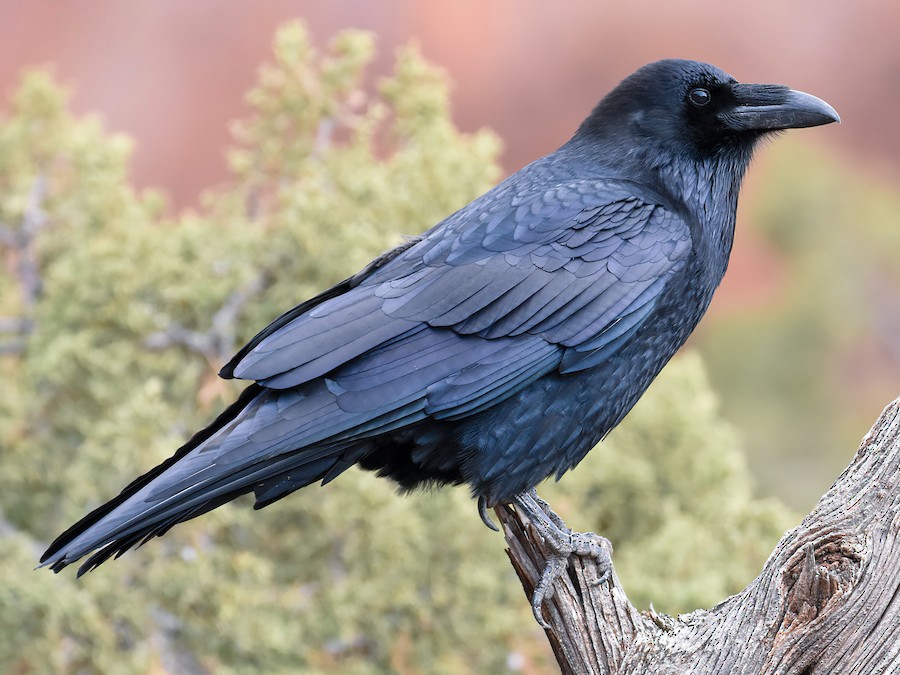
How to identify the Common Raven
Corvus corax
Spotted a bird? Identify it instantly with the Birdby app
Open the appTo correctly identify the Common Raven (Corvus corax), check each of these features. Birds can be tricky: habit, habitat, and call often confirm a sighting that a single photo cannot.
Size at a glance
- Length
- 54-67 cm (21-26 in)
- Wingspan
- 115-150 cm (45-59 in)
- Weight
- 0.69-2 kg (1.5-4.4 lbs)
Physical features to check
- 1
Plumage
Overall feather coloration and pattern.
Entirely glossy black plumage, often with a purplish-blue or greenish sheen visible in good light, especially on the head, neck, and wings. The feathers on the throat (hackles) are shaggy and often ruffled.
- 2
Beak shape
Shape and color of the bill: a key field mark.
Large, heavy, and slightly decurved black beak. The upper mandible is noticeably thicker and longer than the lower.
- 3
Eye color
Iris color and any distinctive eye markings.
Dark brown to black in adults; blue-gray in juveniles, transitioning to brown.
- 4
Leg color
Leg and foot color.
Black
- 5
Distinguishing features
Standout features that separate this species.
Large size, shaggy throat feathers (hackles), wedge-shaped tail (especially noticeable in flight), and a deep, croaking call. In flight, the long, broad wings and stable, powerful flight are characteristic.
- 6
Juvenile appearance
How young birds differ from adults.
Juveniles resemble adults but have duller, less glossy black plumage, a smaller and less robust beak, and blue-gray eyes that gradually darken to brown. Their hackles are also less developed.
- 7
Seasonal changes
Plumage variation between breeding and non-breeding seasons.
No significant seasonal plumage changes. Plumage may appear duller when worn or during molt, but the overall coloration remains consistent.
- 8
Sexual dimorphism
How males and females differ.
Males and females are outwardly similar in plumage and size, though males tend to be slightly larger on average. This difference is not reliably discernible in the field.
Key field marks
- Size and Build. Look for a very large, all-black bird. Its robust build, large head, and heavy beak are distinctive. If seen next to a crow, the size difference is immediately apparent.
- Plumage and Hackles. Observe the glossy black plumage. Crucially, look for the shaggy, often ruffled feathers on the throat (hackles), which are prominent in adults.
- Tail Shape in Flight. In flight, pay close attention to the tail. A Common Raven's tail is wedge-shaped, tapering to a point, unlike the fan-shaped or rounded tail of a crow.
- Flight Style. Ravens often soar and glide on thermals with minimal wing flapping, similar to a hawk or eagle. Their wing beats are deep and powerful. Crows typically have a more constant, shallower flapping flight.
- Vocalizations. Listen for the deep, resonant 'kraa-kraa' or 'cronk-cronk' calls. Ravens have a wide repertoire of complex sounds, but these deep croaks are characteristic and distinct from the higher-pitched 'caws' of crows.
- Beak Size. Note the large, thick, and slightly decurved black beak. It appears much more substantial than a crow's beak.
Explore the Common Raven
Identify birds anywhere
Free on iOS, Android, and Web. Photo & sound identification, full species database, and your personal life list.