
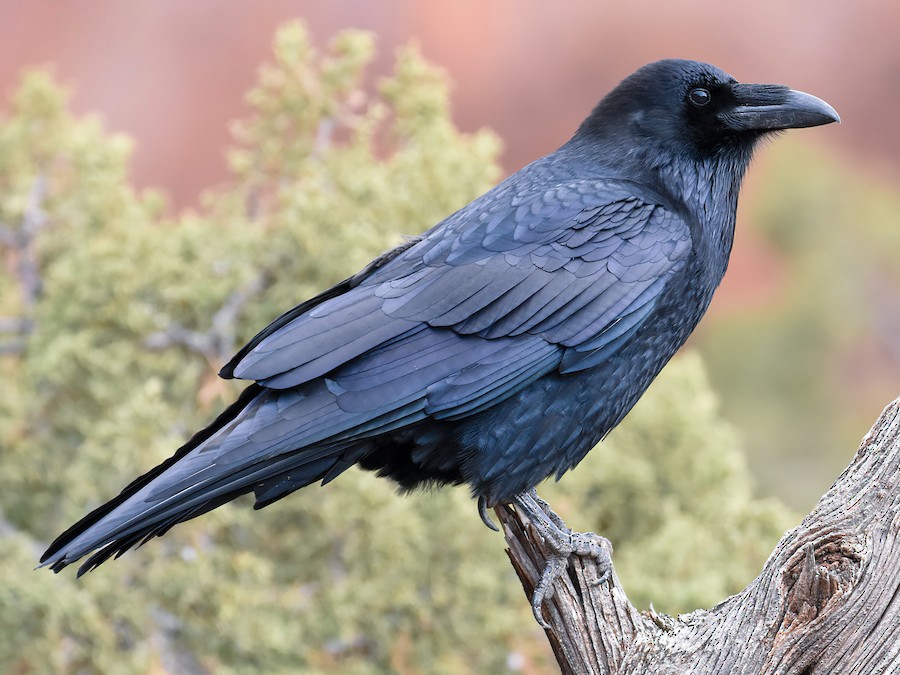
Where does the Common Raven live?
Corvus corax
Spotted a bird? Identify it instantly with the Birdby app
Open the appThe Common Raven lives in specific habitats and regions. Knowing where, and when, to look improves your chances of a successful sighting.
Biomes
Forests (coniferous, deciduous, mixed), mountains, deserts, tundra, coastal areas, grasslands, agricultural lands, and increasingly, urban and suburban environments.
Geographic range
Holarctic distribution, found across North America, Europe, Asia, and North Africa. It is the most widely distributed corvid species.
Preferred environments
Highly adaptable, but often prefers areas with a mix of open country for foraging and tall structures (cliffs, large trees, human-made structures) for nesting and roosting. Remote, undisturbed areas are also favored.
Elevation range
Sea level to over 6,000 meters (20,000 feet) in mountainous regions.
Where to look
Mountainous Regions
Look for them soaring along cliff faces and over valleys in mountainous terrain, where they often nest on ledges.
Remote Wilderness Areas
Common in vast, undisturbed forests, deserts, and tundra, often seen scavenging or perched on prominent trees.
Coastal Areas
Along coastlines, they forage for carrion and marine invertebrates, often seen flying over beaches and rocky shores.
Agricultural and Rural Landscapes
Can be found near farms and ranches, attracted to livestock carrion or spilled grains. Often seen perched on fence posts or utility poles.
Urban/Suburban Edges
Increasingly adapting to human-modified landscapes, they can be found in parks, large gardens, and industrial areas, especially where food sources (like refuse) are available.
Field tips
- Listen for Calls. Their distinctive deep 'cronk' calls often give away their presence before they are seen. Learn to distinguish it from crow calls.
- Scan the Sky. Look for large, dark birds soaring high overhead, especially in areas with thermals. Their flight pattern is a key identifier.
- Check Prominent Perches. Ravens often perch on the highest points available – treetops, cliffs, utility poles, or communication towers – to survey their territory.
- Look for Scavenging Activity. They are often found near carrion (roadkill, animal carcasses) or around human refuse sites, especially in more remote areas.
- Observe Behavior. Their intelligent and curious behavior, including manipulating objects or interacting with other animals, can be a clue to their identity.
Migration
Generally resident throughout their range, though some northern populations may undertake short-distance, altitudinal, or irruptive movements in response to harsh weather or food scarcity. Juveniles may disperse widely from their natal areas.
Explore the Common Raven
Identify birds anywhere
Free on iOS, Android, and Web. Photo & sound identification, full species database, and your personal life list.