
Spotted a bird? Identify it instantly with the Birdby app
Open the appAbout
The Common Cuckoo is a medium-sized, slender migratory bird known for its distinctive call and brood parasitic breeding strategy. It is widespread across Eurasia and Africa, spending its breeding season in temperate regions and migrating to tropical and subtropical Africa and Asia for the non-breeding season. Its appearance often mimics that of a small raptor, particularly a Eurasian Sparrowhawk, which may aid in its parasitic lifestyle.
Size & lifespan
- Length
- 32-34 cm
- Wingspan
- 55-60 cm
- Weight
- 105-130 g (male), 115-155 g (female)
- Lifespan
- Up to 6 years in the wild, though some individuals may live longer.
- Diet
- Insectivore, primarily feeding on large, hairy caterpillars that are often avoided by other birds.
Physical characteristics
- Plumage
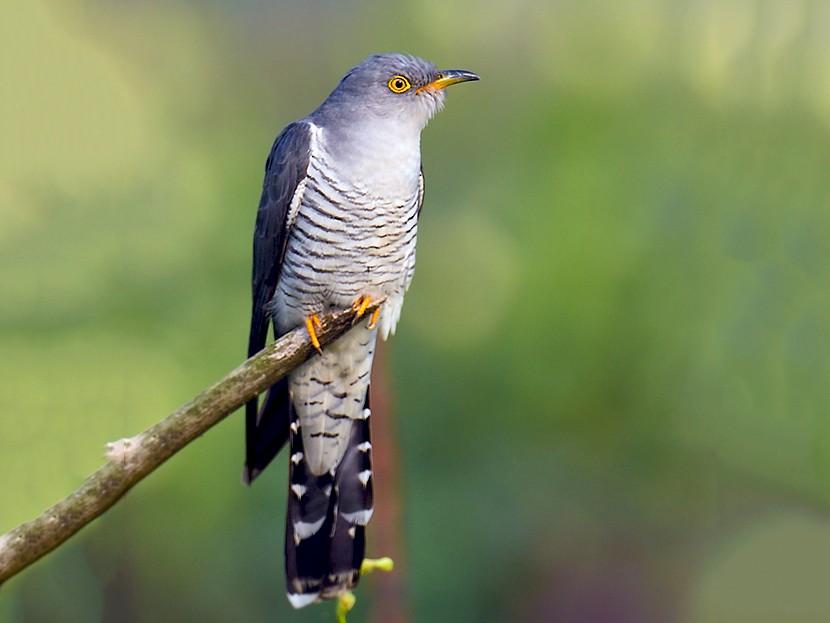
- Adult males typically have slate-grey upperparts, head, and breast. The underparts are white with fine, dark grey barring. The tail is dark grey with white spots on the outer feathers. Adult females can be similar to males (grey morph) or exhibit a rufous morph, which has rufous-brown upperparts with dark barring, and a rufous wash on the breast with barring extending further up. Both sexes have dark primary feathers.
- Beak shape
- Relatively short, slightly down-curved, and stout bill; dark grey to blackish, with a yellowish base to the lower mandible.
- Eye color
- Bright yellow eye-ring and iris in adults. Juveniles have a dark iris.
- Leg color
- Short, strong, and yellow legs and feet.
- Distinguishing features
- Long, pointed wings, long tail, and a distinctive flight pattern resembling a small raptor. The barred underparts are a key feature. The yellow eye-ring and legs are also diagnostic for adults.
- Juvenile appearance
- Juveniles are distinctly different, having dark grey-brown upperparts heavily barred with rufous-brown. The head and nape are often mottled with white, and they have a prominent white patch on the nape. The underparts are white with dense dark barring. The iris and eye-ring are dark brown, becoming yellow with age.
- Seasonal changes
- No significant seasonal plumage changes in adults, beyond wear and tear. Juveniles undergo a post-juvenile molt to adult-like plumage before their first spring migration.
- Sexual dimorphism
- Females are generally slightly larger than males and can occur in two distinct plumage morphs (grey and rufous), while males are almost exclusively grey. The rufous morph female is easily distinguishable.
How to identify
- 1
Call
The most distinctive feature is the male's 'cuck-oo' call. Learn this sound, as it's often heard before the bird is seen.
- 2
Flight and Shape
Observe its flight pattern. It's often direct and hawk-like, with rapid wing beats and glides. Note the long, pointed wings and long tail. Look for the slender body shape.
- 3
Plumage (Adult Male)
Look for slate-grey upperparts, head, and breast, contrasting with white underparts finely barred with dark grey. Yellow legs and eye-ring are key.
- 4
Plumage (Adult Female - Rufous Morph)
If you see a cuckoo with rufous-brown upperparts and heavy dark barring, especially on the breast and flanks, it's likely a rufous morph female.
- 5
Plumage (Juvenile)
Look for heavily barred dark brown and rufous upperparts, a white nape patch, and dark eyes. This plumage is very different from adults.
- 6
Behavior
Watch for its habit of perching conspicuously on branches or wires, often in open areas, before swooping down to catch prey.
Habitat & range
- Biomes
- Forests, woodlands, scrublands, heathlands, grasslands, marshes, and agricultural areas.
- Geographic range
- Breeds across most of Europe and Asia, from the Atlantic to the Pacific. Winters in tropical and subtropical Africa and Asia.
- Elevation range
- From sea level up to 3,000 meters in some parts of its range, though typically found at lower to mid-elevations.
- Preferred environments
- Open woodlands, forest edges, clearings, heathland with scattered trees, and areas with a good supply of host nests. They prefer habitats that support their primary host species.
Behavior
- Activity time
- Diurnal.
- Feeding habits
- Primarily insectivorous, specializing in large, hairy caterpillars (e.g., Lasiocampidae, Arctiidae) that are toxic or unpalatable to many other birds. They also consume other insects like beetles, grasshoppers, and larvae. They forage by perching and scanning, then swooping down to catch prey.
- Social behavior
- Solitary for most of its life, especially during the breeding season. Males are highly territorial and defend large territories. Females are also solitary, seeking out host nests. They may gather in loose groups during migration.
- Flight pattern
- Strong, direct, and often hawk-like flight, with rapid wing beats followed by glides. When soaring, wings are held flat. Often flies low over vegetation.
- Migration pattern
- Long-distance migratory. Breeds in the Palearctic and migrates south to wintering grounds in sub-Saharan Africa and parts of tropical Asia. Migration occurs mainly at night. They are one of the earliest migrants to arrive in their breeding grounds in spring.
- Territoriality
- Males are highly territorial during the breeding season, defending their territories with their characteristic calls. Females are not territorial in the same way but have 'egg-laying territories' where they monitor host nests.
Song & calls
- Song
- The iconic 'cuck-oo' call, typically given by the male. The first syllable is higher pitched and louder than the second. It can be repeated many times, especially in the early morning and evening. The call is often associated with spring and summer.
- Call
- Females have a distinct bubbling or trilling call, often described as a 'kwik-kwik-kwik' or 'water-bubbling' sound, typically given after laying an egg or when agitated. Both sexes may give a 'hoo-hoo-hoo' call when alarmed.
- When they vocalize
- Males call most frequently during the breeding season (April to July), particularly at dawn and dusk. Females call less frequently, usually in response to a male or during egg-laying.
Breeding & reproduction
- Breeding season
- April to July, varying geographically.
- Nesting habits
- Obligate brood parasite. Common Cuckoos do not build their own nests. Females lay their eggs singly in the nests of various host species, typically small passerines. Each female specializes in parasitizing a particular host species, mimicking the host's egg color and pattern.
- Clutch size
- One egg per host nest. A female can lay 12-25 eggs in a breeding season.
- Egg description
- Eggs are typically small, oval, and vary greatly in color and pattern to mimic the eggs of the specific host species. Common hosts include Dunnock, Meadow Pipit, Reed Warbler, and Pied Wagtail. A female Cuckoo can lay up to 25 eggs in a season, each in a different host nest.
- Incubation period
- Approximately 11-13 days, which is often shorter than that of their host species, giving the cuckoo chick a head start.
- Fledging period
- The cuckoo chick typically ejects host eggs or young from the nest shortly after hatching. It is fed by the host parents for about 17-21 days in the nest, and then for several weeks after fledging.
- Parental care
- No parental care from the biological parents. The cuckoo chick is entirely raised by the unwitting host parents.
Where to find
Open Woodlands and Forest Edges
These areas provide both perching sites and access to host nests.
Heathlands and Moorlands
Especially where there are scattered trees or shrubs, providing suitable habitat for host species like Meadow Pipits.
Reedbeds and Marshes
Common Cuckoos often parasitize Reed Warblers in these habitats.
Agricultural Landscapes
Areas with hedgerows, small copses, and diverse vegetation can attract both cuckoos and their hosts.
Field tips
- Listen for the Call. The male's 'cuck-oo' call is the most reliable way to detect its presence, especially in spring and early summer. They call most frequently in the early morning and late evening.
- Scan Perches. Cuckoos often perch prominently on exposed branches, fence posts, or power lines, scanning for prey or host nests. Use binoculars to scan these spots.
- Observe Host Species. If you see small passerines (like Dunnocks, Reed Warblers, Meadow Pipits) acting agitated or feeding an unusually large chick, it might be a cuckoo chick.
- Look for Raptor-like Flight. Keep an eye out for a bird with a hawk-like silhouette and flight pattern, but pay attention to the finer details to distinguish it from a true raptor.
- Timing. The best time to see or hear Common Cuckoos is during their breeding season, from April to July, before they migrate south.
Similar species
Eurasian Sparrowhawk
Accipiter nisus
Common Cuckoos mimic Sparrowhawks in flight and general shape. However, Cuckoos have a longer, more pointed tail, less prominent head, and often a more 'floppy' wingbeat. Sparrowhawks have a shorter, broader tail, more robust head, and typically a more powerful, purposeful flight. Cuckoos have yellow legs and eye-ring, while Sparrowhawks have yellow legs but a dark eye.
Great Spotted Cuckoo
Clamator glandarius
The Great Spotted Cuckoo is larger, has a shaggier crest, and is more heavily spotted on the upperparts. Its underparts are less finely barred and often have a buff wash. Its call is also very different, a harsh 'kwaak-kwaak'.
Oriental Cuckoo
Cuculus optatus
Very similar in appearance to the Common Cuckoo, especially the grey morph. Key differences are subtle: Oriental Cuckoo often has a slightly darker grey plumage, a more uniform grey breast extending further down, and a different call (a two-note 'hoo-hoo' or 'poo-poo'). Identification often relies on vocalizations or careful observation of subtle plumage details and range.
Quick facts
- Primary Diet:
- Hairy caterpillars
- Nesting Strategy:
- Obligate brood parasite
- Migration:
- Long-distance migrant (Palearctic to Africa/Asia)
- Distinctive Sound:
- Male's 'cuck-oo' call
- Mimicry:
- Mimics Eurasian Sparrowhawk in flight; female mimics host eggs
Fun facts
- The Common Cuckoo is famous for its brood parasitism, laying its eggs in the nests of other bird species, which then raise the cuckoo chick as their own.
- A newly hatched cuckoo chick instinctively pushes the host's eggs or young out of the nest, ensuring it receives all the food and attention from the foster parents.
- Female cuckoos often specialize in parasitizing a single host species throughout their lives, and their eggs are adapted to mimic the eggs of that specific host.
- The word 'cuckoo' in many languages is onomatopoeic, derived directly from the male's distinctive call.
- Despite being raised by small passerines, the cuckoo chick grows much larger than its foster parents, often dwarfing them as they feed it.
Scientific classification
- Kingdom
- Animalia
- Phylum
- Chordata
- Class
- Aves
- Order
- Cuculiformes
- Family
- Cuculidae
- Genus
- Cuculus
- Species
- Cuculus canorus
Explore the Common Cuckoo
Identify birds anywhere
Free on iOS, Android, and Web. Photo & sound identification, full species database, and your personal life list.