
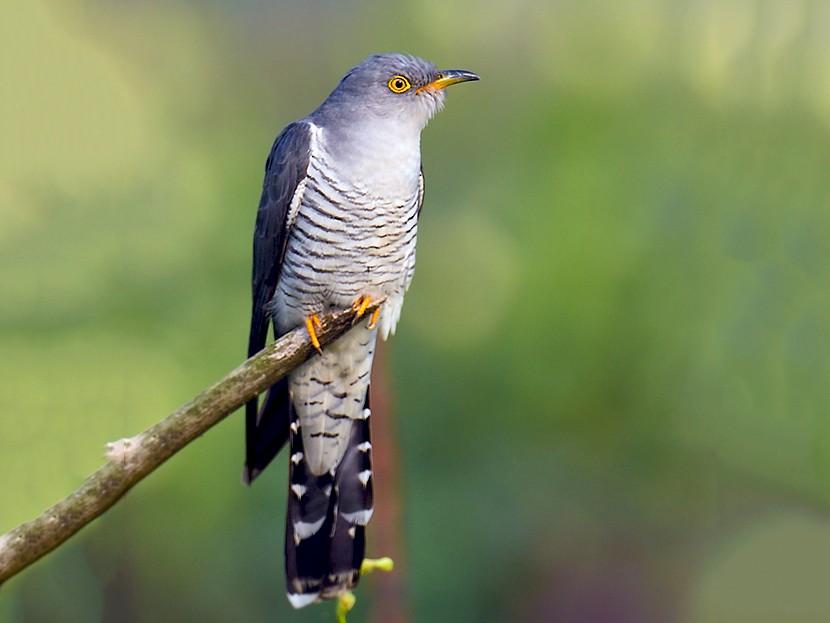
How to identify the Common Cuckoo
Cuculus canorus
Spotted a bird? Identify it instantly with the Birdby app
Open the appTo correctly identify the Common Cuckoo (Cuculus canorus), check each of these features. Birds can be tricky: habit, habitat, and call often confirm a sighting that a single photo cannot.
Size at a glance
- Length
- 32-34 cm
- Wingspan
- 55-60 cm
- Weight
- 105-130 g (male), 115-155 g (female)
Physical features to check
- 1
Plumage
Overall feather coloration and pattern.
Adult males typically have slate-grey upperparts, head, and breast. The underparts are white with fine, dark grey barring. The tail is dark grey with white spots on the outer feathers. Adult females can be similar to males (grey morph) or exhibit a rufous morph, which has rufous-brown upperparts with dark barring, and a rufous wash on the breast with barring extending further up. Both sexes have dark primary feathers.
- 2
Beak shape
Shape and color of the bill: a key field mark.
Relatively short, slightly down-curved, and stout bill; dark grey to blackish, with a yellowish base to the lower mandible.
- 3
Eye color
Iris color and any distinctive eye markings.
Bright yellow eye-ring and iris in adults. Juveniles have a dark iris.
- 4
Leg color
Leg and foot color.
Short, strong, and yellow legs and feet.
- 5
Distinguishing features
Standout features that separate this species.
Long, pointed wings, long tail, and a distinctive flight pattern resembling a small raptor. The barred underparts are a key feature. The yellow eye-ring and legs are also diagnostic for adults.
- 6
Juvenile appearance
How young birds differ from adults.
Juveniles are distinctly different, having dark grey-brown upperparts heavily barred with rufous-brown. The head and nape are often mottled with white, and they have a prominent white patch on the nape. The underparts are white with dense dark barring. The iris and eye-ring are dark brown, becoming yellow with age.
- 7
Seasonal changes
Plumage variation between breeding and non-breeding seasons.
No significant seasonal plumage changes in adults, beyond wear and tear. Juveniles undergo a post-juvenile molt to adult-like plumage before their first spring migration.
- 8
Sexual dimorphism
How males and females differ.
Females are generally slightly larger than males and can occur in two distinct plumage morphs (grey and rufous), while males are almost exclusively grey. The rufous morph female is easily distinguishable.
Key field marks
- Call. The most distinctive feature is the male's 'cuck-oo' call. Learn this sound, as it's often heard before the bird is seen.
- Flight and Shape. Observe its flight pattern. It's often direct and hawk-like, with rapid wing beats and glides. Note the long, pointed wings and long tail. Look for the slender body shape.
- Plumage (Adult Male). Look for slate-grey upperparts, head, and breast, contrasting with white underparts finely barred with dark grey. Yellow legs and eye-ring are key.
- Plumage (Adult Female - Rufous Morph). If you see a cuckoo with rufous-brown upperparts and heavy dark barring, especially on the breast and flanks, it's likely a rufous morph female.
- Plumage (Juvenile). Look for heavily barred dark brown and rufous upperparts, a white nape patch, and dark eyes. This plumage is very different from adults.
- Behavior. Watch for its habit of perching conspicuously on branches or wires, often in open areas, before swooping down to catch prey.
Explore the Common Cuckoo
Identify birds anywhere
Free on iOS, Android, and Web. Photo & sound identification, full species database, and your personal life list.