
Spotted a bird? Identify it instantly with the Birdby app
Open the appAbout
The Eurasian Blue Tit is a small, brightly colored passerine bird, easily recognizable by its blue and yellow plumage. It is a common and widespread species across much of Europe and western Asia, known for its acrobatic foraging behavior and adaptability to various habitats, including urban environments. It plays an important ecological role as an insectivore, particularly during the breeding season.
Size & lifespan
- Length
- 10.5-12 cm
- Wingspan
- 17.5-20 cm
- Weight
- 7.5-12 g
- Lifespan
- 2-3 years (up to 9 years recorded in the wild)
- Diet
- Omnivore (primarily insectivore, especially caterpillars, spiders; also seeds, nuts, and fruit in winter)
Physical characteristics
- Plumage
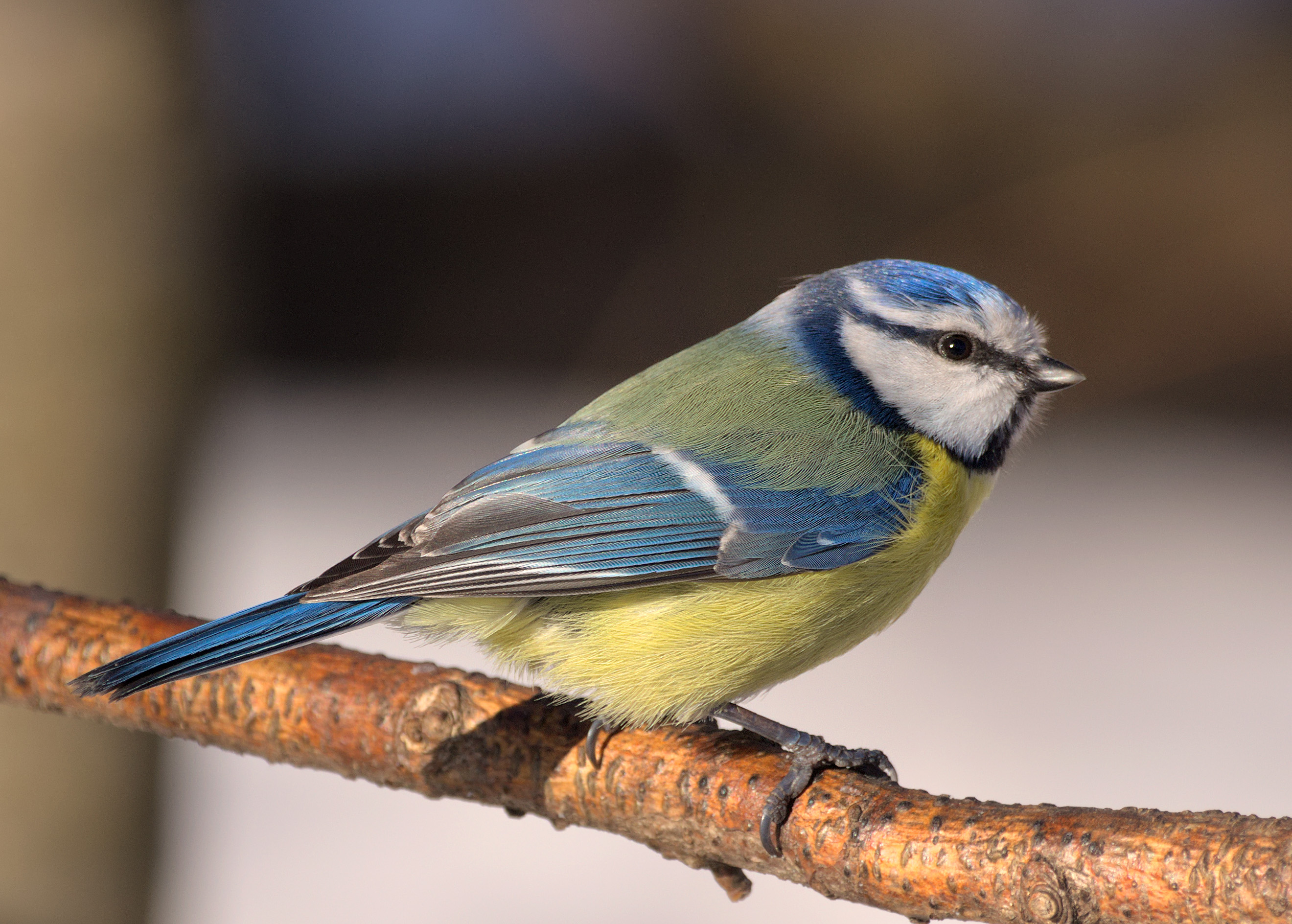
- Adults have a bright blue crown, nape, and wings, with a white face bordered by a dark blue-black eye-stripe and collar. The back is greenish-blue, and the underparts are bright yellow with a narrow dark line down the belly. The tail is blue. The wing-bar is white.
- Beak shape
- Small, conical, and pointed; dark grey to black.
- Eye color
- Dark brown.
- Leg color
- Dark grey to bluish-grey.
- Distinguishing features
- The combination of a bright blue cap, white cheeks with a dark eye-stripe, and yellow underparts with a dark belly stripe is distinctive. The white wing-bar on blue wings is also a key feature.
- Juvenile appearance
- Juveniles are duller than adults, with a yellowish-green crown and cheeks, and duller yellow underparts. The blue areas are less vibrant, and the eye-stripe is less defined. They lack the crisp white wing-bar of adults, which is often yellowish.
- Seasonal changes
- No significant seasonal plumage changes. Plumage may appear slightly duller after breeding due to wear, but no distinct non-breeding plumage.
- Sexual dimorphism
- Males tend to have slightly brighter plumage, particularly the blue on the crown and the yellow on the breast, and a broader, darker belly stripe. However, these differences are subtle and often difficult to discern in the field.
How to identify
- 1
Size and Shape
Small, plump, and compact with a relatively short tail and a small, pointed bill.
- 2
Head Pattern
Look for the distinctive bright blue cap, white cheeks, and a dark blue-black eye-stripe extending to a collar around the nape.
- 3
Body Plumage
Bright yellow underparts with a narrow dark line down the belly. Greenish-blue back. Blue wings with a single white wing-bar.
- 4
Behavior
Observe its acrobatic feeding style, often hanging upside down. It is very active and restless.
- 5
Vocalizations
Listen for its characteristic high-pitched, tinkling song ('tsee-tsee-tsee-tsooit') and sharp 'tink' calls.
Habitat & range
- Biomes
- Temperate forests, woodlands, parks, gardens, hedgerows, orchards.
- Geographic range
- Widespread across temperate and subarctic Europe, extending east to western Asia and south to North Africa (Maghreb region). Absent from Iceland and parts of northern Scandinavia.
- Elevation range
- Sea level up to 1,800 meters, occasionally higher in mountainous regions.
- Preferred environments
- Deciduous and mixed woodlands, particularly those with oak trees. Highly adaptable to human-modified landscapes, including suburban gardens and urban parks, as long as suitable trees and nesting sites (e.g., nest boxes) are available.
Behavior
- Activity time
- Diurnal.
- Feeding habits
- Highly agile and acrobatic, often hanging upside down from branches to access insects and buds. Primarily insectivorous, feeding on caterpillars, aphids, spiders, and other invertebrates, especially during spring and summer. In autumn and winter, they supplement their diet with seeds, nuts (especially beech mast and sunflower seeds), and berries. They are frequent visitors to bird feeders.
- Social behavior
- During the breeding season, they are territorial and typically found in pairs. Outside of breeding, they often join mixed-species foraging flocks with other tits (e.g., Great Tits, Coal Tits) and other small passerines, especially in winter.
- Flight pattern
- Undulating flight pattern over longer distances, but often short, direct flights between branches. Very agile and quick within foliage.
- Migration pattern
- Mostly resident throughout their range. Northern and eastern populations may undertake short-distance irruptive movements in harsh winters or years of food scarcity. Juveniles disperse from their natal territories.
- Territoriality
- Pairs defend a breeding territory during the nesting season. Outside of breeding, territoriality is less pronounced, especially when foraging in mixed flocks.
Song & calls
- Song
- A high-pitched, tinkling 'tsee-tsee-tsee-tsooit' or 'tiss-tiss-tiss-suih-suih', often described as a 'churring' or 'trilling' song, typically delivered from a prominent perch.
- Call
- A variety of calls, including a sharp 'tink' or 'pit', a scolding 'churr-r-r-r', and a high-pitched 'see-see-see' alarm call. Contact calls are often soft 'tsee-tsee' notes.
- When they vocalize
- Most vocal during the breeding season (late winter to early summer) when establishing territories and attracting mates. Calls can be heard year-round, especially during foraging.
Breeding & reproduction
- Breeding season
- Typically April to July, with peak egg-laying in late April to May.
- Nesting habits
- Monogamous. Nests are built in tree cavities, old woodpecker holes, crevices in walls, or readily use nest boxes. The female builds the nest, which is a cup-shaped structure of moss, wool, hair, and feathers.
- Clutch size
- Typically 7-13 eggs, but can range from 6 to 16. They usually have one brood per year, but occasionally two.
- Egg description
- 8-12 (sometimes up to 16) small, white, smooth, glossy eggs, sparsely speckled with reddish-brown or purplish spots, mainly at the broader end. Approximately 15 x 11 mm.
- Incubation period
- 12-16 days, primarily by the female.
- Fledging period
- 16-22 days after hatching. Young are fed by both parents.
- Parental care
- Both parents feed the nestlings and fledglings. The female incubates, while the male brings food to the female during incubation and helps feed the young after hatching.
Where to find
Deciduous and Mixed Woodlands
Primary habitat, especially those with mature oak trees, which provide abundant insect food.
Parks and Gardens
Common in suburban and urban green spaces, particularly where there are mature trees and shrubs. They readily use bird feeders and nest boxes.
Orchards and Hedgerows
Agricultural areas with suitable tree cover and nesting opportunities.
Field tips
- Look for movement in tree canopies. Blue Tits are constantly on the move, flitting between branches and often hanging upside down. Look for small, quick movements in the foliage.
- Listen for their calls and songs. Their distinctive high-pitched song and sharp calls are often the first indication of their presence, especially during spring.
- Check bird feeders. They are frequent and bold visitors to garden bird feeders, especially those offering sunflower seeds, peanuts, and suet.
- Install nest boxes. Providing suitable nest boxes with a small entrance hole (around 25-28mm) can attract them to your garden for breeding.
Similar species
Azure Tit
Cyanistes cyanus
The Azure Tit has a white crown, white cheeks, and a broader white wing-bar. Its blue is paler, and it lacks the yellow underparts and dark belly stripe of the Eurasian Blue Tit. Its range is more eastern.
African Blue Tit
Cyanistes teneriffae
Formerly considered a subspecies of Eurasian Blue Tit, the African Blue Tit (found in North Africa and Canary Islands) has a darker blue crown and a more extensive black collar. Some subspecies, like the Canary Islands Blue Tit (C. t. teneriffae), have a darker, almost black cap and a more intense blue overall.
Great Tit
Parus major
Larger than the Blue Tit. Has a black head and bib, white cheeks, a prominent black stripe down its yellow belly, and a greenish back. Lacks the bright blue cap and wings of the Blue Tit.
Quick facts
- Diet:
- Mainly insects (especially caterpillars), also seeds and nuts.
- Nesting:
- Cavity nester, often uses nest boxes.
- Sociality:
- Paired in breeding season, forms mixed flocks in winter.
- Distinguishing Feature:
- Bright blue cap, white cheeks with dark eye-stripe, yellow belly.
- Conservation Status:
- Least Concern (stable population).
Fun facts
- Eurasian Blue Tits are known for their intelligence and problem-solving abilities, famously learning to peck through foil caps of milk bottles to get at the cream in the past.
- They have one of the largest clutch sizes among European passerines, often laying 8-13 eggs, sometimes up to 16, to maximize reproductive success.
- Their diet of caterpillars makes them important natural pest controllers in woodlands and gardens.
- The intensity of the yellow plumage in males is often linked to their diet, with more carotenoid-rich food leading to brighter yellow, which can signal fitness to females.
- They are highly adaptable and have successfully colonized urban environments, benefiting from garden feeders and nest boxes.
Scientific classification
- Kingdom
- Animalia
- Phylum
- Chordata
- Class
- Aves
- Order
- Passeriformes
- Family
- Paridae
- Genus
- Cyanistes
- Species
- Cyanistes caeruleus
Explore the Eurasian Blue Tit
Identify birds anywhere
Free on iOS, Android, and Web. Photo & sound identification, full species database, and your personal life list.