
Spotted a bird? Identify it instantly with the Birdby app
Open the appAbout
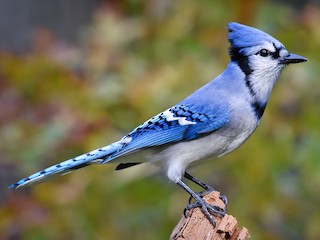
The Blue Jay is a striking, intelligent, and vocal passerine bird native to eastern North America. Known for its vibrant blue, white, and black plumage, it is a highly recognizable species. Blue Jays are omnivorous, consuming a wide variety of foods, and are particularly noted for their habit of caching acorns and other seeds, playing a significant role in forest regeneration. They are highly adaptable and can be found in various habitats, from dense forests to suburban backyards.
Size & lifespan
- Length
- 22-30 cm (9-12 in)
- Wingspan
- 34-43 cm (13-17 in)
- Weight
- 70-100 g (2.5-3.5 oz)
- Lifespan
- Up to 7 years in the wild, with records of over 26 years in captivity.
- Diet
- Omnivore
Physical characteristics
- Plumage
- Adults have a bright blue crest, back, wings, and tail. The face is white with a black collar or necklace extending from the nape around the throat. The underparts are grayish-white. The wings and tail are barred with black and have prominent white patches. The primary coverts and secondaries are tipped with white.
- Beak shape
- Strong, conical, and pointed; black in color.
- Eye color
- Dark brown
- Leg color
- Black
- Distinguishing features
- Vibrant blue plumage, prominent crest, black necklace, and white wing/tail markings. The crest can be raised or lowered depending on the bird's mood.
- Juvenile appearance
- Juveniles resemble adults but have duller blue plumage, a less defined black necklace, and a slightly grayer overall appearance. Their crest may also be less prominent.
- Seasonal changes
- No significant seasonal plumage changes. Plumage remains consistent year-round.
- Sexual dimorphism
- Males and females are monomorphic in plumage, meaning they look identical. Males may be slightly larger on average, but this is not a reliable field mark.
How to identify
- 1
Plumage Coloration
Look for the unmistakable combination of bright blue on the back, wings, and tail, contrasting with white underparts and a black necklace.
- 2
Crest
The prominent blue crest on its head is a key identifier. Note how it can be raised or lowered.
- 3
Facial Pattern
Observe the white face with a distinct black 'bridle' or necklace that wraps around the throat.
- 4
Wing and Tail Markings
Look for the intricate black barring and white patches on the blue wings and tail, especially noticeable in flight or when perched.
- 5
Vocalizations
Listen for their loud, harsh 'JAY-jay' calls, bell-like 'tool-li' notes, or convincing mimicry of hawks. Their calls are often the first indication of their presence.
- 6
Behavior
Watch for their bold, often aggressive behavior, especially around feeders. Their habit of caching acorns is also distinctive.
Habitat & range
- Biomes
- Temperate forests, woodlands, suburban areas, parks, gardens.
- Geographic range
- Eastern and central North America, from southern Canada through the eastern and central United States to Florida and northeastern Texas. Western populations extend into the Rocky Mountains.
- Elevation range
- Typically found from sea level up to approximately 1,500 meters (5,000 feet).
- Preferred environments
- Deciduous, coniferous, and mixed forests, especially those with oak trees due to their reliance on acorns. Also common in urban and suburban environments where food and nesting sites are available.
Behavior
- Activity time
- Diurnal
- Feeding habits
- Highly opportunistic omnivores. Diet includes acorns, nuts, seeds, berries, fruits, insects (beetles, grasshoppers, caterpillars), spiders, small vertebrates (frogs, mice, nestlings, eggs of other birds), and carrion. Known for caching large quantities of acorns and other seeds for later consumption, often burying them in the ground or hiding them in crevices. They use their strong bills to crack open nuts.
- Social behavior
- Often seen in pairs or small family groups. During migration, they can form large flocks. They are known to be aggressive towards other birds, especially near feeders or nesting sites. They are highly intelligent and can mimic the calls of hawks, particularly the Red-shouldered Hawk, to scare away other birds from food sources.
- Flight pattern
- Strong, undulating flight with rapid wing beats. Often flies with its crest raised. Can be quite agile through trees.
- Migration pattern
- Partially migratory. Northern populations often migrate south for the winter, while southern populations are largely resident. Migration patterns can be irregular and depend on food availability, particularly acorn crops. Migrating flocks can be quite large.
- Territoriality
- Highly territorial during the breeding season, aggressively defending their nest site. Outside of breeding, they may be less territorial, especially when foraging in groups.
Song & calls
- Song
- Blue Jays do not have a complex, melodic song in the traditional sense. Their vocalizations are varied and often described as a series of musical whistles, clicks, and gurgles, sometimes strung together into a soft, warbling 'song' that is usually heard only at close range.
- Call
- Known for a wide array of loud, harsh calls. The most common is a loud 'JAY-jay' or 'jeer-jeer' call. They also produce a bell-like 'tool-li' call, a harsh 'squawk', and a 'rattle' call. Famously mimic the calls of raptors, especially the Red-shouldered Hawk ('kee-ah'), which can be very convincing.
- When they vocalize
- Vocalize year-round, but are particularly vocal during the breeding season and when agitated or warning others of predators. Mimicry is often heard when other birds are present.
Breeding & reproduction
- Breeding season
- April to July, peaking in May.
- Nesting habits
- Nests are typically built by both sexes in the crotch or thick branches of a tree, 3-10 meters (10-30 feet) above the ground. The nest is a bulky cup made of twigs, bark strips, leaves, moss, and often lined with fine roots, feathers, and sometimes even paper or cloth. They are known to be secretive during nesting.
- Clutch size
- 3-7 eggs
- Egg description
- 3-7 eggs, typically 4-5. Eggs are oval, pale blue, greenish, or buff, often heavily spotted or blotched with brown, olive, or purple, especially at the larger end.
- Incubation period
- 17-18 days, primarily by the female.
- Fledging period
- 17-21 days after hatching. Young are fed by both parents.
- Parental care
- Both parents participate in nest building, incubation (female primarily), and feeding of the young. Fledglings remain dependent on parents for several weeks after leaving the nest.
Where to find
Forests and Woodlands
Look in deciduous, coniferous, and mixed forests, particularly those with oak trees. They prefer areas with a good understory for nesting and foraging.
Suburban and Urban Parks
Common in residential areas, parks, and gardens, especially where mature trees and bird feeders are present. They adapt well to human-modified landscapes.
Backyards
Attracted to bird feeders offering peanuts, sunflower seeds, and suet. They are frequent visitors to backyard habitats.
Field tips
- Listen for Calls. Blue Jays are very vocal. Their loud 'JAY-jay' calls or hawk mimicry often reveal their presence before they are seen. Listen for these distinctive sounds.
- Look for Movement. They are active birds, often flying between trees or foraging on the ground. Watch for flashes of blue movement in the canopy or on the forest floor.
- Check Oak Trees. During fall and winter, focus on oak trees, as acorns are a primary food source and they will be actively caching them.
- Visit Bird Feeders. If you have a feeder, offer peanuts in the shell or black oil sunflower seeds. Blue Jays are often bold visitors and can be observed at close range.
- Observe Behavior. Pay attention to their interactions with other birds; their assertive nature and intelligence are often evident in their behavior.
Similar species
Steller's Jay
Cyanocitta stelleri
Steller's Jays are found in western North America. They have a blackish-brown head and crest, gradually fading to blue on the body, lacking the distinct white face and black necklace of the Blue Jay. Their calls are also different, often harsher and more varied.
Florida Scrub-Jay
Aphelocoma coerulescens
The Florida Scrub-Jay is a uniform blue-gray with a paler belly and lacks a crest. It is restricted to Florida's scrub habitats and is a federally threatened species. Its calls are also distinct.
Western Scrub-Jay
Aphelocoma californica
Western Scrub-Jays (now often split into California Scrub-Jay and Woodhouse's Scrub-Jay) are found in western North America, lack a crest, and have a more uniform blue back with a grayish-white belly and a blue breast band. Their calls are also different.
Quick facts
- Diet:
- Omnivorous (nuts, seeds, insects, small vertebrates)
- Habitat:
- Forests, woodlands, suburban areas
- Migration:
- Partial migrant (northern populations)
- Vocalization:
- Loud 'JAY-jay' calls, hawk mimicry, varied whistles
- Nesting:
- Cup nest in trees, 3-10m high
- Conservation Status:
- Least Concern
Fun facts
- Blue Jays are known for their intelligence and ability to mimic the calls of raptors, such as the Red-shouldered Hawk, to scare other birds away from food sources.
- They are expert at caching food, especially acorns, and are believed to be significant dispersers of oak trees, contributing to forest regeneration.
- Despite their vibrant blue appearance, the blue color in their feathers is not due to pigment but rather to structural coloration, where the microscopic structure of the feathers scatters light, making them appear blue.
- Blue Jays have been observed using tools, such as strips of newspaper, to rake in food that is out of reach.
- They are known to eat eggs and nestlings of other birds, though this behavior is less common than often perceived and makes up a small portion of their diet.
Scientific classification
- Kingdom
- Animalia
- Phylum
- Chordata
- Class
- Aves
- Order
- Passeriformes
- Family
- Corvidae
- Genus
- Cyanocitta
- Species
- Cyanocitta cristata
Explore the Blue Jay
Identify birds anywhere
Free on iOS, Android, and Web. Photo & sound identification, full species database, and your personal life list.