
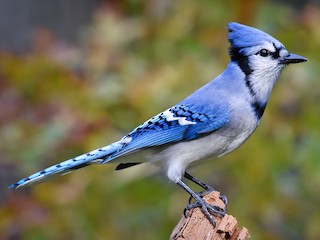
Where does the Blue Jay live?
Cyanocitta cristata
Spotted a bird? Identify it instantly with the Birdby app
Open the appThe Blue Jay lives in specific habitats and regions. Knowing where, and when, to look improves your chances of a successful sighting.
Biomes
Temperate forests, woodlands, suburban areas, parks, gardens.
Geographic range
Eastern and central North America, from southern Canada through the eastern and central United States to Florida and northeastern Texas. Western populations extend into the Rocky Mountains.
Preferred environments
Deciduous, coniferous, and mixed forests, especially those with oak trees due to their reliance on acorns. Also common in urban and suburban environments where food and nesting sites are available.
Elevation range
Typically found from sea level up to approximately 1,500 meters (5,000 feet).
Where to look
Forests and Woodlands
Look in deciduous, coniferous, and mixed forests, particularly those with oak trees. They prefer areas with a good understory for nesting and foraging.
Suburban and Urban Parks
Common in residential areas, parks, and gardens, especially where mature trees and bird feeders are present. They adapt well to human-modified landscapes.
Backyards
Attracted to bird feeders offering peanuts, sunflower seeds, and suet. They are frequent visitors to backyard habitats.
Field tips
- Listen for Calls. Blue Jays are very vocal. Their loud 'JAY-jay' calls or hawk mimicry often reveal their presence before they are seen. Listen for these distinctive sounds.
- Look for Movement. They are active birds, often flying between trees or foraging on the ground. Watch for flashes of blue movement in the canopy or on the forest floor.
- Check Oak Trees. During fall and winter, focus on oak trees, as acorns are a primary food source and they will be actively caching them.
- Visit Bird Feeders. If you have a feeder, offer peanuts in the shell or black oil sunflower seeds. Blue Jays are often bold visitors and can be observed at close range.
- Observe Behavior. Pay attention to their interactions with other birds; their assertive nature and intelligence are often evident in their behavior.
Migration
Partially migratory. Northern populations often migrate south for the winter, while southern populations are largely resident. Migration patterns can be irregular and depend on food availability, particularly acorn crops. Migrating flocks can be quite large.
Explore the Blue Jay
Identify birds anywhere
Free on iOS, Android, and Web. Photo & sound identification, full species database, and your personal life list.