
How to identify the Blue Jay
Cyanocitta cristata
Spotted a bird? Identify it instantly with the Birdby app
Open the appTo correctly identify the Blue Jay (Cyanocitta cristata), check each of these features. Birds can be tricky: habit, habitat, and call often confirm a sighting that a single photo cannot.
Size at a glance
- Length
- 22-30 cm (9-12 in)
- Wingspan
- 34-43 cm (13-17 in)
- Weight
- 70-100 g (2.5-3.5 oz)
Physical features to check
- 1
Plumage
Overall feather coloration and pattern.
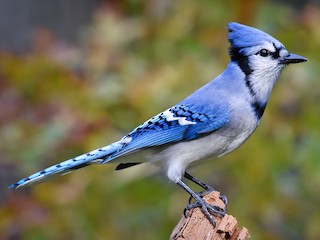
Adults have a bright blue crest, back, wings, and tail. The face is white with a black collar or necklace extending from the nape around the throat. The underparts are grayish-white. The wings and tail are barred with black and have prominent white patches. The primary coverts and secondaries are tipped with white.
- 2
Beak shape
Shape and color of the bill: a key field mark.
Strong, conical, and pointed; black in color.
- 3
Eye color
Iris color and any distinctive eye markings.
Dark brown
- 4
Leg color
Leg and foot color.
Black
- 5
Distinguishing features
Standout features that separate this species.
Vibrant blue plumage, prominent crest, black necklace, and white wing/tail markings. The crest can be raised or lowered depending on the bird's mood.
- 6
Juvenile appearance
How young birds differ from adults.
Juveniles resemble adults but have duller blue plumage, a less defined black necklace, and a slightly grayer overall appearance. Their crest may also be less prominent.
- 7
Seasonal changes
Plumage variation between breeding and non-breeding seasons.
No significant seasonal plumage changes. Plumage remains consistent year-round.
- 8
Sexual dimorphism
How males and females differ.
Males and females are monomorphic in plumage, meaning they look identical. Males may be slightly larger on average, but this is not a reliable field mark.
Key field marks
- Plumage Coloration. Look for the unmistakable combination of bright blue on the back, wings, and tail, contrasting with white underparts and a black necklace.
- Crest. The prominent blue crest on its head is a key identifier. Note how it can be raised or lowered.
- Facial Pattern. Observe the white face with a distinct black 'bridle' or necklace that wraps around the throat.
- Wing and Tail Markings. Look for the intricate black barring and white patches on the blue wings and tail, especially noticeable in flight or when perched.
- Vocalizations. Listen for their loud, harsh 'JAY-jay' calls, bell-like 'tool-li' notes, or convincing mimicry of hawks. Their calls are often the first indication of their presence.
- Behavior. Watch for their bold, often aggressive behavior, especially around feeders. Their habit of caching acorns is also distinctive.
Explore the Blue Jay
Identify birds anywhere
Free on iOS, Android, and Web. Photo & sound identification, full species database, and your personal life list.