
Spotted a bird? Identify it instantly with the Birdby app
Open the appAbout
The Trumpeter Swan is the largest waterfowl species in North America and the heaviest flying bird native to the continent. Renowned for its majestic appearance and powerful, trumpet-like call, it is a symbol of wilderness and successful conservation efforts after facing near extinction in the early 20th century.
Size & lifespan
- Length
- 138-180 cm (54-71 in)
- Wingspan
- 185-250 cm (73-98 in)
- Weight
- 7-13.6 kg (15-30 lbs), with males typically larger than females
- Lifespan
- 10-20 years in the wild, up to 30 years in captivity
- Diet
- Herbivore
Physical characteristics
- Plumage
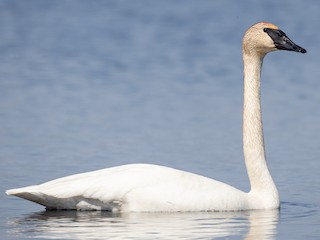
- Adults are entirely pure white. Juveniles (cygnets) are typically dull gray, sometimes with a brownish tinge, gradually molting to white over their first year.
- Beak shape
- Large, wedge-shaped bill, entirely black. A distinctive feature is the 'salmon patch' or 'smile line' where the black bill meets the pinkish-red gape line, though this is not always visible and can be subtle.
- Eye color
- Dark brown
- Leg color
- Black
- Distinguishing features
- Massive size, all-white plumage (adults), entirely black bill, and a deep, resonant, trumpet-like call. The bill is typically straight, lacking the yellow lore patch often seen on Tundra Swans.
- Juvenile appearance
- Cygnets are covered in dense gray down, which transitions to dull gray-brown juvenile plumage. Their bills are grayish-black, often with a pinkish base, and their legs are grayish-pink. They gradually whiten over their first year.
- Seasonal changes
- No significant seasonal plumage changes in adults. Juveniles transition from gray to white over their first year.
- Sexual dimorphism
- Males (cobs) are generally larger and heavier than females (pens), but plumage is identical.
How to identify
- 1
Size
Look for the largest white waterfowl in North America. Its sheer size often makes it stand out from other swans and geese.
- 2
Bill Color
Observe the bill. It should be entirely black. Absence of any yellow at the base of the bill (lore spot) is a key differentiator from Tundra Swans.
- 3
Bill Shape/Gape Line
Note the bill's profile. Trumpeter Swans typically have a straight gape line (where the upper and lower mandibles meet), sometimes with a subtle 'salmon patch' of pinkish-red. Tundra Swans often have a more concave gape line.
- 4
Vocalization
Listen for its distinctive call. The deep, resonant, trumpet-like 'oh-OH' is unmistakable and differs significantly from the higher-pitched Tundra Swan and the silent Mute Swan.
- 5
Neck Posture
While swimming, Trumpeter Swans typically hold their neck straight, unlike the S-curved neck of a Mute Swan.
- 6
Juvenile Plumage
Young birds (cygnets) are dull gray with grayish-black bills, gradually turning white over their first year. This distinguishes them from adult white swans.
Habitat & range
- Biomes
- Freshwater wetlands, marshes, shallow lakes, slow-moving rivers, and ponds.
- Geographic range
- North America, primarily in Alaska, western Canada, and scattered populations in the Rocky Mountains, Great Lakes region, and Pacific Northwest of the United States. Wintering grounds extend south to parts of the central and southern U.S.
- Elevation range
- Typically found at low to moderate elevations, primarily in wetland habitats.
- Preferred environments
- Large, undisturbed bodies of shallow freshwater with abundant submerged aquatic vegetation for foraging, and isolated islands or muskrat/beaver lodges for nesting. Requires open water for foraging and takeoff/landing, especially during winter.
Behavior
- Activity time
- Diurnal, active during daylight hours for foraging and other activities.
- Feeding habits
- Primarily herbivorous, feeding on submerged aquatic vegetation such as pondweeds, sedges, rushes, and tubers. They dabble and up-end in shallow water to reach vegetation. During winter, they may also graze on waste grains in agricultural fields.
- Social behavior
- Highly social outside of the breeding season, forming large flocks on wintering grounds. During breeding, pairs are territorial and can be aggressive towards other swans and waterfowl.
- Flight pattern
- Powerful, direct flight with slow, deliberate wing beats. Requires a long 'runway' on water to become airborne due to their heavy body mass. Flies with neck outstretched. Often flies in V-formations during migration.
- Migration pattern
- Migratory in most of its range, moving from northern breeding grounds to ice-free wintering areas further south. Some populations, particularly in the Pacific Northwest and parts of the Great Lakes, may be resident or undertake short-distance movements. Migration occurs in large family groups or flocks.
- Territoriality
- Breeding pairs are highly territorial, defending their nesting sites and surrounding foraging areas from other swans and potential threats. Non-breeding birds are less territorial.
Song & calls
- Song
- Does not have a complex song. Its vocalizations are primarily calls.
- Call
- Distinctive, deep, resonant, low-pitched 'oh-OH' or 'ko-HO' call, often described as a trumpet-like bugle. It is louder and more sonorous than the higher-pitched, more nasal call of the Tundra Swan. Calls can be heard over long distances.
- When they vocalize
- Vocalizes year-round, but calls are particularly frequent during courtship, territorial disputes, and when communicating within flocks, especially during migration.
Breeding & reproduction
- Breeding season
- Begins in late April to May, with eggs laid from late May to early June.
- Nesting habits
- Nests are large mounds of vegetation (grasses, sedges, cattails, mosses) built on muskrat or beaver lodges, small islands, or elevated hummocks in shallow water. Both parents contribute to nest construction.
- Clutch size
- 3-9 eggs, commonly 4-6.
- Egg description
- Large, dull white to creamy white, sometimes stained. Typically oval-shaped.
- Incubation period
- 32-37 days, primarily by the female.
- Fledging period
- 90-120 days. Cygnets are precocial and can swim and feed shortly after hatching but remain with parents for their first year.
- Parental care
- Both parents care for the young. The male guards the nest and territory, while the female incubates. After hatching, both parents protect and guide the cygnets, teaching them foraging skills. Cygnets stay with their parents through their first winter.
Where to find
Large freshwater wetlands and shallow lakes
Look for them in expansive, undisturbed wetlands with abundant aquatic vegetation, especially during breeding season.
Slow-moving rivers and large ponds
During migration and winter, they can be found on larger, ice-free bodies of water, including rivers and reservoirs.
Agricultural fields (winter)
In some wintering areas, they may forage in harvested grain fields, often near water sources.
Field tips
- Scan large bodies of water. Use binoculars or a spotting scope to scan open water for large white birds. Their size makes them relatively easy to spot from a distance.
- Listen for their call. Their loud, distinctive call is often heard before the bird is seen, especially in foggy or low-light conditions.
- Visit known wintering grounds. During winter, visit wildlife refuges and protected areas known to host Trumpeter Swan populations for the best viewing opportunities.
- Observe behavior. Watch for their characteristic 'up-ending' behavior while foraging in shallow water, with their tail pointing skyward.
- Distinguish from other swans. Pay close attention to bill color and shape, and listen carefully to vocalizations to differentiate from Tundra and Mute Swans.
Similar species
Tundra Swan
Cygnus columbianus
Trumpeter Swans are significantly larger and heavier. The most reliable field mark is the bill: Trumpeter Swans have an entirely black bill, often with a straight gape line, while Tundra Swans typically have a small yellow patch (lore spot) at the base of the bill near the eye, and a more concave gape line. The Trumpeter's call is a deep, resonant 'oh-OH', whereas the Tundra's call is a higher-pitched, more nasal 'woo-HOO' or 'hoo-hoo-hoo'.
Mute Swan
Cygnus olor
Mute Swans are distinguished by their orange bill with a prominent black knob at the base (larger in males). They typically hold their neck in an S-curve and often hold their wings arched over their back. Mute Swans are largely silent, only hissing when agitated, unlike the vocal Trumpeter Swan.
Quick facts
- Largest North American Waterfowl:
- Yes
- Heaviest Flying Bird in North America:
- Yes
- Bill Color (Adult):
- Entirely black
- Call:
- Deep, trumpet-like bugle
- Diet:
- Submerged aquatic vegetation
- Conservation Success Story:
- Yes, recovered from near extinction
Fun facts
- Trumpeter Swans were hunted to near extinction in the 19th and early 20th centuries for their feathers and meat, with only 69 individuals known in the contiguous U.S. by the 1930s.
- Their scientific name 'buccinator' comes from the Latin word for 'trumpeter' or 'bugler', referring to their distinctive call.
- A pair of Trumpeter Swans can maintain a breeding territory of several square miles, aggressively defending it from intruders.
- Cygnets stay with their parents for their entire first year, learning migration routes and foraging techniques.
- They require a long stretch of open water (up to 100 yards) to take off, flapping their powerful wings to gain momentum.
Scientific classification
- Kingdom
- Animalia
- Phylum
- Chordata
- Class
- Aves
- Order
- Anseriformes
- Family
- Anatidae
- Genus
- Cygnus
- Species
- Cygnus buccinator
Explore the Trumpeter Swan
Identify birds anywhere
Free on iOS, Android, and Web. Photo & sound identification, full species database, and your personal life list.