
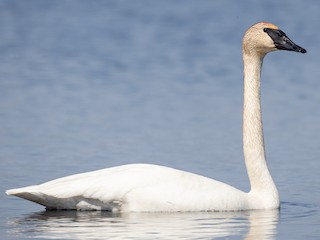
How to identify the Trumpeter Swan
Cygnus buccinator
Spotted a bird? Identify it instantly with the Birdby app
Open the appTo correctly identify the Trumpeter Swan (Cygnus buccinator), check each of these features. Birds can be tricky: habit, habitat, and call often confirm a sighting that a single photo cannot.
Size at a glance
- Length
- 138-180 cm (54-71 in)
- Wingspan
- 185-250 cm (73-98 in)
- Weight
- 7-13.6 kg (15-30 lbs), with males typically larger than females
Physical features to check
- 1
Plumage
Overall feather coloration and pattern.
Adults are entirely pure white. Juveniles (cygnets) are typically dull gray, sometimes with a brownish tinge, gradually molting to white over their first year.
- 2
Beak shape
Shape and color of the bill: a key field mark.
Large, wedge-shaped bill, entirely black. A distinctive feature is the 'salmon patch' or 'smile line' where the black bill meets the pinkish-red gape line, though this is not always visible and can be subtle.
- 3
Eye color
Iris color and any distinctive eye markings.
Dark brown
- 4
Leg color
Leg and foot color.
Black
- 5
Distinguishing features
Standout features that separate this species.
Massive size, all-white plumage (adults), entirely black bill, and a deep, resonant, trumpet-like call. The bill is typically straight, lacking the yellow lore patch often seen on Tundra Swans.
- 6
Juvenile appearance
How young birds differ from adults.
Cygnets are covered in dense gray down, which transitions to dull gray-brown juvenile plumage. Their bills are grayish-black, often with a pinkish base, and their legs are grayish-pink. They gradually whiten over their first year.
- 7
Seasonal changes
Plumage variation between breeding and non-breeding seasons.
No significant seasonal plumage changes in adults. Juveniles transition from gray to white over their first year.
- 8
Sexual dimorphism
How males and females differ.
Males (cobs) are generally larger and heavier than females (pens), but plumage is identical.
Key field marks
- Size. Look for the largest white waterfowl in North America. Its sheer size often makes it stand out from other swans and geese.
- Bill Color. Observe the bill. It should be entirely black. Absence of any yellow at the base of the bill (lore spot) is a key differentiator from Tundra Swans.
- Bill Shape/Gape Line. Note the bill's profile. Trumpeter Swans typically have a straight gape line (where the upper and lower mandibles meet), sometimes with a subtle 'salmon patch' of pinkish-red. Tundra Swans often have a more concave gape line.
- Vocalization. Listen for its distinctive call. The deep, resonant, trumpet-like 'oh-OH' is unmistakable and differs significantly from the higher-pitched Tundra Swan and the silent Mute Swan.
- Neck Posture. While swimming, Trumpeter Swans typically hold their neck straight, unlike the S-curved neck of a Mute Swan.
- Juvenile Plumage. Young birds (cygnets) are dull gray with grayish-black bills, gradually turning white over their first year. This distinguishes them from adult white swans.
Explore the Trumpeter Swan
Identify birds anywhere
Free on iOS, Android, and Web. Photo & sound identification, full species database, and your personal life list.