
Spotted a bird? Identify it instantly with the Birdby app
Open the appAbout
The Whooper Swan is a large, elegant waterfowl species known for its striking yellow and black bill and loud, trumpeting calls. It is a migratory bird, breeding in the subarctic and arctic regions of Eurasia and wintering further south.
Size & lifespan
- Length
- 140-165 cm (55-65 in)
- Wingspan
- 205-275 cm (81-108 in)
- Weight
- 8.2-11.4 kg (18-25 lb), males typically larger than females
- Lifespan
- Up to 10 years in the wild, with records of over 20 years in captivity.
- Diet
- Herbivore, primarily feeding on aquatic vegetation, grasses, and agricultural crops.
Physical characteristics
- Plumage
- Adults are entirely pure white. Juveniles have greyish-brown plumage, gradually turning white over their first year.
- Beak shape
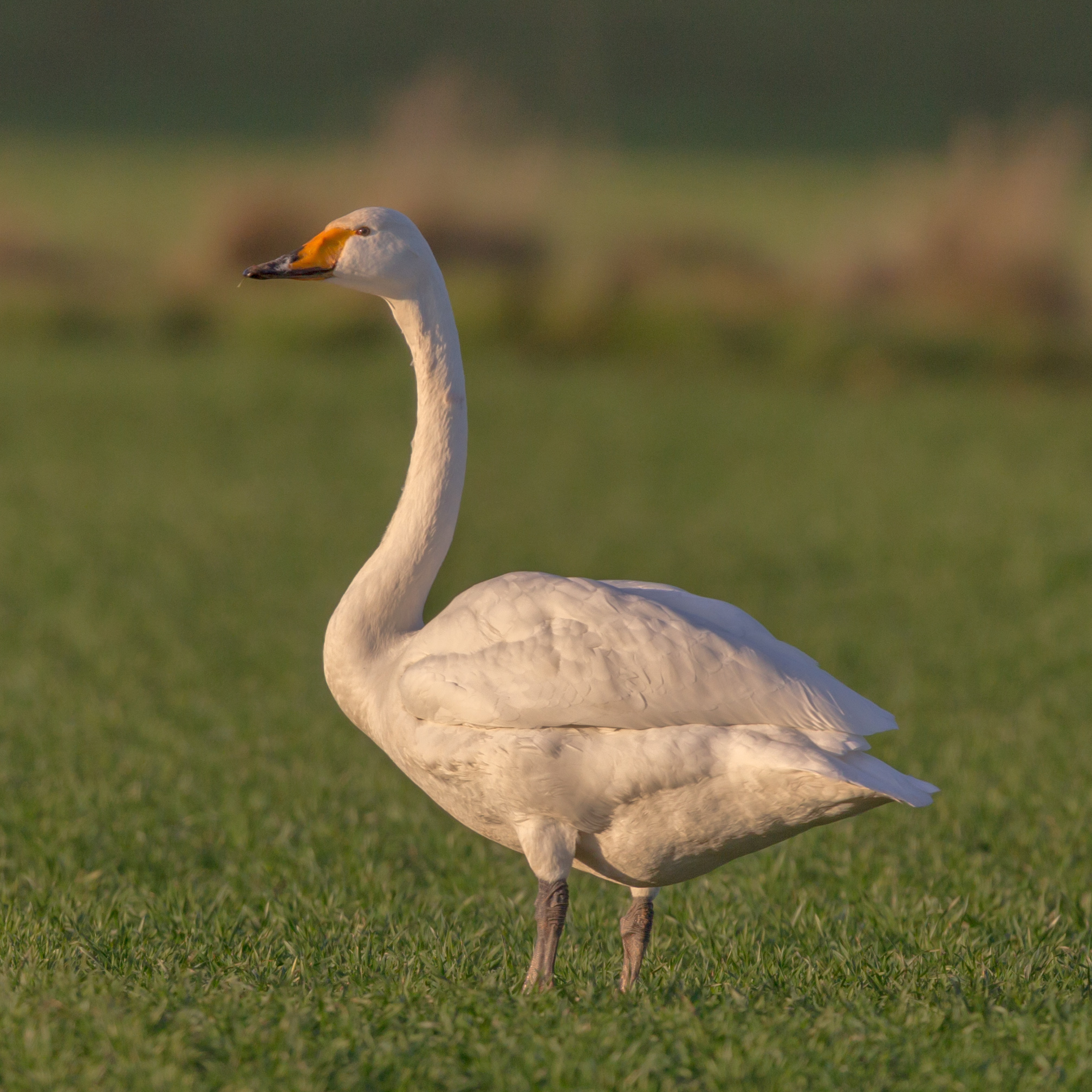
- Large, wedge-shaped bill. Distinctive pattern of yellow and black. The yellow extends from the base of the bill to a point, with a black tip and black along the cutting edge. The extent of yellow can vary individually.
- Eye color
- Dark brown
- Leg color
- Black
- Distinguishing features
- The most distinctive feature is the large yellow and black bill. The yellow patch on the bill is typically triangular or wedge-shaped, extending further forward than on the Bewick's Swan (Cygnus columbianus bewickii). They hold their neck straight and erect, unlike the S-curve often seen in Mute Swans.
- Juvenile appearance
- Young birds (cygnets) are greyish-brown with a duller, pinkish-grey bill that gradually develops the adult yellow and black pattern. Their legs are also greyish-pink, turning black with age.
- Seasonal changes
- No significant seasonal plumage changes in adults. Juveniles undergo a gradual molt to adult white plumage over their first year.
- Sexual dimorphism
- Males (cobs) are generally larger and heavier than females (pens), but plumage is identical.
How to identify
- 1
Bill Pattern
Look for the distinctive large yellow and black bill. The yellow forms a wedge or triangle, extending well forward from the base, with a black tip and cutting edge. This is the most reliable field mark.
- 2
Neck Posture
Observe how the swan holds its neck. Whooper Swans typically hold their neck straight and erect, unlike the graceful S-curve of the Mute Swan.
- 3
Size
Whooper Swans are large, but smaller than Mute Swans and larger than Bewick's Swans. This can be difficult to judge without direct comparison, but their overall bulk is noticeable.
- 4
Vocalization
Listen for their loud, resonant, trumpeting 'whoop-whoop' calls. This is a key identifier, especially when they are in flight or in flocks.
- 5
Juvenile Plumage
Young Whooper Swans are greyish-brown, not pure white, and have a duller, pinkish-grey bill that gradually develops the adult yellow and black pattern.
Habitat & range
- Biomes
- Tundra, taiga, wetlands, freshwater lakes, rivers, coastal lagoons, agricultural fields.
- Geographic range
- Breeds across the subarctic and arctic regions of Eurasia, from Iceland and Scandinavia eastward through Russia to the Pacific. Winters in temperate Europe, the Black Sea region, Caspian Sea, and East Asia (e.g., Japan, Korea, China).
- Elevation range
- Typically found at low elevations, primarily in lowland wetlands and coastal areas, but can breed in upland tundra regions.
- Preferred environments
- Shallow, nutrient-rich freshwater bodies such as lakes, ponds, slow-moving rivers, and marshes during breeding. In winter, they utilize larger lakes, estuaries, coastal waters, and often feed in agricultural fields (e.g., stubble fields, potato fields).
Behavior
- Activity time
- Diurnal, though they may feed at night, especially in wintering grounds if disturbed during the day.
- Feeding habits
- Primarily grazers, feeding on submerged aquatic vegetation (roots, stems, leaves), grasses, sedges, and agricultural crops like potatoes, cereals, and oilseed rape. They dabble and up-end in shallow water to reach vegetation, and graze on land.
- Social behavior
- Highly social, especially outside the breeding season. They form large flocks during migration and in wintering grounds. During breeding, pairs are territorial and defend their nesting sites.
- Flight pattern
- Powerful, direct flight with slow, deliberate wingbeats. They fly with their necks outstretched. Often fly in V-formations during migration.
- Migration pattern
- Long-distance migratory. Breeds in the north and migrates south for the winter. Icelandic population winters mainly in the UK and Ireland. Scandinavian and Russian populations winter in various parts of Europe and Asia. Migration occurs from September to November and March to May.
- Territoriality
- Breeding pairs are territorial, defending their nesting area from other swans and waterfowl. In winter, they are gregarious and less territorial, forming large feeding and roosting flocks.
Song & calls
- Song
- Not a 'song' in the passerine sense, but a loud, resonant, bugle-like call. Often described as 'whoop-whoop-whoop' or 'klo-klo-klo', given both in flight and on the water. The call is distinctive and carries a long distance.
- Call
- The primary call is a deep, resonant, trumpeting 'whoop' or 'honk'. They also produce softer murmurs and hisses, especially during courtship or when communicating with cygnets. Alarm calls are louder and more urgent versions of their trumpeting call.
- When they vocalize
- Vocalize frequently, especially when in flocks, during migration, and when disturbed. Calls are heard throughout the day and sometimes at night.
Breeding & reproduction
- Breeding season
- May to July, with egg-laying typically in May.
- Nesting habits
- Nests are large mounds of vegetation (grasses, sedges, mosses, reeds) built on small islands, hummocks, or dense vegetation near water. Both parents contribute to nest building.
- Clutch size
- 3-7 eggs, most commonly 4-6.
- Egg description
- Typically 4-7 eggs, dull white or creamy, becoming stained during incubation. Size: approximately 112 x 73 mm.
- Incubation period
- 35-42 days, primarily by the female, while the male guards the nest.
- Fledging period
- 60-70 days. Cygnets are precocial and can swim and feed shortly after hatching, but remain with parents for several months, often through their first winter.
- Parental care
- Both parents care for the young. The male defends the territory and family, while the female primarily incubates and broods. Cygnets stay with their parents for their entire first winter, learning migration routes and foraging techniques.
Where to find
Breeding Grounds
Arctic and subarctic tundra and taiga wetlands, remote lakes, and slow-moving rivers in northern Eurasia, including Iceland, Scandinavia, and Russia.
Wintering Grounds
Temperate lakes, estuaries, coastal lagoons, and agricultural fields across Europe (e.g., UK, Ireland, Netherlands, Germany), the Black Sea region, Caspian Sea, and East Asia (e.g., Japan, Korea, China).
Migration Stopovers
Large wetlands, lakes, and coastal areas along their migratory routes.
Field tips
- Listen for Calls. Their loud, trumpeting calls are often heard before the birds are seen, especially during migration or when large flocks are present.
- Scan Water Bodies and Fields. In winter, check large freshwater lakes, estuaries, and coastal areas. Also, look for them grazing in open agricultural fields, particularly stubble fields or those with root crops.
- Observe Bill Pattern Closely. Use binoculars or a scope to get a clear view of the bill's yellow and black pattern, paying attention to the extent and shape of the yellow.
- Look for Family Groups. During winter, family groups (parents with greyish-brown cygnets) often stay together, which can aid in identification.
Similar species
Mute Swan
Cygnus olor
Mute Swans have an orange bill with a prominent black knob at the base (larger in males), and typically hold their neck in an S-curve with the bill pointed downwards. They are generally silent, only hissing when disturbed. Whooper Swans have a yellow and black bill, no knob, and hold their neck straight and erect, and are very vocal.
Bewick's Swan (Tundra Swan)
Cygnus columbianus bewickii
Bewick's Swans are significantly smaller than Whooper Swans. Their bill pattern is also yellow and black, but the yellow patch is typically smaller and more rounded, not extending as far forward as on the Whooper Swan. The black on the bill is more extensive, often forming a 'smile' pattern. Their calls are also trumpeting but higher-pitched and less resonant than the Whooper Swan's.
Trumpeter Swan
Cygnus buccinator
Trumpeter Swans are found in North America and are generally larger than Whooper Swans. They have an entirely black bill (or sometimes a small red patch on the lower mandible near the gape), lacking any yellow. Their calls are also loud and trumpeting, similar in quality but distinct from Whooper Swans.
Quick facts
- Call:
- Loud, trumpeting 'whoop-whoop'
- Bill Color:
- Yellow and black
- Neck Posture:
- Straight and erect
- Habitat:
- Wetlands, lakes, fields
- Migration:
- Long-distance migrant
Fun facts
- The Whooper Swan is the national bird of Finland.
- They are known for their strong pair bonds, often mating for life.
- Whooper Swans can fly at altitudes of several thousand meters during migration.
- The name 'Whooper' comes directly from their distinctive 'whooping' call.
- In some cultures, Whooper Swans are seen as symbols of purity and grace.
Scientific classification
- Kingdom
- Animalia
- Phylum
- Chordata
- Class
- Aves
- Order
- Anseriformes
- Family
- Anatidae
- Genus
- Cygnus
- Species
- Cygnus cygnus
Explore the Whooper Swan
Identify birds anywhere
Free on iOS, Android, and Web. Photo & sound identification, full species database, and your personal life list.