
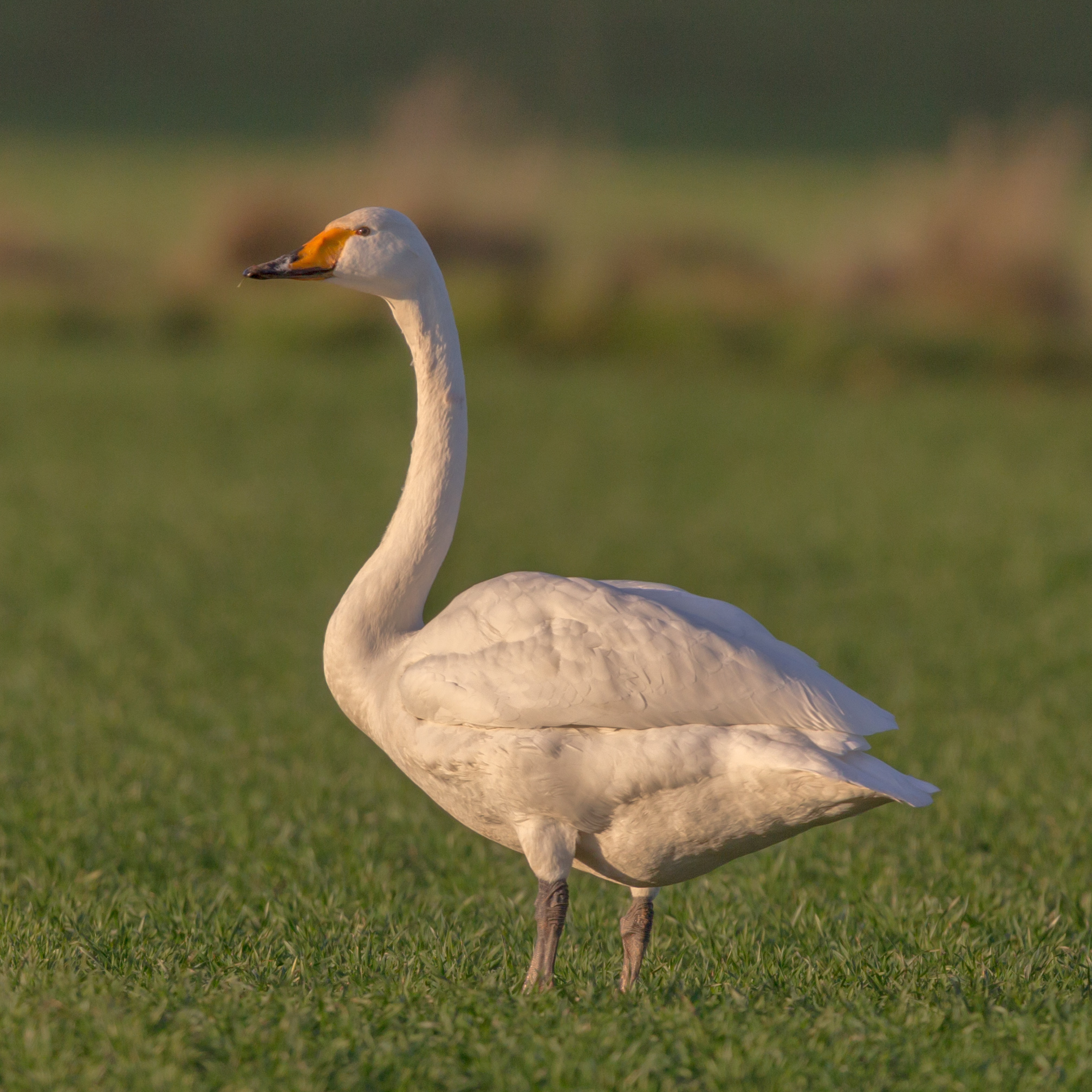
How to identify the Whooper Swan
Cygnus cygnus
Spotted a bird? Identify it instantly with the Birdby app
Open the appTo correctly identify the Whooper Swan (Cygnus cygnus), check each of these features. Birds can be tricky: habit, habitat, and call often confirm a sighting that a single photo cannot.
Size at a glance
- Length
- 140-165 cm (55-65 in)
- Wingspan
- 205-275 cm (81-108 in)
- Weight
- 8.2-11.4 kg (18-25 lb), males typically larger than females
Physical features to check
- 1
Plumage
Overall feather coloration and pattern.
Adults are entirely pure white. Juveniles have greyish-brown plumage, gradually turning white over their first year.
- 2
Beak shape
Shape and color of the bill: a key field mark.
Large, wedge-shaped bill. Distinctive pattern of yellow and black. The yellow extends from the base of the bill to a point, with a black tip and black along the cutting edge. The extent of yellow can vary individually.
- 3
Eye color
Iris color and any distinctive eye markings.
Dark brown
- 4
Leg color
Leg and foot color.
Black
- 5
Distinguishing features
Standout features that separate this species.
The most distinctive feature is the large yellow and black bill. The yellow patch on the bill is typically triangular or wedge-shaped, extending further forward than on the Bewick's Swan (Cygnus columbianus bewickii). They hold their neck straight and erect, unlike the S-curve often seen in Mute Swans.
- 6
Juvenile appearance
How young birds differ from adults.
Young birds (cygnets) are greyish-brown with a duller, pinkish-grey bill that gradually develops the adult yellow and black pattern. Their legs are also greyish-pink, turning black with age.
- 7
Seasonal changes
Plumage variation between breeding and non-breeding seasons.
No significant seasonal plumage changes in adults. Juveniles undergo a gradual molt to adult white plumage over their first year.
- 8
Sexual dimorphism
How males and females differ.
Males (cobs) are generally larger and heavier than females (pens), but plumage is identical.
Key field marks
- Bill Pattern. Look for the distinctive large yellow and black bill. The yellow forms a wedge or triangle, extending well forward from the base, with a black tip and cutting edge. This is the most reliable field mark.
- Neck Posture. Observe how the swan holds its neck. Whooper Swans typically hold their neck straight and erect, unlike the graceful S-curve of the Mute Swan.
- Size. Whooper Swans are large, but smaller than Mute Swans and larger than Bewick's Swans. This can be difficult to judge without direct comparison, but their overall bulk is noticeable.
- Vocalization. Listen for their loud, resonant, trumpeting 'whoop-whoop' calls. This is a key identifier, especially when they are in flight or in flocks.
- Juvenile Plumage. Young Whooper Swans are greyish-brown, not pure white, and have a duller, pinkish-grey bill that gradually develops the adult yellow and black pattern.
Explore the Whooper Swan
Identify birds anywhere
Free on iOS, Android, and Web. Photo & sound identification, full species database, and your personal life list.