
Spotted a bird? Identify it instantly with the Birdby app
Open the appAbout
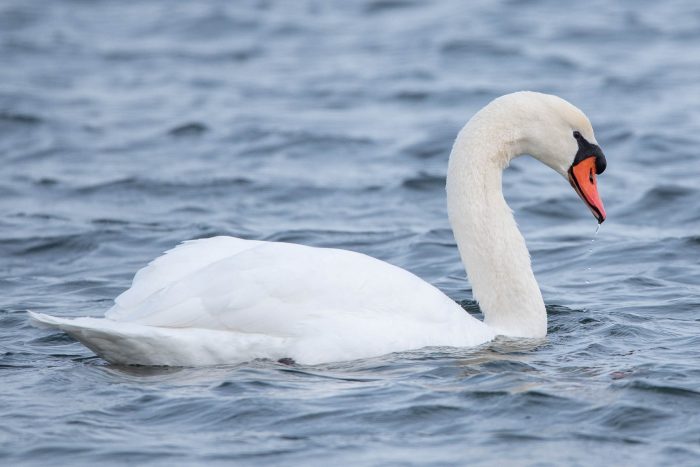
The Mute Swan is a large, elegant waterbird native to Eurasia, characterized by its pure white plumage, long S-curved neck, and distinctive orange bill with a prominent black knob at the base. Despite its name, it is not entirely mute, but its vocalizations are less frequent and less resonant than those of other swan species. It is a familiar sight in parks, lakes, and slow-moving rivers across its range.
Size & lifespan
- Length
- 125-170 cm (49-67 in)
- Wingspan
- 200-240 cm (79-94 in)
- Weight
- Male: 9.5-14 kg (21-31 lb), Female: 8-11 kg (18-24 lb); exceptionally up to 23 kg (51 lb)
- Lifespan
- Up to 19 years in the wild, often longer in captivity (20-30 years)
- Diet
- Herbivore
Physical characteristics
- Plumage
- Adults are entirely pure white. Juveniles (cygnets) are typically grey-brown, gradually molting to white over their first year, though a rare 'Polish' morph is white from hatching.
- Beak shape
- Large, wedge-shaped bill. Adults have a bright orange bill with a prominent black knob (called a 'knob' or 'berry') at the base, which is larger in males (cobs) than in females (pens). The bill tip and cutting edges are black.
- Eye color
- Dark brown
- Leg color
- Blackish-grey
- Distinguishing features
- The most distinctive features are the S-curved neck (often held in an elegant 'S' shape, especially when swimming), the orange bill with a black knob, and its generally silent nature compared to other swans. When swimming, it often holds its wings slightly raised over its back in a characteristic 'busking' posture, particularly when displaying or feeling threatened.
- Juvenile appearance
- Cygnets are typically covered in grey-brown down, with a greyish-pink bill that gradually darkens to orange with a developing black knob. They retain some greyish feathers through their first winter before becoming fully white.
- Seasonal changes
- No significant seasonal plumage changes in adults. The black knob on the male's bill may become slightly more prominent during the breeding season.
- Sexual dimorphism
- Males (cobs) are generally larger than females (pens) and have a noticeably larger black knob on their bill, especially during the breeding season. Otherwise, plumage is identical.
How to identify
- 1
Neck Posture
Look for the distinctive S-curve of the neck, especially when swimming. Other swan species typically hold their necks straighter.
- 2
Bill Color and Knob
Identify the bright orange bill with a prominent black knob at the base. The size of the knob is larger in males.
- 3
Plumage
Adults are pure white. Juveniles are grey-brown with a greyish-pink bill.
- 4
Vocalizations
Listen for its relative silence, primarily hisses when agitated, and the characteristic 'singing' sound of its wings in flight. Absence of loud bugling calls helps distinguish it from other swans.
- 5
Busking Display
Observe if the swan holds its wings arched over its back, especially when swimming or displaying. This 'busking' posture is typical for Mute Swans.
Habitat & range
- Biomes
- Temperate freshwater wetlands, estuaries, coastal lagoons, slow-moving rivers, lakes, ponds, and sometimes brackish waters.
- Geographic range
- Native to temperate Europe and Asia, from Great Britain and Scandinavia eastwards across central Asia to the Russian Far East. Introduced populations exist in North America, Australia, New Zealand, and parts of South Africa.
- Elevation range
- Primarily lowlands, from sea level up to a few hundred meters.
- Preferred environments
- Shallow, nutrient-rich waters with abundant aquatic vegetation for feeding, and secluded banks or islands for nesting. They tolerate human presence well and are often found in urban parks and ornamental waters.
Behavior
- Activity time
- Diurnal, active during daylight hours.
- Feeding habits
- Primarily herbivorous, feeding on submerged aquatic vegetation (such as pondweeds, algae, and grasses) by dabbling and up-ending, reaching depths of up to a meter with their long necks. They also graze on terrestrial grasses near water bodies and may consume small invertebrates incidentally.
- Social behavior
- Typically found in pairs during the breeding season, which are monogamous and often mate for life. Outside of breeding, they can form large flocks, especially during winter or at favored feeding sites. They can be highly territorial and aggressive towards other waterfowl, especially when nesting or with cygnets.
- Flight pattern
- Powerful, direct flight with slow, deep wing beats that produce a characteristic 'singing' or 'thrumming' sound. They require a long run-up on water to become airborne.
- Migration pattern
- Resident in much of its native range, particularly in Western Europe. Eastern and northern populations are partially migratory, moving south and west to ice-free waters during winter. Introduced populations are generally resident.
- Territoriality
- Highly territorial during the breeding season, aggressively defending their nest site and young from perceived threats, including other swans, geese, ducks, and even humans. They will hiss, flap their wings, and charge intruders.
Song & calls
- Song
- Mute Swans do not have a true song. Their vocalizations are generally limited.
- Call
- The most characteristic sound is a deep, resonant 'hiss' when threatened or agitated. They also produce soft grunts, snorts, and a low 'hoo-hoo' call, particularly between mates. The 'singing' sound of their wings in flight is a distinctive auditory cue.
- When they vocalize
- Mainly vocalize when agitated, defending territory, or communicating softly with mates and cygnets. Wing sounds are heard during flight.
Breeding & reproduction
- Breeding season
- Typically March to June, varying with geographic location.
- Nesting habits
- Build large, conspicuous nests, often several feet across, made of reeds, rushes, grasses, and other aquatic vegetation. Nests are usually located on islands, secluded banks, or dense emergent vegetation near water, often reused year after year.
- Clutch size
- 3-10 eggs
- Egg description
- 3-10 (typically 5-7) large, oval eggs; initially pale greenish-blue, fading to dirty white or buff as incubation progresses. Average size is about 112 x 74 mm.
- Incubation period
- 35-38 days
- Fledging period
- 120-150 days (4-5 months), one of the longest fledging periods among waterfowl. Cygnets remain with parents for several months, often through their first winter.
- Parental care
- Both parents participate in incubation (though the female does most) and extensive care of the cygnets. Parents are highly protective and will aggressively defend their young.
Where to find
Lakes and Ponds
Common in freshwater lakes, ornamental ponds in parks, and large garden ponds.
Rivers and Canals
Frequently found on slow-moving rivers, canals, and backwaters.
Estuaries and Coastal Lagoons
Can be found in brackish water environments, especially during winter.
Urban Parks
Highly adapted to human presence, they are a common sight in urban and suburban parks with water features.
Field tips
- Look for the S-curve. When observing swans, the S-shaped neck is the most immediate visual cue for Mute Swans.
- Check the bill. The orange bill with a black knob is unmistakable in adults. Note the size of the knob to differentiate sexes.
- Listen for silence (or lack thereof). While not truly mute, their relative quietness compared to the loud calls of Whooper or Tundra Swans is a key identifier. Listen for wing sounds in flight.
- Observe behavior. Watch for the 'busking' posture with raised wings, especially when they are swimming purposefully or interacting with other birds.
Similar species
Whooper Swan
Cygnus cygnus
The Whooper Swan has a straight neck, a black bill with a large yellow patch at the base (extending to a point), and lacks the black knob of the Mute Swan. It is also much more vocal, with a loud, bugling 'whoop-whoop' call.
Tundra Swan (Bewick's Swan)
Cygnus columbianus bewickii
Smaller than the Mute Swan. Has a straight neck and a black bill with a smaller, more rounded yellow patch at the base. Like the Whooper Swan, it is vocal, with a softer, more musical 'hoo-hoo-hoo' call, and lacks the Mute Swan's black knob.
Trumpeter Swan
Cygnus buccinator
Found in North America. Larger than the Mute Swan on average, with a completely black bill (no orange or knob) and a straight neck. It is very vocal, with a loud, resonant, trumpet-like call.
Quick facts
- Distinguishing Feature:
- Orange bill with black knob, S-curved neck
- Flight Sound:
- Distinctive 'singing' or 'thrumming' sound from wings
- Diet:
- Aquatic vegetation
- Territoriality:
- Highly territorial during breeding
- Cygnets:
- Typically grey-brown, long fledging period
Fun facts
- Despite their name, Mute Swans are not entirely silent, but their vocalizations are much less frequent and less resonant than other swan species. The 'mute' refers to their lack of a loud, bugling call.
- The characteristic 'singing' sound of their wings in flight is caused by the rapid movement of their primary feathers, a unique auditory identifier.
- In the UK, all unmarked Mute Swans in open waters are traditionally considered property of the Crown, a custom dating back to the 12th century when swans were a prized food source.
- Mute Swans are one of the heaviest flying birds, with some males reaching weights of over 20 kg (44 lbs).
- They are known for their aggressive defense of nests and young, often chasing away much larger animals, including humans, with hissing and wing-flapping displays.
Scientific classification
- Kingdom
- Animalia
- Phylum
- Chordata
- Class
- Aves
- Order
- Anseriformes
- Family
- Anatidae
- Genus
- Cygnus
- Species
- Cygnus olor
Explore the Mute Swan
Identify birds anywhere
Free on iOS, Android, and Web. Photo & sound identification, full species database, and your personal life list.