
Where does the Mute Swan live?
Cygnus olor
Spotted a bird? Identify it instantly with the Birdby app
Open the appThe Mute Swan lives in specific habitats and regions. Knowing where, and when, to look improves your chances of a successful sighting.
Biomes
Temperate freshwater wetlands, estuaries, coastal lagoons, slow-moving rivers, lakes, ponds, and sometimes brackish waters.
Geographic range
Native to temperate Europe and Asia, from Great Britain and Scandinavia eastwards across central Asia to the Russian Far East. Introduced populations exist in North America, Australia, New Zealand, and parts of South Africa.
Preferred environments
Shallow, nutrient-rich waters with abundant aquatic vegetation for feeding, and secluded banks or islands for nesting. They tolerate human presence well and are often found in urban parks and ornamental waters.
Elevation range
Primarily lowlands, from sea level up to a few hundred meters.
Where to look
Lakes and Ponds
Common in freshwater lakes, ornamental ponds in parks, and large garden ponds.
Rivers and Canals
Frequently found on slow-moving rivers, canals, and backwaters.
Estuaries and Coastal Lagoons
Can be found in brackish water environments, especially during winter.
Urban Parks
Highly adapted to human presence, they are a common sight in urban and suburban parks with water features.
Field tips
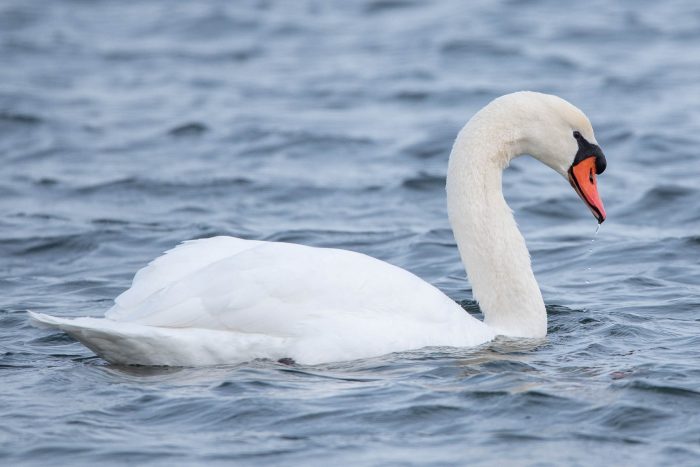
- Look for the S-curve. When observing swans, the S-shaped neck is the most immediate visual cue for Mute Swans.
- Check the bill. The orange bill with a black knob is unmistakable in adults. Note the size of the knob to differentiate sexes.
- Listen for silence (or lack thereof). While not truly mute, their relative quietness compared to the loud calls of Whooper or Tundra Swans is a key identifier. Listen for wing sounds in flight.
- Observe behavior. Watch for the 'busking' posture with raised wings, especially when they are swimming purposefully or interacting with other birds.
Migration
Resident in much of its native range, particularly in Western Europe. Eastern and northern populations are partially migratory, moving south and west to ice-free waters during winter. Introduced populations are generally resident.
Explore the Mute Swan
Identify birds anywhere
Free on iOS, Android, and Web. Photo & sound identification, full species database, and your personal life list.