
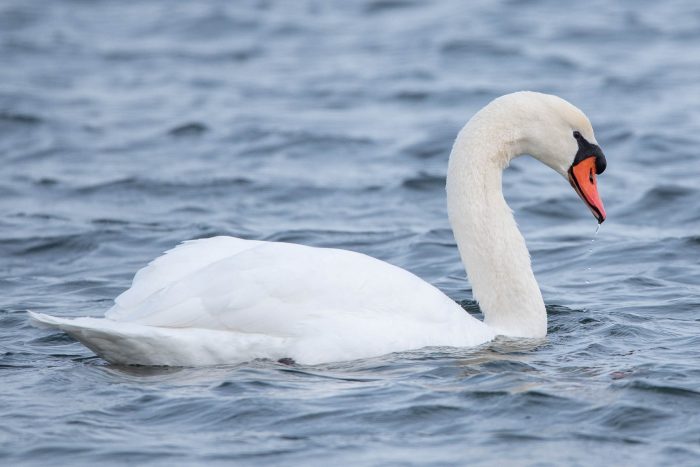
How to identify the Mute Swan
Cygnus olor
Spotted a bird? Identify it instantly with the Birdby app
Open the appTo correctly identify the Mute Swan (Cygnus olor), check each of these features. Birds can be tricky: habit, habitat, and call often confirm a sighting that a single photo cannot.
Size at a glance
- Length
- 125-170 cm (49-67 in)
- Wingspan
- 200-240 cm (79-94 in)
- Weight
- Male: 9.5-14 kg (21-31 lb), Female: 8-11 kg (18-24 lb); exceptionally up to 23 kg (51 lb)
Physical features to check
- 1
Plumage
Overall feather coloration and pattern.
Adults are entirely pure white. Juveniles (cygnets) are typically grey-brown, gradually molting to white over their first year, though a rare 'Polish' morph is white from hatching.
- 2
Beak shape
Shape and color of the bill: a key field mark.
Large, wedge-shaped bill. Adults have a bright orange bill with a prominent black knob (called a 'knob' or 'berry') at the base, which is larger in males (cobs) than in females (pens). The bill tip and cutting edges are black.
- 3
Eye color
Iris color and any distinctive eye markings.
Dark brown
- 4
Leg color
Leg and foot color.
Blackish-grey
- 5
Distinguishing features
Standout features that separate this species.
The most distinctive features are the S-curved neck (often held in an elegant 'S' shape, especially when swimming), the orange bill with a black knob, and its generally silent nature compared to other swans. When swimming, it often holds its wings slightly raised over its back in a characteristic 'busking' posture, particularly when displaying or feeling threatened.
- 6
Juvenile appearance
How young birds differ from adults.
Cygnets are typically covered in grey-brown down, with a greyish-pink bill that gradually darkens to orange with a developing black knob. They retain some greyish feathers through their first winter before becoming fully white.
- 7
Seasonal changes
Plumage variation between breeding and non-breeding seasons.
No significant seasonal plumage changes in adults. The black knob on the male's bill may become slightly more prominent during the breeding season.
- 8
Sexual dimorphism
How males and females differ.
Males (cobs) are generally larger than females (pens) and have a noticeably larger black knob on their bill, especially during the breeding season. Otherwise, plumage is identical.
Key field marks
- Neck Posture. Look for the distinctive S-curve of the neck, especially when swimming. Other swan species typically hold their necks straighter.
- Bill Color and Knob. Identify the bright orange bill with a prominent black knob at the base. The size of the knob is larger in males.
- Plumage. Adults are pure white. Juveniles are grey-brown with a greyish-pink bill.
- Vocalizations. Listen for its relative silence, primarily hisses when agitated, and the characteristic 'singing' sound of its wings in flight. Absence of loud bugling calls helps distinguish it from other swans.
- Busking Display. Observe if the swan holds its wings arched over its back, especially when swimming or displaying. This 'busking' posture is typical for Mute Swans.
Explore the Mute Swan
Identify birds anywhere
Free on iOS, Android, and Web. Photo & sound identification, full species database, and your personal life list.