
Spotted a bird? Identify it instantly with the Birdby app
Open the appAbout
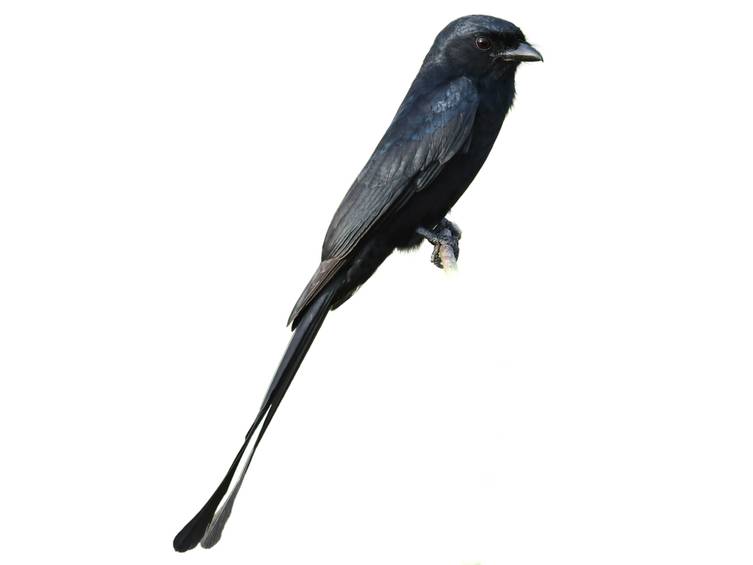
The Black Drongo is a small passerine bird of the drongo family Dicruridae, native to tropical southern Asia from Iran through India and Sri Lanka to southern China and Java. It is a wholly black bird with a distinctive forked tail. It is known for its aggressive and fearless nature, often seen chasing away much larger birds of prey. It is a common and widespread resident bird, often found in open country, agricultural lands, and urban gardens.
Size & lifespan
- Length
- 26-32 cm
- Wingspan
- 44-48 cm
- Weight
- 40-60 g
- Lifespan
- 4-6 years in the wild
- Diet
- Insectivore
Physical characteristics
- Plumage
- Adults are entirely glossy black with a metallic sheen, especially on the head and upperparts. The feathers are soft and velvety. Juveniles are duller black, often with white or buffy mottling on the underparts, especially on the belly and vent, which fades with age.
- Beak shape
- Stout, slightly hooked, and black. The culmen is curved.
- Eye color
- Dark brown to reddish-brown
- Leg color
- Black
- Distinguishing features
- Its most distinctive feature is the deeply forked, scissor-like tail, which is long and often held slightly open in flight. The overall sleek, glossy black plumage and upright posture are also key identifiers.
- Juvenile appearance
- Juveniles are duller black than adults, often with white or buffy mottling or barring on the belly and vent. The gape is yellowish, and the tail fork may be less pronounced initially.
- Seasonal changes
- No significant seasonal changes in plumage. The glossy black plumage remains consistent throughout the year.
- Sexual dimorphism
- Males and females are monomorphic in plumage and size, making them indistinguishable in the field based on appearance alone.
How to identify
- 1
Plumage
Look for the entirely glossy black plumage. No other drongo in its range is uniformly black without other distinguishing features like a crest or grey coloration.
- 2
Tail Shape
The deeply forked, 'scissor-like' tail is a key identifier. Observe it in flight or when perched, as it is often held slightly open.
- 3
Behavior
Its aggressive and fearless nature, often mobbing larger birds, is characteristic. Watch for its sallying flights from prominent perches to catch insects.
- 4
Habitat
Commonly found in open agricultural areas, grasslands, and near human habitation, often perched on wires or fences.
- 5
Vocalizations
Listen for its harsh, metallic, and chattering calls, often incorporating mimicry.
Habitat & range
- Biomes
- Tropical and subtropical grasslands, savannas, shrublands, agricultural lands, rural gardens, and urban parks.
- Geographic range
- Southern Asia, from southeastern Iran, Afghanistan, Pakistan, India, Sri Lanka, Bangladesh, Myanmar, Thailand, Laos, Cambodia, Vietnam, southern China, and parts of Indonesia (Sumatra, Java, Bali).
- Elevation range
- Typically found from sea level up to 2,000 meters (6,500 feet), occasionally higher.
- Preferred environments
- Open habitats with scattered trees, cultivation, pastures, and human-modified landscapes. They prefer areas with perching posts (wires, fences, branches) from which to hunt insects.
Behavior
- Activity time
- Diurnal, most active during the day, especially in the morning and late afternoon.
- Feeding habits
- Primarily insectivorous, catching insects in flight or by sallying from a perch. They consume a wide variety of insects including grasshoppers, crickets, beetles, moths, and termites. They are also known to follow livestock or tractors to catch disturbed insects. Occasionally, they may take small vertebrates, nectar, or grain.
- Social behavior
- Usually seen singly or in pairs, especially during the breeding season. Outside of breeding, they may gather in small groups at communal roosts. They are highly territorial and aggressive, particularly during nesting.
- Flight pattern
- Strong, direct, and agile flight, often involving rapid wing beats and sudden turns, especially when pursuing insects. The deeply forked tail is prominent during flight.
- Migration pattern
- Mostly resident throughout its range. Some populations in the northern parts of its range (e.g., northern India, Pakistan) may undertake short-distance altitudinal or local movements in response to food availability or weather, but generally not considered migratory.
- Territoriality
- Highly territorial, especially around nesting sites. They aggressively defend their territory against other birds, including much larger raptors, often mobbing intruders with loud calls and aerial attacks.
Song & calls
- Song
- The Black Drongo has a varied repertoire of calls, but no true complex song. It often mimics other birds' calls. Its vocalizations are generally harsh, metallic, and unmusical, but can include some melodious notes.
- Call
- Common calls include a harsh, metallic 'chee-wit', a sharp 'twee-twee', and various chattering, scolding, and squeaky notes. They also produce alarm calls when predators are sighted, often a loud, repeated 'chink-chink'.
- When they vocalize
- Vocalizes throughout the day, particularly active in the mornings and evenings, and especially during the breeding season to defend territory and communicate with mates.
Breeding & reproduction
- Breeding season
- Typically March to August, varying geographically with the onset of monsoons.
- Nesting habits
- Monogamous. Nests are cup-shaped, made of twigs, grass, and rootlets, bound together with cobwebs, and lined with finer materials. They are usually placed in the fork of a tree branch, often at a considerable height (5-15 meters), and are well-concealed. Both parents participate in nest building.
- Clutch size
- 3-5 eggs
- Egg description
- 3-5 eggs, typically pale pinkish-white to reddish-brown, often speckled or blotched with darker reddish-brown or purplish-grey markings, particularly at the broader end. Eggs measure approximately 25 x 19 mm.
- Incubation period
- 14-16 days
- Fledging period
- 16-20 days after hatching, young leave the nest but are still fed by parents for some time.
- Parental care
- Both parents share incubation duties and care for the young. They are highly protective of the nest and aggressively defend it against predators.
Where to find
Agricultural Fields
Often seen perched on fences, power lines, or branches overlooking cultivated fields, waiting to pounce on insects.
Open Grasslands and Savannas
Look for them in open areas with scattered trees and shrubs, where they can find suitable perches for hunting.
Rural and Urban Gardens/Parks
Common in human-modified landscapes, especially those with lawns, trees, and open spaces.
Roadsides
Frequently perch on roadside wires and poles, making them easy to spot from vehicles.
Field tips
- Look for prominent perches. Black Drongos prefer to hunt from elevated perches like power lines, fence posts, dead branches, or tall shrubs. Scan these areas.
- Observe their hunting style. Watch for their characteristic sallying flights, where they dart out from a perch to catch an insect in mid-air and then return to the same or a different perch.
- Listen for their calls. Their distinctive harsh, metallic calls can often give away their presence even before you see them.
- Look for interactions with other birds. Their aggressive nature means they often interact with or mob other birds, which can draw attention to them.
Similar species
Ashy Drongo
Dicrurus leucophaeus
The Ashy Drongo is primarily grey, not black, and has a less deeply forked tail. It also has a more upright posture and often a white patch around the eye (though this can be variable).
Bronzed Drongo
Dicrurus aeneus
Smaller than the Black Drongo, with a more iridescent bronze-green sheen on its plumage. Its tail is less deeply forked and appears more square-ended or slightly emarginated.
Hair-crested Drongo (Spangled Drongo)
Dicrurus hottentottus
Larger and heavier-billed than the Black Drongo, with a more pronounced crest of hair-like feathers on the forehead (often difficult to see in the field). Its tail is also deeply forked but often has a slight upward curl at the tips.
Quick facts
- Common Name:
- Black Drongo
- Scientific Name:
- Dicrurus macrocercus
- Family:
- Dicruridae
- Diet:
- Insectivore
- Conservation Status:
- Least Concern
- Distinguishing Feature:
- Deeply forked, scissor-like tail
- Behavior:
- Aggressive and territorial
Fun facts
- The Black Drongo is often called the 'King Crow' due to its aggressive nature and ability to chase away much larger birds, including crows and raptors.
- They are known to form symbiotic relationships with other animals, such as cattle, by perching on their backs and catching insects disturbed by their movement.
- Black Drongos are excellent mimics and can imitate the calls of various other bird species, though their own calls are generally harsh.
- In some regions, they are considered beneficial birds by farmers because they consume large quantities of agricultural insect pests.
Scientific classification
- Kingdom
- Animalia
- Phylum
- Chordata
- Class
- Aves
- Order
- Passeriformes
- Family
- Dicruridae
- Genus
- Dicrurus
- Species
- Dicrurus macrocercus
Explore the Black Drongo
Identify birds anywhere
Free on iOS, Android, and Web. Photo & sound identification, full species database, and your personal life list.