
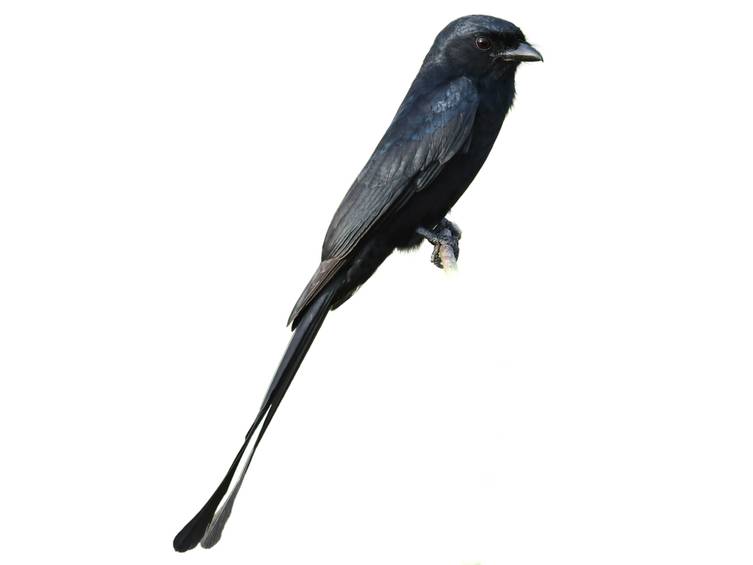
How to identify the Black Drongo
Dicrurus macrocercus
Spotted a bird? Identify it instantly with the Birdby app
Open the appTo correctly identify the Black Drongo (Dicrurus macrocercus), check each of these features. Birds can be tricky: habit, habitat, and call often confirm a sighting that a single photo cannot.
Size at a glance
- Length
- 26-32 cm
- Wingspan
- 44-48 cm
- Weight
- 40-60 g
Physical features to check
- 1
Plumage
Overall feather coloration and pattern.
Adults are entirely glossy black with a metallic sheen, especially on the head and upperparts. The feathers are soft and velvety. Juveniles are duller black, often with white or buffy mottling on the underparts, especially on the belly and vent, which fades with age.
- 2
Beak shape
Shape and color of the bill: a key field mark.
Stout, slightly hooked, and black. The culmen is curved.
- 3
Eye color
Iris color and any distinctive eye markings.
Dark brown to reddish-brown
- 4
Leg color
Leg and foot color.
Black
- 5
Distinguishing features
Standout features that separate this species.
Its most distinctive feature is the deeply forked, scissor-like tail, which is long and often held slightly open in flight. The overall sleek, glossy black plumage and upright posture are also key identifiers.
- 6
Juvenile appearance
How young birds differ from adults.
Juveniles are duller black than adults, often with white or buffy mottling or barring on the belly and vent. The gape is yellowish, and the tail fork may be less pronounced initially.
- 7
Seasonal changes
Plumage variation between breeding and non-breeding seasons.
No significant seasonal changes in plumage. The glossy black plumage remains consistent throughout the year.
- 8
Sexual dimorphism
How males and females differ.
Males and females are monomorphic in plumage and size, making them indistinguishable in the field based on appearance alone.
Key field marks
- Plumage. Look for the entirely glossy black plumage. No other drongo in its range is uniformly black without other distinguishing features like a crest or grey coloration.
- Tail Shape. The deeply forked, 'scissor-like' tail is a key identifier. Observe it in flight or when perched, as it is often held slightly open.
- Behavior. Its aggressive and fearless nature, often mobbing larger birds, is characteristic. Watch for its sallying flights from prominent perches to catch insects.
- Habitat. Commonly found in open agricultural areas, grasslands, and near human habitation, often perched on wires or fences.
- Vocalizations. Listen for its harsh, metallic, and chattering calls, often incorporating mimicry.
Explore the Black Drongo
Identify birds anywhere
Free on iOS, Android, and Web. Photo & sound identification, full species database, and your personal life list.