
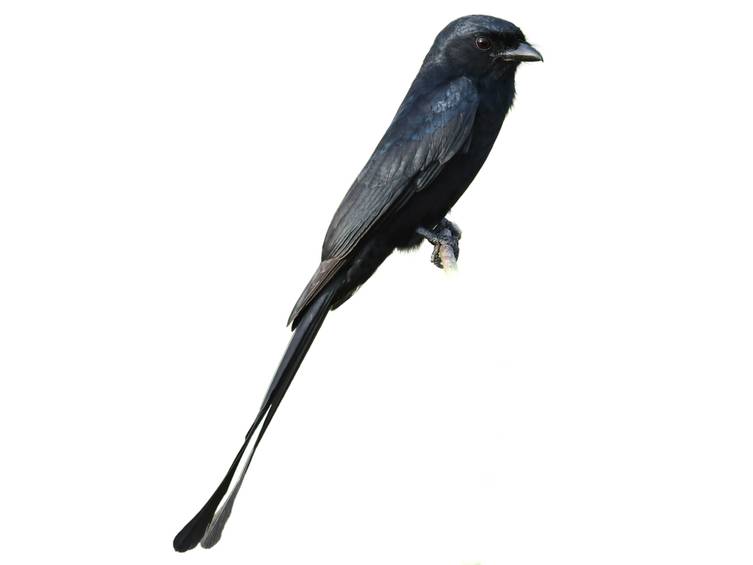
Where does the Black Drongo live?
Dicrurus macrocercus
Spotted a bird? Identify it instantly with the Birdby app
Open the appThe Black Drongo lives in specific habitats and regions. Knowing where, and when, to look improves your chances of a successful sighting.
Biomes
Tropical and subtropical grasslands, savannas, shrublands, agricultural lands, rural gardens, and urban parks.
Geographic range
Southern Asia, from southeastern Iran, Afghanistan, Pakistan, India, Sri Lanka, Bangladesh, Myanmar, Thailand, Laos, Cambodia, Vietnam, southern China, and parts of Indonesia (Sumatra, Java, Bali).
Preferred environments
Open habitats with scattered trees, cultivation, pastures, and human-modified landscapes. They prefer areas with perching posts (wires, fences, branches) from which to hunt insects.
Elevation range
Typically found from sea level up to 2,000 meters (6,500 feet), occasionally higher.
Where to look
Agricultural Fields
Often seen perched on fences, power lines, or branches overlooking cultivated fields, waiting to pounce on insects.
Open Grasslands and Savannas
Look for them in open areas with scattered trees and shrubs, where they can find suitable perches for hunting.
Rural and Urban Gardens/Parks
Common in human-modified landscapes, especially those with lawns, trees, and open spaces.
Roadsides
Frequently perch on roadside wires and poles, making them easy to spot from vehicles.
Field tips
- Look for prominent perches. Black Drongos prefer to hunt from elevated perches like power lines, fence posts, dead branches, or tall shrubs. Scan these areas.
- Observe their hunting style. Watch for their characteristic sallying flights, where they dart out from a perch to catch an insect in mid-air and then return to the same or a different perch.
- Listen for their calls. Their distinctive harsh, metallic calls can often give away their presence even before you see them.
- Look for interactions with other birds. Their aggressive nature means they often interact with or mob other birds, which can draw attention to them.
Migration
Mostly resident throughout its range. Some populations in the northern parts of its range (e.g., northern India, Pakistan) may undertake short-distance altitudinal or local movements in response to food availability or weather, but generally not considered migratory.
Explore the Black Drongo
Identify birds anywhere
Free on iOS, Android, and Web. Photo & sound identification, full species database, and your personal life list.