
Spotted a bird? Identify it instantly with the Birdby app
Open the appAbout
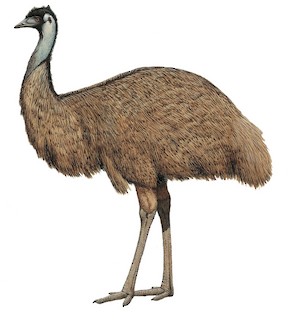
The Emu is the second-largest living bird by height, endemic to Australia. It is a flightless ratite, characterized by its long neck and legs, shaggy brown plumage, and ability to run at high speeds. Emus are highly nomadic, often traveling long distances to find food and water.
Size & lifespan
- Length
- 150-190 cm (59-75 in)
- Wingspan
- Approximately 80-120 cm (31-47 in) (vestigial wings)
- Weight
- 18-60 kg (40-132 lb), typically 30-45 kg (66-99 lb)
- Lifespan
- 10-20 years in the wild, up to 30 years in captivity
- Diet
- Omnivore (primarily herbivorous)
Physical characteristics
- Plumage
- Adult Emus have shaggy, coarse, brown to grey-brown plumage, which provides excellent camouflage in their varied habitats. The feathers are double-shafted, giving them a hair-like appearance. The head and neck are sparsely feathered, revealing bluish-black skin, particularly noticeable on the sides of the neck and around the eyes. Juveniles have distinctive longitudinal stripes.
- Beak shape
- The beak is relatively short, broad, and flattened, adapted for grazing and browsing. It is dark grey to black.
- Eye color
- Eyes are typically brown, large, and prominent.
- Leg color
- Legs are thick, powerful, and dark grey to black, ending in three forward-pointing toes with strong claws.
- Distinguishing features
- Large size, flightless nature, long neck and legs, shaggy brown plumage, and the distinctive bluish-black skin on the head and neck. The vestigial wings are barely visible, covered by body feathers.
- Juvenile appearance
- Chicks are cream-colored with distinctive dark brown longitudinal stripes along their bodies, which help them camouflage. These stripes fade as they mature, and they gradually develop adult plumage over several months.
- Seasonal changes
- No significant seasonal plumage changes. The shaggy feathers provide insulation against both heat and cold.
- Sexual dimorphism
- Males and females are generally similar in appearance, though females tend to be slightly larger and heavier than males, especially during the breeding season. During courtship, females may exhibit a more prominent blue coloration on their heads and necks.
How to identify
- 1
Size and Stature
Look for a very large, flightless bird, standing up to 1.9 meters tall, with a long neck and powerful legs. Its sheer size is often the first clue.
- 2
Plumage
Observe the shaggy, coarse, brown to grey-brown feathers that give it a somewhat disheveled appearance. The feathers are double-shafted.
- 3
Head and Neck
Note the sparsely feathered head and neck, revealing bluish-black skin, especially on the sides. This is a key field mark.
- 4
Legs and Feet
Identify the thick, dark, powerful legs with three forward-pointing toes, adapted for running.
- 5
Gait and Movement
Watch for its distinctive long-striding, powerful run, capable of high speeds. They often move with a swaying motion of the head and neck.
- 6
Vocalizations
Listen for the deep, resonant 'booming' or 'drumming' sounds, particularly from females, which can carry over long distances.
Habitat & range
- Biomes
- Grasslands, woodlands, savannas, mallee scrub, and semi-arid to arid regions.
- Geographic range
- Widespread across mainland Australia, avoiding densely populated areas, dense rainforests, and extremely arid deserts.
- Elevation range
- Sea level to approximately 1,500 meters (4,900 feet).
- Preferred environments
- Open plains, eucalyptus forests, and areas with a mix of grasses, shrubs, and trees, often near water sources.
Behavior
- Activity time
- Diurnal. Most active during the day, particularly in the early morning and late afternoon.
- Feeding habits
- Emus are opportunistic feeders. Their diet consists mainly of native and introduced plants, including seeds, fruits, flowers, young shoots, and roots. They also consume insects (e.g., grasshoppers, caterpillars), small vertebrates, and droppings of other animals. They swallow small stones (gastroliths) to aid digestion.
- Social behavior
- Generally solitary or found in pairs, though they can form large, nomadic flocks (hundreds or even thousands) in response to food availability or during migrations. They are not territorial in the traditional sense, but males defend the nest during incubation.
- Flight pattern
- Flightless. Emus are cursorial birds, meaning they are adapted for running. They can run at speeds up to 50 km/h (31 mph) with a long, powerful stride.
- Migration pattern
- Nomadic rather than migratory. Emus undertake seasonal movements in response to rainfall and food availability, often moving north in summer and south in winter in some regions, or following rainfall patterns across the continent.
- Territoriality
- Not strictly territorial outside of the breeding season. During breeding, the male establishes and defends a nesting territory.
Song & calls
- Song
- Emus do not have a 'song' in the typical avian sense. Their vocalizations are primarily low-frequency booming and drumming sounds.
- Call
- The most characteristic calls are deep, resonant 'booming' sounds produced by the female, often during courtship or to assert dominance. Males produce softer 'grunting' or 'hissing' sounds. Chicks emit high-pitched whistles.
- When they vocalize
- Vocalizations are most frequent during the breeding season, particularly by females. Booming can be heard at various times of the day, especially in the morning and evening.
Breeding & reproduction
- Breeding season
- Typically from April to June (autumn/winter) in southern Australia, and later in the year (July to December) in northern Australia, varying with rainfall.
- Nesting habits
- The male builds a simple, shallow nest on the ground, usually in a sheltered spot among grass or shrubs. It is a flat platform of bark, grass, leaves, and sticks.
- Clutch size
- 5-15 eggs, typically 8-10.
- Egg description
- Large, dark green to almost black, thick-shelled, and oval-shaped. They measure approximately 13 x 9 cm (5.1 x 3.5 in).
- Incubation period
- Approximately 56 days (8 weeks). The male alone incubates the eggs, rarely leaving the nest to feed or drink.
- Fledging period
- Chicks are precocial and leave the nest within a few days of hatching. They remain with the male for 5-18 months.
- Parental care
- The male Emu is solely responsible for incubation and raising the young. He becomes highly protective and aggressive towards intruders, including the female, during this period.
Where to find
National Parks and Reserves
Many national parks and wildlife reserves across mainland Australia offer excellent opportunities to see Emus, particularly in open woodland and grassland areas. Examples include Hattah-Kulkyne National Park, Mungo National Park, and various parks in Western Australia and Queensland.
Agricultural Lands
Emus are often seen in agricultural areas, especially where native vegetation borders farmlands, as they forage for crops and insects.
Roadsides in Rural Areas
When driving through rural and semi-arid parts of Australia, Emus can frequently be spotted grazing by the side of the road, particularly at dawn and dusk.
Field tips
- Look in open country. Emus prefer open woodlands, grasslands, and plains where they can see predators and run freely. Scan wide-open areas.
- Early morning and late afternoon. These are their most active feeding times, making them more visible. They may rest during the hottest parts of the day.
- Listen for calls. The female's booming call can travel far and help pinpoint their location, especially during the breeding season.
- Drive slowly in rural areas. Emus can be unpredictable and may cross roads suddenly. Driving slowly increases your chances of spotting them safely.
- Look for family groups. During the breeding season and for many months afterward, you might see a male Emu accompanied by a group of striped chicks.
Quick facts
- Tallest Australian Bird:
- The Emu is the tallest bird native to Australia.
- Second Largest Bird:
- It is the second-largest living bird by height globally, after the Ostrich.
- Flightless Ratite:
- Belongs to the group of flightless birds known as ratites, which also includes Ostriches, Rheas, Cassowaries, and Kiwis.
- Male Parental Care:
- The male Emu performs all incubation and chick-rearing duties.
- National Emblem:
- The Emu is featured on the Australian coat of arms, alongside the Red Kangaroo.
Fun facts
- Emus have vestigial wings, each with a small claw at the tip, which they use for balance while running.
- They can go for long periods without water, but when water is available, they drink large quantities.
- Emus have a nictitating membrane (a transparent third eyelid) that sweeps across their eyes to protect them from dust and debris while running.
- The Emu War of 1932 was a military operation in Western Australia where soldiers attempted to control the Emu population using machine guns, with limited success.
- Emu oil, derived from their fat, has been traditionally used by Indigenous Australians for its anti-inflammatory properties and is now used in various cosmetic and therapeutic products.
Scientific classification
- Kingdom
- Animalia
- Phylum
- Chordata
- Class
- Aves
- Order
- Casuariiformes
- Family
- Dromaiidae
- Genus
- Dromaius
- Species
- Dromaius novaehollandiae
Explore the Emu
Identify birds anywhere
Free on iOS, Android, and Web. Photo & sound identification, full species database, and your personal life list.