
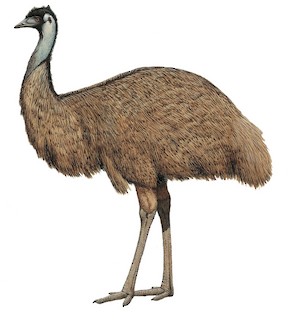
How to identify the Emu
Dromaius novaehollandiae
Spotted a bird? Identify it instantly with the Birdby app
Open the appTo correctly identify the Emu (Dromaius novaehollandiae), check each of these features. Birds can be tricky: habit, habitat, and call often confirm a sighting that a single photo cannot.
Size at a glance
- Length
- 150-190 cm (59-75 in)
- Wingspan
- Approximately 80-120 cm (31-47 in) (vestigial wings)
- Weight
- 18-60 kg (40-132 lb), typically 30-45 kg (66-99 lb)
Physical features to check
- 1
Plumage
Overall feather coloration and pattern.
Adult Emus have shaggy, coarse, brown to grey-brown plumage, which provides excellent camouflage in their varied habitats. The feathers are double-shafted, giving them a hair-like appearance. The head and neck are sparsely feathered, revealing bluish-black skin, particularly noticeable on the sides of the neck and around the eyes. Juveniles have distinctive longitudinal stripes.
- 2
Beak shape
Shape and color of the bill: a key field mark.
The beak is relatively short, broad, and flattened, adapted for grazing and browsing. It is dark grey to black.
- 3
Eye color
Iris color and any distinctive eye markings.
Eyes are typically brown, large, and prominent.
- 4
Leg color
Leg and foot color.
Legs are thick, powerful, and dark grey to black, ending in three forward-pointing toes with strong claws.
- 5
Distinguishing features
Standout features that separate this species.
Large size, flightless nature, long neck and legs, shaggy brown plumage, and the distinctive bluish-black skin on the head and neck. The vestigial wings are barely visible, covered by body feathers.
- 6
Juvenile appearance
How young birds differ from adults.
Chicks are cream-colored with distinctive dark brown longitudinal stripes along their bodies, which help them camouflage. These stripes fade as they mature, and they gradually develop adult plumage over several months.
- 7
Seasonal changes
Plumage variation between breeding and non-breeding seasons.
No significant seasonal plumage changes. The shaggy feathers provide insulation against both heat and cold.
- 8
Sexual dimorphism
How males and females differ.
Males and females are generally similar in appearance, though females tend to be slightly larger and heavier than males, especially during the breeding season. During courtship, females may exhibit a more prominent blue coloration on their heads and necks.
Key field marks
- Size and Stature. Look for a very large, flightless bird, standing up to 1.9 meters tall, with a long neck and powerful legs. Its sheer size is often the first clue.
- Plumage. Observe the shaggy, coarse, brown to grey-brown feathers that give it a somewhat disheveled appearance. The feathers are double-shafted.
- Head and Neck. Note the sparsely feathered head and neck, revealing bluish-black skin, especially on the sides. This is a key field mark.
- Legs and Feet. Identify the thick, dark, powerful legs with three forward-pointing toes, adapted for running.
- Gait and Movement. Watch for its distinctive long-striding, powerful run, capable of high speeds. They often move with a swaying motion of the head and neck.
- Vocalizations. Listen for the deep, resonant 'booming' or 'drumming' sounds, particularly from females, which can carry over long distances.
Explore the Emu
Identify birds anywhere
Free on iOS, Android, and Web. Photo & sound identification, full species database, and your personal life list.