
Spotted a bird? Identify it instantly with the Birdby app
Open the appAbout
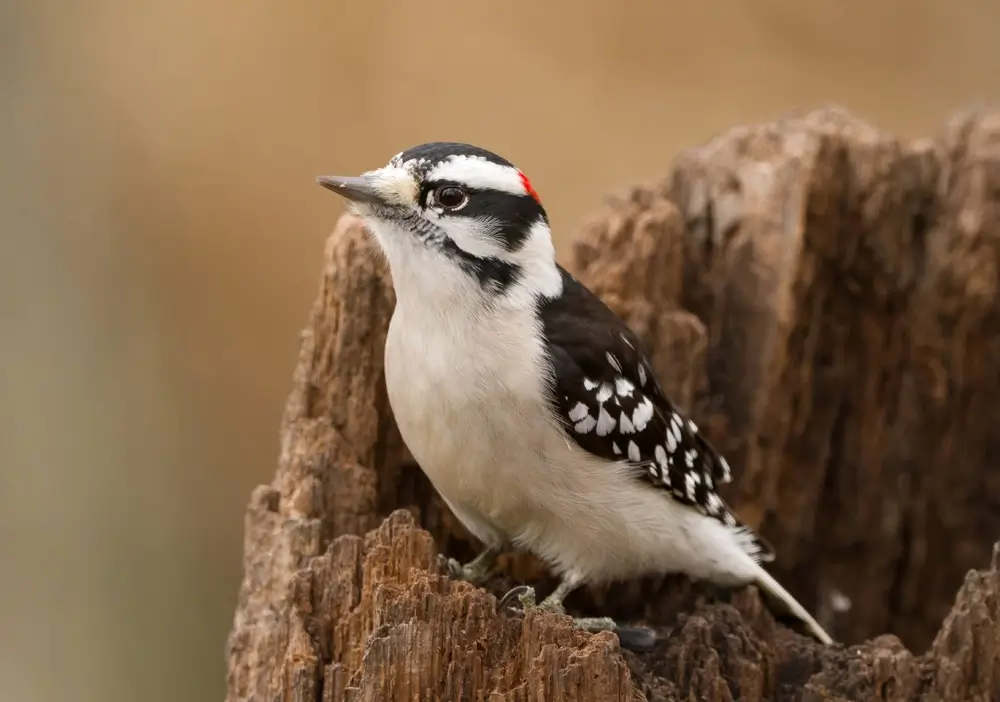
The Downy Woodpecker is the smallest and one of the most widespread woodpeckers in North America. It is a common and familiar backyard bird, known for its black and white plumage and active foraging behavior on trees and shrubs. Its small size and relatively short bill are key identification features.
Size & lifespan
- Length
- 14-18 cm (5.5-7.1 in)
- Wingspan
- 25-31 cm (9.8-12.2 in)
- Weight
- 20-33 g (0.7-1.2 oz)
- Lifespan
- Average 1-2 years in the wild, up to 11 years recorded
- Diet
- Insectivore, primarily consuming insects, larvae, and eggs found in or on trees, supplemented with berries, seeds, and sap.
Physical characteristics
- Plumage
- Predominantly black and white. White underparts, black wings with white barring, black back with a broad white stripe down the center. White superciliary and malar stripes on the head, separated by a black eye-stripe. Tail is black with white outer tail feathers, often barred with black.
- Beak shape
- Short, straight, chisel-like bill, dark gray to black.
- Eye color
- Dark brown.
- Leg color
- Dark gray to black.
- Distinguishing features
- Small size, short bill (relative to head size), and the broad white stripe down the back are key field marks. The white outer tail feathers often show black barring.
- Juvenile appearance
- Juveniles resemble adults but may have a pinkish-red wash or patch on the crown (top of the head), which can be present in both sexes. Their plumage may appear slightly duller or less sharply defined.
- Seasonal changes
- No significant seasonal plumage changes; plumage remains consistent year-round.
- Sexual dimorphism
- Males have a small red patch on the nape (back of the head), which is absent in females.
How to identify
- 1
Size and Bill Length
Look for a very small woodpecker (sparrow-sized) with a noticeably short, stubby bill relative to its head size. This is the primary distinction from the Hairy Woodpecker.
- 2
Plumage Pattern
Observe the black and white pattern: white underparts, black wings with white barring, a broad white stripe down the back, and white facial stripes. Males have a red patch on the nape.
- 3
Tail Feathers
Check the outer white tail feathers; Downy Woodpeckers often have black barring on these, whereas Hairy Woodpeckers typically have pure white outer tail feathers.
- 4
Foraging Behavior
Note its agility and preference for foraging on smaller branches, twigs, and even weed stalks, often hanging upside down. Its small size allows it to access these areas more easily than larger woodpeckers.
- 5
Vocalizations and Drumming
Listen for its soft 'pik' call and a short, descending rattle. Its drumming is a rapid, short burst, distinct from the longer, more powerful drumming of larger woodpeckers.
Habitat & range
- Biomes
- Forests, woodlands, suburban areas, parks, orchards, riparian zones.
- Geographic range
- Widespread across most of North America, from Alaska and Canada south through the United States, excluding arid southwestern deserts and parts of Florida.
- Elevation range
- Sea level up to approximately 2,700 meters (9,000 feet) in some western regions, but typically found at lower to mid-elevations.
- Preferred environments
- Deciduous and mixed forests, suburban gardens with mature trees, parks, and orchards. They prefer areas with a good mix of tree sizes, including smaller branches and shrubs where they can forage effectively.
Behavior
- Activity time
- Diurnal.
- Feeding habits
- Forages primarily on tree trunks, branches, and even small twigs and weed stalks. They glean insects from the surface, probe into crevices, and excavate small holes to extract larvae. Also visits suet feeders frequently, especially in winter. They often hang upside down to access food.
- Social behavior
- Generally solitary or found in pairs, especially during the breeding season. May join mixed-species foraging flocks in winter, particularly with chickadees and nuthatches.
- Flight pattern
- Undulating flight pattern, typical of woodpeckers, with several rapid wing beats followed by a short glide on closed wings.
- Migration pattern
- Mostly resident throughout its range, though some northern populations may make short-distance, altitudinal, or irruptive movements in winter, especially in response to food availability.
- Territoriality
- Defends a breeding territory during the nesting season. Territories are typically small and defended against other Downy Woodpeckers.
Song & calls
- Song
- Not a true songbird, but males produce a rapid series of 'pik' notes that can sound like a short, descending trill, often given during territorial displays or courtship.
- Call
- Common calls include a sharp 'pik' or 'chip' note, often repeated. They also have a rapid, rattling call, 'kik-kik-kik-kik-kik-kik', which can be given as an alarm or contact call. Drumming is a key form of communication, consisting of a rapid, short burst of taps on resonant surfaces.
- When they vocalize
- Vocalizes year-round, with increased calling and drumming activity during the breeding season (late winter through spring).
Breeding & reproduction
- Breeding season
- Typically April to July, with peak activity in May and June.
- Nesting habits
- Nests in cavities excavated in dead wood, often in snags or dead limbs of live trees. Both sexes participate in excavating the nest hole, which is usually 1.5-12 meters (5-40 feet) above the ground. The entrance hole is small, just large enough for the bird to enter.
- Clutch size
- 3-8 eggs, usually 4-5.
- Egg description
- 3-8 (typically 4-5) pure white, unmarked, glossy eggs. Approximately 19 x 14 mm (0.75 x 0.55 in).
- Incubation period
- 12 days, incubated by both parents.
- Fledging period
- 18-21 days after hatching, young leave the nest.
- Parental care
- Both parents incubate the eggs and feed the nestlings. Young are fed insects and larvae. After fledging, parents continue to feed the young for several weeks.
Where to find
Suburban Backyards and Parks
Common visitors to bird feeders, especially suet feeders, and can be found foraging on trees in residential areas.
Deciduous and Mixed Forests
Found throughout these habitats, particularly in areas with a mix of tree sizes and dead wood.
Orchards and Riparian Zones
Often present in areas with fruit trees and along watercourses where trees and shrubs are abundant.
Field tips
- Install a Suet Feeder. Downy Woodpeckers are frequent visitors to suet feeders, especially in winter, providing excellent viewing opportunities.
- Look on Smaller Branches. Unlike larger woodpeckers, Downies often forage on smaller branches and even weed stalks, so scan these areas carefully.
- Listen for Calls and Drumming. Their soft 'pik' call and short drumming bursts can help locate them, especially when they are hidden by foliage.
- Observe Mixed-Species Flocks. In winter, they often join foraging flocks with chickadees and nuthatches; look for them among these groups.
Similar species
Hairy Woodpecker
Dryobates villosus
The Hairy Woodpecker is almost identical in plumage pattern but is significantly larger (23-26 cm length) and has a much longer, stouter bill (about as long as its head). The outer white tail feathers of the Hairy Woodpecker are typically pure white, lacking the black barring often seen on the Downy Woodpecker. Their calls are also different: Hairy's 'peek' call is louder and sharper, and its rattle call is faster and less descending than the Downy's.
Quick facts
- Smallest North American Woodpecker:
- The Downy Woodpecker is the smallest woodpecker species found in North America.
- Common Feeder Visitor:
- It is a frequent and welcome guest at suet feeders, especially during colder months.
- Short Bill:
- Its relatively short bill is a key feature distinguishing it from the similar Hairy Woodpecker.
- Resident Species:
- Mostly non-migratory, remaining in its breeding range year-round.
Fun facts
- Downy Woodpeckers can often be seen foraging on corn stalks and other large weeds, demonstrating their adaptability to various substrates.
- Despite their small size, they are quite aggressive at feeders and will often chase away larger birds to get to the suet.
- The 'downy' in their name refers to the soft, down-like feathers on their back, which are less stiff than those of the Hairy Woodpecker.
- They are known to excavate roosting cavities in dead wood for shelter during cold nights, often creating a new one each year.
Scientific classification
- Kingdom
- Animalia
- Phylum
- Chordata
- Class
- Aves
- Order
- Piciformes
- Family
- Picidae
- Genus
- Dryobates
- Species
- Dryobates pubescens
Explore the Downy Woodpecker
Identify birds anywhere
Free on iOS, Android, and Web. Photo & sound identification, full species database, and your personal life list.