
How to identify the Downy Woodpecker
Dryobates pubescens
Spotted a bird? Identify it instantly with the Birdby app
Open the appTo correctly identify the Downy Woodpecker (Dryobates pubescens), check each of these features. Birds can be tricky: habit, habitat, and call often confirm a sighting that a single photo cannot.
Size at a glance
- Length
- 14-18 cm (5.5-7.1 in)
- Wingspan
- 25-31 cm (9.8-12.2 in)
- Weight
- 20-33 g (0.7-1.2 oz)
Physical features to check
- 1
Plumage
Overall feather coloration and pattern.
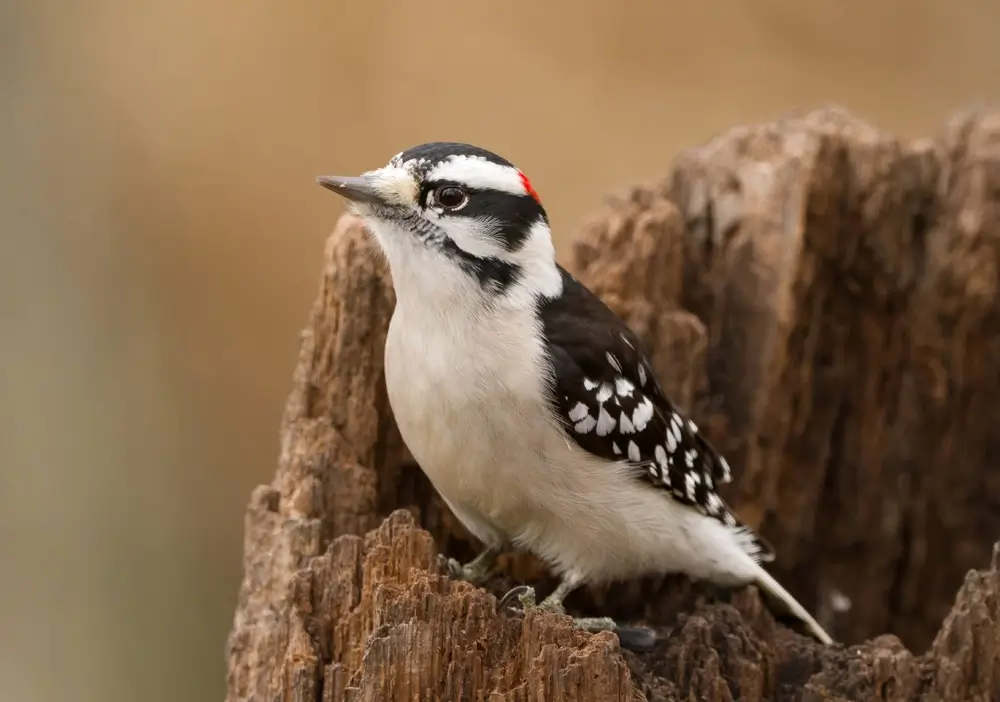
Predominantly black and white. White underparts, black wings with white barring, black back with a broad white stripe down the center. White superciliary and malar stripes on the head, separated by a black eye-stripe. Tail is black with white outer tail feathers, often barred with black.
- 2
Beak shape
Shape and color of the bill: a key field mark.
Short, straight, chisel-like bill, dark gray to black.
- 3
Eye color
Iris color and any distinctive eye markings.
Dark brown.
- 4
Leg color
Leg and foot color.
Dark gray to black.
- 5
Distinguishing features
Standout features that separate this species.
Small size, short bill (relative to head size), and the broad white stripe down the back are key field marks. The white outer tail feathers often show black barring.
- 6
Juvenile appearance
How young birds differ from adults.
Juveniles resemble adults but may have a pinkish-red wash or patch on the crown (top of the head), which can be present in both sexes. Their plumage may appear slightly duller or less sharply defined.
- 7
Seasonal changes
Plumage variation between breeding and non-breeding seasons.
No significant seasonal plumage changes; plumage remains consistent year-round.
- 8
Sexual dimorphism
How males and females differ.
Males have a small red patch on the nape (back of the head), which is absent in females.
Key field marks
- Size and Bill Length. Look for a very small woodpecker (sparrow-sized) with a noticeably short, stubby bill relative to its head size. This is the primary distinction from the Hairy Woodpecker.
- Plumage Pattern. Observe the black and white pattern: white underparts, black wings with white barring, a broad white stripe down the back, and white facial stripes. Males have a red patch on the nape.
- Tail Feathers. Check the outer white tail feathers; Downy Woodpeckers often have black barring on these, whereas Hairy Woodpeckers typically have pure white outer tail feathers.
- Foraging Behavior. Note its agility and preference for foraging on smaller branches, twigs, and even weed stalks, often hanging upside down. Its small size allows it to access these areas more easily than larger woodpeckers.
- Vocalizations and Drumming. Listen for its soft 'pik' call and a short, descending rattle. Its drumming is a rapid, short burst, distinct from the longer, more powerful drumming of larger woodpeckers.
Explore the Downy Woodpecker
Identify birds anywhere
Free on iOS, Android, and Web. Photo & sound identification, full species database, and your personal life list.