
Spotted a bird? Identify it instantly with the Birdby app
Open the appAbout
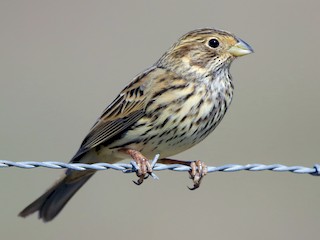
The Corn Bunting is a large, streaky brown passerine bird, often described as rather nondescript in appearance. It is known for its distinctive, jingling song, typically delivered from an elevated perch. Historically widespread across agricultural landscapes, its populations have declined significantly in many areas due to changes in farming practices.
Size & lifespan
- Length
- 16-19 cm
- Wingspan
- 26-32 cm
- Weight
- 38-56 g
- Lifespan
- Typically 2-3 years in the wild, with records up to 7 years.
- Diet
- Omnivore, primarily granivorous, especially outside the breeding season. During breeding, insects and other invertebrates form a significant part of the diet, particularly for feeding young.
Physical characteristics
- Plumage
- Overall dull, streaky brown plumage. Upperparts are heavily streaked dark brown on a paler brown or buff background. Underparts are whitish or pale buff, with prominent dark brown streaking on the breast and flanks. The rump is unstreaked or very faintly streaked. No obvious wing bars. The tail is plain brown, lacking the white outer tail feathers characteristic of many other buntings.
- Beak shape
- Conical, stout, and relatively large for a bunting, pale horn-coloured, sometimes with a darker culmen.
- Eye color
- Dark brown.
- Leg color
- Pinkish-brown to pale brown.
- Distinguishing features
- Large size for a bunting, heavy streaking all over (including the unstreaked rump), and a relatively large, stout bill. Lacks white in the tail, which is a key differentiator from many other Emberiza species. Often appears 'pot-bellied' in flight.
- Juvenile appearance
- Juveniles resemble adults but may have slightly more diffuse streaking and a generally softer, less defined appearance. They are often indistinguishable from adults after their post-juvenile moult.
- Seasonal changes
- No significant seasonal plumage changes. The plumage remains consistent throughout the year, though fresh plumage may appear slightly richer in colour before wear and fading.
- Sexual dimorphism
- Minimal to none. Males and females are virtually identical in plumage. Males tend to be slightly larger on average, but this is not discernible in the field.
How to identify
- 1
Size and Shape
Look for a large, rather bulky bunting, often appearing 'pot-bellied' in flight. It's larger than most other buntings and sparrows.
- 2
Plumage
Observe the overall dull, streaky brown plumage. Note the heavy streaking on both upperparts and underparts (breast and flanks). Crucially, look for the lack of white outer tail feathers and an unstreaked rump.
- 3
Bill
Identify the relatively large, stout, conical, pale horn-coloured bill, which is heavier than that of many other small passerines.
- 4
Song
Listen for the distinctive, metallic, jingling song, often described as 'a bunch of keys' or 'bicycle bell'. This is often the easiest way to identify a Corn Bunting, even when it's hidden in vegetation.
- 5
Perching Behavior
Look for birds perched conspicuously on elevated points in open country, such as fence posts, telegraph wires, tall weeds, or isolated bushes, from where they deliver their song.
- 6
Habitat
Consider the habitat: open agricultural land, cereal fields, and rough grasslands are prime locations for Corn Buntings.
Habitat & range
- Biomes
- Temperate grasslands, agricultural land, open scrubland.
- Geographic range
- Widespread across much of Europe (excluding Fennoscandia and parts of Russia), North Africa, and temperate Asia east to Kazakhstan. Absent from Ireland and declining in the UK.
- Elevation range
- Primarily lowlands, but can be found up to 1,000-1,500 meters in some parts of its range, particularly in southern Europe.
- Preferred environments
- Open, treeless or sparsely treed agricultural areas, especially cereal fields, fallow land, rough grassland, and pastures with scattered bushes or fences for perching. Avoids dense woodland and urban areas.
Behavior
- Activity time
- Diurnal.
- Feeding habits
- Forages primarily on the ground, gleaning seeds from stubble fields, cultivated land, and grassland. During the breeding season, it also catches insects and other invertebrates, often by short flights or by picking them from vegetation. Will feed on spilled grain.
- Social behavior
- Outside the breeding season, often forms loose flocks, sometimes mixed with other finches and buntings, especially when foraging in stubble fields. During the breeding season, males are territorial, often polygynous, defending a territory and attracting multiple females.
- Flight pattern
- Heavy, rather undulating flight with shallow wing beats. Often flies low over fields. When disturbed, it may fly a short distance and then drop back into cover or perch on a fence post.
- Migration pattern
- Mostly resident or short-distance migrant. Northern and eastern populations may move south and west for winter, while southern populations are largely sedentary. Movements are often irruptive and dependent on food availability.
- Territoriality
- Males are highly territorial during the breeding season, establishing and defending territories through song and display. They are often polygynous, with a single male mating with several females within his territory.
Song & calls
- Song
- A distinctive, rather monotonous, metallic, and jingling song, often likened to a bunch of keys being rattled or a bicycle bell. It's a rapid, repetitive series of short, sharp notes, often described as 'chip-chip-chip-chip-che-che-che-chichichichi'. Delivered from an exposed perch (e.g., fence post, bush top, telegraph wire).
- Call
- A short, sharp 'zit' or 'tsip' call, often given in flight or when disturbed. Also a harsher 'chick' or 'twick'.
- When they vocalize
- Males sing persistently from early spring (February/March) through to late summer (July/August), often throughout the day, especially in the morning and evening. Calls are given year-round.
Breeding & reproduction
- Breeding season
- Typically April to August, with two or sometimes three broods per season.
- Nesting habits
- The nest is built by the female, usually on or very close to the ground, well concealed within dense vegetation (e.g., tall grass, cereal crops, thistles). It is a cup-shaped structure made of grass, stems, and moss, lined with finer grasses and hair.
- Clutch size
- 3-5 eggs, most commonly 4.
- Egg description
- 3-5 eggs, typically whitish or pale greyish-blue, heavily marked with dark brown or purplish-black blotches, streaks, and scribbles, often concentrated at the broad end. Size: approximately 23 x 17 mm.
- Incubation period
- 11-14 days, primarily by the female.
- Fledging period
- 9-13 days. Young leave the nest before they can fly properly and are cared for by the female for a further period.
- Parental care
- Female primarily incubates and broods. Both parents feed the young, though the female does the majority of the work, especially if the male is polygynous and attending to other nests.
Where to find
Agricultural Fields
Look in cereal fields (wheat, barley, oats), especially those with wide margins or adjacent fallow land. Stubble fields after harvest are also good.
Rough Grassland
Areas of unmanaged or extensively managed grassland, often with scattered scrub or tall weeds, provide suitable nesting and foraging sites.
Hedgerows and Fences
Males frequently perch on the tops of hedgerows, fence posts, telegraph wires, or isolated bushes to sing and survey their territory.
Field tips
- Listen for the Song. The Corn Bunting's song is its most distinctive feature. Learn to recognize the 'jingling keys' sound, and you'll often hear them before you see them. They sing persistently, especially on warm, sunny days.
- Scan Elevated Perches. Once you hear the song, scan the highest available perches in the vicinity – fence posts, power lines, tall thistles, or the tops of bushes. Males are often very conspicuous when singing.
- Look for Movement in Fields. When not singing, they can be elusive, foraging on the ground. Look for movement in the lower parts of cereal crops or rough grass. They often fly up briefly when disturbed.
- Visit Early Morning or Late Afternoon. Vocalization is often most intense during the early morning and late afternoon/early evening, making these good times for detection.
Similar species
Yellowhammer
Emberiza citrinella
The Yellowhammer is smaller, has a distinctive bright yellow head and underparts (especially the male), and prominent white outer tail feathers, which the Corn Bunting lacks. Its song is also very different: 'a little bit of bread and no cheese'.
Reed Bunting
Emberiza schoeniclus
Reed Buntings are smaller, males have a black head and throat with a white moustachial stripe (females are streaky but lack the Corn Bunting's bulk and overall dullness). They also have white outer tail feathers and prefer wetter habitats.
Skylark
Alauda arvensis
Skylarks are similar in size and streaky brown plumage but have a crest, a much finer bill, and a very different, sustained, high-pitched warbling song delivered in hovering flight. They also lack the Corn Bunting's heavy streaking on the breast and flanks.
House Sparrow
Passer domesticus
House Sparrows are smaller, stockier, and have a more distinct plumage pattern (grey crown, chestnut nape in males). They lack the extensive streaking of the Corn Bunting and have a different bill shape and call.
Quick facts
- Key Identification Feature:
- Jingling song and overall streaky brown plumage without white outer tail feathers.
- Habitat Preference:
- Open agricultural land and rough grasslands.
- Diet:
- Seeds (especially cereals) and invertebrates.
- Social Structure:
- Polygynous males, often forming loose flocks outside breeding season.
- Conservation Concern:
- Significant declines in Western Europe due to agricultural intensification.
Fun facts
- The Corn Bunting is one of the few passerine species where polygyny (one male mating with multiple females) is common, with males often having up to seven mates.
- Its song has been described in various ways, from 'a bunch of keys' to 'a small boy learning to play the violin' or 'a bicycle bell'.
- Despite its rather plain appearance, its loud and persistent song makes it a characteristic sound of traditional European farmland.
- The species has undergone dramatic population declines in many parts of its range, particularly in the UK, where it has been lost from many areas, highlighting the impact of modern farming practices.
Scientific classification
- Kingdom
- Animalia
- Phylum
- Chordata
- Class
- Aves
- Order
- Passeriformes
- Family
- Emberizidae
- Genus
- Emberiza
- Species
- Emberiza calandra
Explore the Corn Bunting
Identify birds anywhere
Free on iOS, Android, and Web. Photo & sound identification, full species database, and your personal life list.