
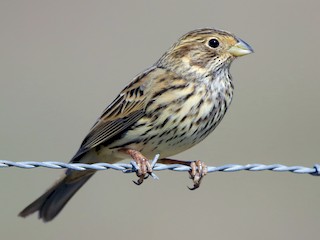
How to identify the Corn Bunting
Emberiza calandra
Spotted a bird? Identify it instantly with the Birdby app
Open the appTo correctly identify the Corn Bunting (Emberiza calandra), check each of these features. Birds can be tricky: habit, habitat, and call often confirm a sighting that a single photo cannot.
Size at a glance
- Length
- 16-19 cm
- Wingspan
- 26-32 cm
- Weight
- 38-56 g
Physical features to check
- 1
Plumage
Overall feather coloration and pattern.
Overall dull, streaky brown plumage. Upperparts are heavily streaked dark brown on a paler brown or buff background. Underparts are whitish or pale buff, with prominent dark brown streaking on the breast and flanks. The rump is unstreaked or very faintly streaked. No obvious wing bars. The tail is plain brown, lacking the white outer tail feathers characteristic of many other buntings.
- 2
Beak shape
Shape and color of the bill: a key field mark.
Conical, stout, and relatively large for a bunting, pale horn-coloured, sometimes with a darker culmen.
- 3
Eye color
Iris color and any distinctive eye markings.
Dark brown.
- 4
Leg color
Leg and foot color.
Pinkish-brown to pale brown.
- 5
Distinguishing features
Standout features that separate this species.
Large size for a bunting, heavy streaking all over (including the unstreaked rump), and a relatively large, stout bill. Lacks white in the tail, which is a key differentiator from many other Emberiza species. Often appears 'pot-bellied' in flight.
- 6
Juvenile appearance
How young birds differ from adults.
Juveniles resemble adults but may have slightly more diffuse streaking and a generally softer, less defined appearance. They are often indistinguishable from adults after their post-juvenile moult.
- 7
Seasonal changes
Plumage variation between breeding and non-breeding seasons.
No significant seasonal plumage changes. The plumage remains consistent throughout the year, though fresh plumage may appear slightly richer in colour before wear and fading.
- 8
Sexual dimorphism
How males and females differ.
Minimal to none. Males and females are virtually identical in plumage. Males tend to be slightly larger on average, but this is not discernible in the field.
Key field marks
- Size and Shape. Look for a large, rather bulky bunting, often appearing 'pot-bellied' in flight. It's larger than most other buntings and sparrows.
- Plumage. Observe the overall dull, streaky brown plumage. Note the heavy streaking on both upperparts and underparts (breast and flanks). Crucially, look for the lack of white outer tail feathers and an unstreaked rump.
- Bill. Identify the relatively large, stout, conical, pale horn-coloured bill, which is heavier than that of many other small passerines.
- Song. Listen for the distinctive, metallic, jingling song, often described as 'a bunch of keys' or 'bicycle bell'. This is often the easiest way to identify a Corn Bunting, even when it's hidden in vegetation.
- Perching Behavior. Look for birds perched conspicuously on elevated points in open country, such as fence posts, telegraph wires, tall weeds, or isolated bushes, from where they deliver their song.
- Habitat. Consider the habitat: open agricultural land, cereal fields, and rough grasslands are prime locations for Corn Buntings.
Explore the Corn Bunting
Identify birds anywhere
Free on iOS, Android, and Web. Photo & sound identification, full species database, and your personal life list.