
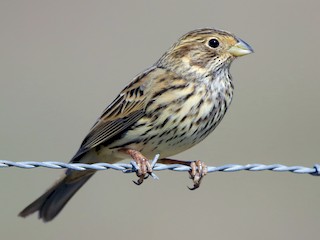
Where does the Corn Bunting live?
Emberiza calandra
Spotted a bird? Identify it instantly with the Birdby app
Open the appThe Corn Bunting lives in specific habitats and regions. Knowing where, and when, to look improves your chances of a successful sighting.
Biomes
Temperate grasslands, agricultural land, open scrubland.
Geographic range
Widespread across much of Europe (excluding Fennoscandia and parts of Russia), North Africa, and temperate Asia east to Kazakhstan. Absent from Ireland and declining in the UK.
Preferred environments
Open, treeless or sparsely treed agricultural areas, especially cereal fields, fallow land, rough grassland, and pastures with scattered bushes or fences for perching. Avoids dense woodland and urban areas.
Elevation range
Primarily lowlands, but can be found up to 1,000-1,500 meters in some parts of its range, particularly in southern Europe.
Where to look
Agricultural Fields
Look in cereal fields (wheat, barley, oats), especially those with wide margins or adjacent fallow land. Stubble fields after harvest are also good.
Rough Grassland
Areas of unmanaged or extensively managed grassland, often with scattered scrub or tall weeds, provide suitable nesting and foraging sites.
Hedgerows and Fences
Males frequently perch on the tops of hedgerows, fence posts, telegraph wires, or isolated bushes to sing and survey their territory.
Field tips
- Listen for the Song. The Corn Bunting's song is its most distinctive feature. Learn to recognize the 'jingling keys' sound, and you'll often hear them before you see them. They sing persistently, especially on warm, sunny days.
- Scan Elevated Perches. Once you hear the song, scan the highest available perches in the vicinity – fence posts, power lines, tall thistles, or the tops of bushes. Males are often very conspicuous when singing.
- Look for Movement in Fields. When not singing, they can be elusive, foraging on the ground. Look for movement in the lower parts of cereal crops or rough grass. They often fly up briefly when disturbed.
- Visit Early Morning or Late Afternoon. Vocalization is often most intense during the early morning and late afternoon/early evening, making these good times for detection.
Migration
Mostly resident or short-distance migrant. Northern and eastern populations may move south and west for winter, while southern populations are largely sedentary. Movements are often irruptive and dependent on food availability.
Explore the Corn Bunting
Identify birds anywhere
Free on iOS, Android, and Web. Photo & sound identification, full species database, and your personal life list.