
Spotted a bird? Identify it instantly with the Birdby app
Open the appAbout
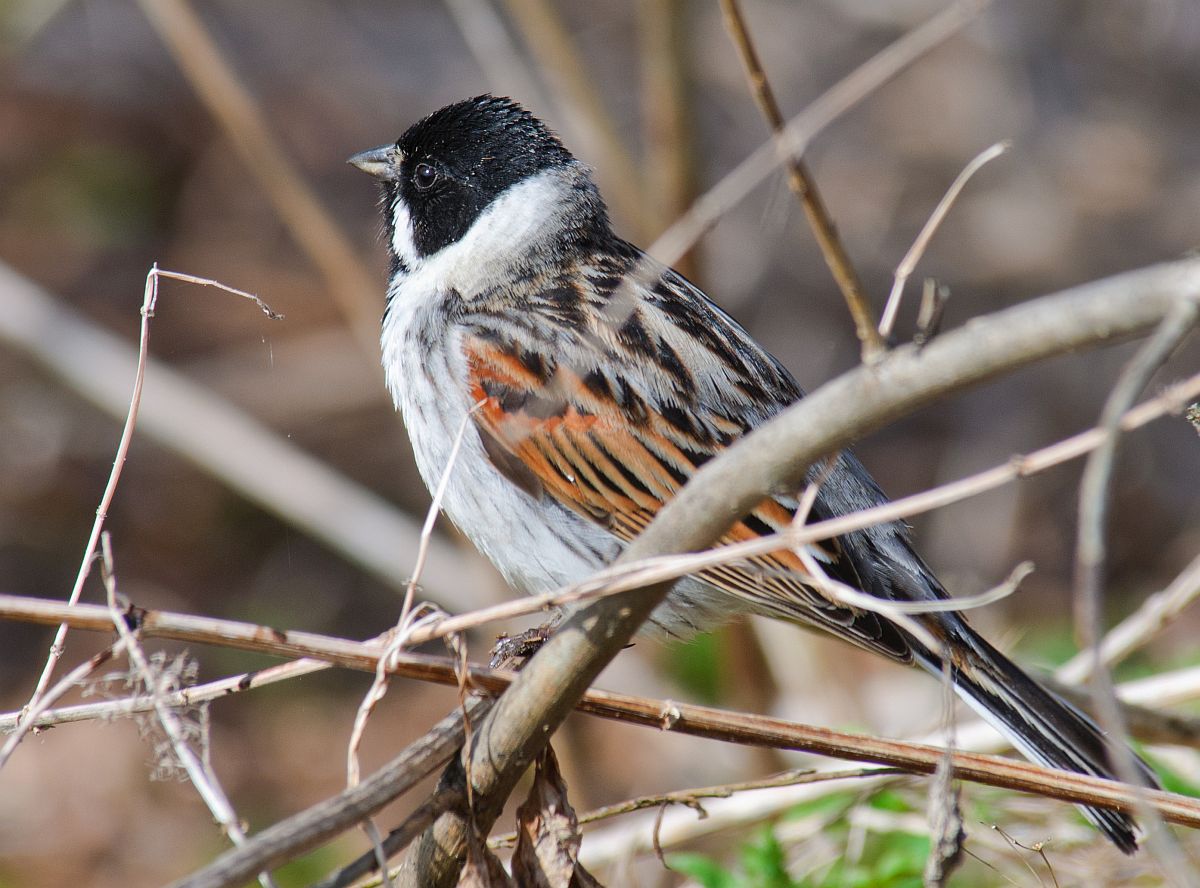
The Reed Bunting is a small passerine bird belonging to the bunting family Emberizidae. It is a common and widespread species found across much of Europe and Asia, typically inhabiting wetlands, reedbeds, and damp scrub. Known for its distinctive black head and throat in breeding males, it is a familiar sight in its preferred habitats.
Size & lifespan
- Length
- 13.5-16 cm
- Wingspan
- 21-27 cm
- Weight
- 13-23 g
- Lifespan
- 2-5 years (up to 9 years recorded)
- Diet
- Omnivore (primarily seeds in winter, insects in summer)
Physical characteristics
- Plumage
- Overall streaky brown plumage with a relatively long, notched tail. Males in breeding plumage are striking with a black head and throat, a white moustachial stripe, and a white collar. Females and non-breeding males are duller, with streaky brown heads and a buffy supercilium.
- Beak shape
- Conical, relatively small, dark grey to blackish.
- Eye color
- Dark brown.
- Leg color
- Pinkish-brown to dark brown.
- Distinguishing features
- Breeding male's black head, white collar, and white moustachial stripe are unmistakable. Females and non-breeding males show a streaky brown head with a pale supercilium and dark malar stripe, often with a faint dark spot on the ear coverts. The outer tail feathers are white, visible in flight.
- Juvenile appearance
- Juveniles are heavily streaked brown overall, resembling adult females but often with a more rufous tinge and less defined head patterns. They lack the distinct head markings of adult males and have a less contrasting plumage than adult females.
- Seasonal changes
- Males undergo a significant plumage change. In breeding season (spring/summer), they display a striking black head and throat with a white collar. In non-breeding season (autumn/winter), the black is largely obscured by pale feather fringes, making them appear much duller and more similar to females, though often still showing a darker cap and malar stripe.
- Sexual dimorphism
- Pronounced sexual dimorphism in breeding plumage. Males have a black head and throat, white collar, and white moustachial stripe. Females lack the black head, having a streaky brown head with a pale supercilium and dark malar stripe. In non-breeding plumage, males resemble females but retain some darker markings on the head.
How to identify
- 1
Breeding Male Head Pattern
Look for the unmistakable black head and throat, sharply contrasted by a clean white moustachial stripe and a broad white collar extending around the nape. This is the most reliable field mark for males in spring/summer.
- 2
Female/Non-breeding Male Head Pattern
Observe the streaky brown head with a pale supercilium (eyebrow stripe) and a dark malar stripe (from the gape down the side of the throat). There is often a faint dark spot on the ear coverts. The overall impression is of a 'messy' brown head compared to the clean patterns of the male.
- 3
Habitat
Always consider the habitat. Reed Buntings are almost exclusively found in wetlands, reedbeds, and damp scrub. If you see a bunting-like bird in such an environment, it's a strong indicator.
- 4
Tail
Note the relatively long, notched tail with white outer tail feathers, which are particularly noticeable in flight.
- 5
Song/Call
Listen for the simple, somewhat melancholic 'tsip, tsip, tsee-tsee-tsee' song or the sharp 'tzip' call. These vocalizations are distinctive and often given from a prominent perch.
Habitat & range
- Biomes
- Wetlands, marshes, fens, reedbeds, damp meadows, scrubland, riverbanks, ditches, and occasionally agricultural land.
- Geographic range
- Widespread across most of Europe and temperate Asia, from the Atlantic coast to the Pacific. Absent from Iceland and parts of southern Europe.
- Elevation range
- Typically found from sea level up to around 1,000 meters, occasionally higher in some mountainous regions.
- Preferred environments
- Dense vegetation near water, particularly reedbeds (Phragmites australis), sedges, and willow/alder scrub. Requires a mix of open water, dense cover for nesting, and emergent vegetation for foraging.
Behavior
- Activity time
- Diurnal.
- Feeding habits
- Forages on the ground or in low vegetation, picking seeds and insects. In winter, diet consists mainly of seeds from grasses, reeds, and other wetland plants. In summer, insects and other invertebrates (beetles, flies, caterpillars, spiders) form a significant part of the diet, especially when feeding young.
- Social behavior
- During the breeding season, they are territorial and typically seen in pairs. Outside the breeding season, they often form small to large flocks, sometimes mixed with other finches and buntings, especially when foraging for seeds.
- Flight pattern
- Undulating flight, typical of buntings, often low over vegetation. When disturbed, it will fly short distances before dropping back into cover.
- Migration pattern
- Northern and eastern populations are migratory, moving south and west for the winter. Southern and western populations are largely resident or undertake short-distance movements. Migrants typically arrive in breeding grounds from March to May and depart from September to November.
- Territoriality
- Males establish and defend breeding territories, primarily through song and display. Territories are typically centered around suitable nesting and foraging areas within wetland habitats.
Song & calls
- Song
- A simple, rather monotonous, and often melancholic song, typically described as 'tsip, tsip, tsee-tsee-tsee' or 'twick, twick, tsee-tsee-tsee'. It's often delivered from a prominent perch within the reedbed or scrub.
- Call
- Common calls include a sharp 'tzip' or 'tsick', often given in flight or when alarmed. A softer 'seep' contact call is also used.
- When they vocalize
- Males sing frequently during the breeding season, from early spring through summer, to attract mates and defend territory. Calls are given year-round.
Breeding & reproduction
- Breeding season
- April to August, typically two broods per season.
- Nesting habits
- Nest is built by the female, usually on or very close to the ground, well-hidden within dense vegetation such as reed tussocks, sedges, or thick grass. It is a cup-shaped structure made of grass, moss, and leaves, lined with finer materials like hair or reed flowers.
- Clutch size
- 3-6 eggs (typically 4-5).
- Egg description
- 3-6 eggs, typically 4-5. Pale greyish-white to pale blue, heavily streaked, spotted, and blotched with dark brown, black, or purplish markings, often concentrated at the broad end.
- Incubation period
- 11-14 days, primarily by the female.
- Fledging period
- 10-13 days after hatching. Young leave the nest before they can fly properly and are cared for by both parents for a further period.
- Parental care
- Both parents feed the nestlings and fledglings. The male may take over feeding the first brood while the female starts a second clutch.
Where to find
Reedbeds
The primary habitat, especially dense stands of common reed (Phragmites australis) along lakes, rivers, and marshes.
Wetlands and Marshes
Any area with standing water and emergent vegetation, including fens, bogs, and wet meadows.
Damp Scrub and Ditches
Areas with willow, alder, or other scrubby vegetation bordering water bodies or drainage ditches.
Coastal Lagoons and Estuaries
Where suitable reed or scrub habitat exists near brackish or freshwater.
Field tips
- Listen for the song. During the breeding season, males often sing from the tops of reeds or small bushes, making them easier to locate. Their song is distinctive, though not particularly loud.
- Scan reed edges. Reed Buntings often perch on the outer edges of reedbeds or on nearby low vegetation, especially in the morning and late afternoon.
- Look for movement in reeds. They can be quite skulking, moving through dense reeds. Look for subtle movements or rustling in the vegetation.
- Check feeding areas. In winter, look for flocks foraging for seeds on the ground in stubble fields or along the edges of wetlands.
- Be patient. Reed Buntings can be elusive. Patience and quiet observation in suitable habitat will increase your chances of a sighting.
Similar species
Common Bunting (Corn Bunting)
Emberiza calandra
Larger and stockier than the Reed Bunting, with a much thicker bill. Lacks the distinct head pattern of the breeding male Reed Bunting. Overall duller and more uniformly streaked brown, without white outer tail feathers. Song is a distinctive 'squeaky-gate' rattle.
Yellowhammer
Emberiza citrinella
Males are easily distinguished by their bright yellow head and underparts. Females are duller but still show yellow tinges and a more rufous rump. Found in more open, drier habitats. Song is a characteristic 'a little bit of bread and no cheese'.
Lapland Bunting (Lapland Longspur)
Calcarius lapponicus
Breeding male Lapland Bunting has a black head and throat, but also a chestnut nape and a different facial pattern (white stripe behind the eye, not a moustachial stripe). Found in Arctic tundra and high mountains. Non-breeding and female plumage is also distinct, lacking the Reed Bunting's specific head markings.
Quick facts
- Habitat:
- Wetlands, reedbeds, damp scrub
- Diet:
- Seeds (winter), Insects (summer)
- Male Breeding Plumage:
- Black head, white collar, white moustachial stripe
- Tail Feature:
- White outer tail feathers
- Conservation Status:
- Least Concern
Fun facts
- The Reed Bunting is one of the most widespread bunting species in Europe and Asia.
- Despite its name, it doesn't exclusively rely on reeds; it also uses sedges, rushes, and various damp scrub habitats.
- Males often sing from prominent perches, making them easier to spot in their dense habitats.
- Some northern populations undertake long migrations, traveling thousands of kilometers to their wintering grounds.
- The species shows significant variation across its range, with numerous recognized subspecies, though these are often subtle in appearance.
Scientific classification
- Kingdom
- Animalia
- Phylum
- Chordata
- Class
- Aves
- Order
- Passeriformes
- Family
- Emberizidae
- Genus
- Emberiza
- Species
- Emberiza schoeniclus
Explore the Reed Bunting
Identify birds anywhere
Free on iOS, Android, and Web. Photo & sound identification, full species database, and your personal life list.