
Spotted a bird? Identify it instantly with the Birdby app
Open the appAbout
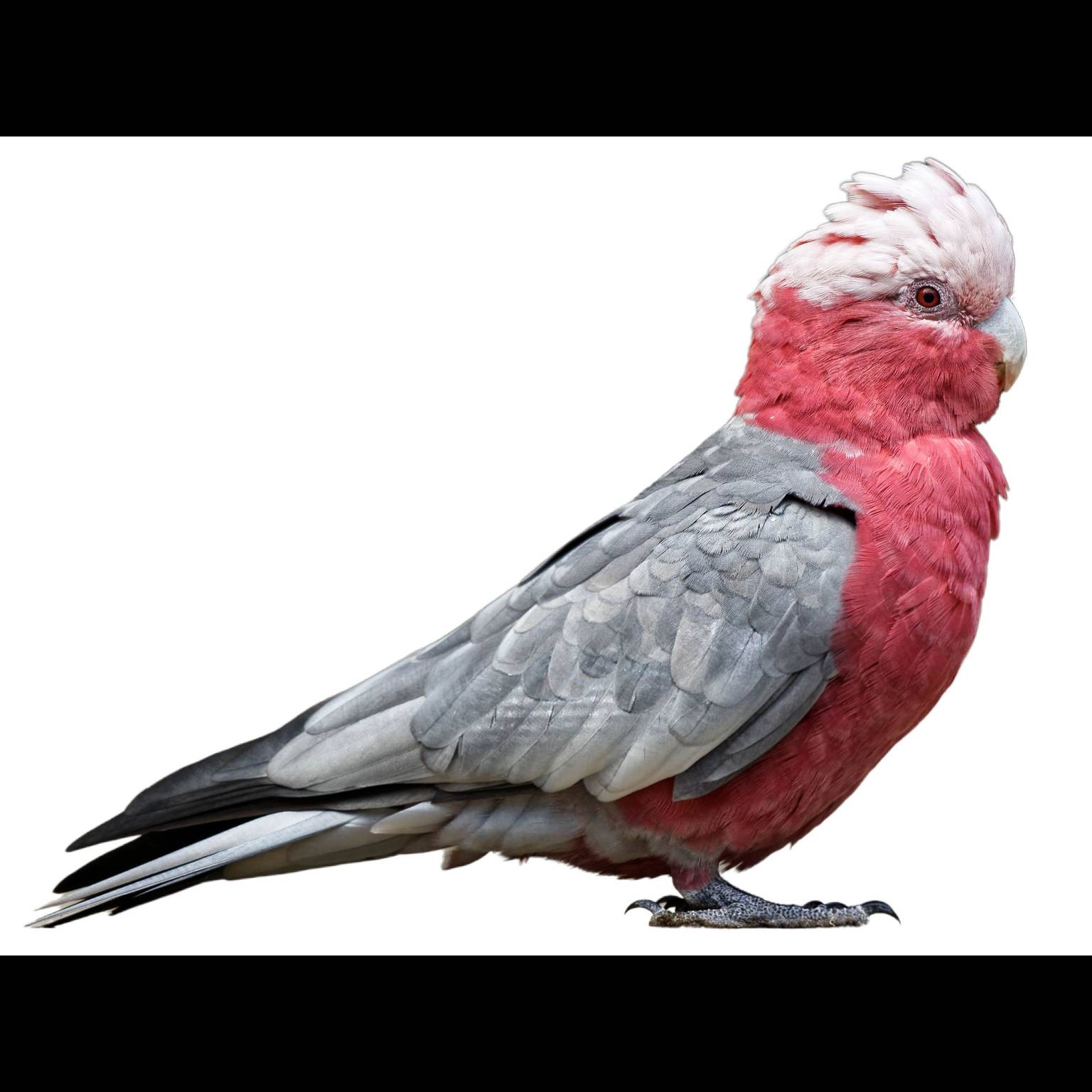
The Galah, also known as the Rose-breasted Cockatoo or Pink and Grey Cockatoo, is one of the most common and widespread cockatoos in Australia. It is a highly social and intelligent parrot, easily recognized by its distinctive pink and grey plumage and often seen in large, noisy flocks.
Size & lifespan
- Length
- 35-38 cm
- Wingspan
- 70-80 cm
- Weight
- 270-350 g
- Lifespan
- 20-30 years in the wild, up to 80 years in captivity
- Diet
- Herbivore (primarily granivore)
Physical characteristics
- Plumage
- Adults have a striking appearance with a rose-pink face, neck, and underparts, contrasting with a pale grey back, wings, and tail. The crest is short and pale pink to whitish. The rump is also pale grey. The underwing and undertail coverts are pink.
- Beak shape
- Pale grey to whitish, strongly hooked, typical of a cockatoo, adapted for cracking seeds.
- Eye color
- Males have dark brown (almost black) irises; females have reddish-brown irises. Juveniles have dark brown irises.
- Leg color
- Dark grey
- Distinguishing features
- The combination of rose-pink and pale grey plumage is unique among Australian cockatoos. The short, pale crest is also a key feature.
- Juvenile appearance
- Juveniles resemble adults but have duller plumage, particularly the pink areas, which are paler and less vibrant. Their irises are dark brown, regardless of sex, until they mature.
- Seasonal changes
- No significant seasonal plumage changes. Plumage remains consistent year-round.
- Sexual dimorphism
- Subtle, primarily in eye color: males have dark brown irises, while females have reddish-brown irises. Otherwise, plumage is identical.
How to identify
- 1
Plumage Coloration
Look for the unmistakable combination of rose-pink on the face, neck, and underparts, contrasting sharply with pale grey on the back, wings, and tail. This is the primary identification feature.
- 2
Crest
Observe the short, pale pink to whitish crest, which is often flattened but can be raised when excited. It is not as prominent or colorful as other cockatoos.
- 3
Eye Color (Sexing)
If close enough, note the iris color: dark brown for males, reddish-brown for females. This is the most reliable way to sex adult Galahs.
- 4
Flight and Behavior
Watch for their characteristic strong, undulating flight and their tendency to gather in large, noisy flocks, especially at dawn and dusk. They are often seen feeding on the ground.
- 5
Vocalizations
Listen for their loud, high-pitched 'chee-chee' or 'chur-r-r' calls, which are very distinctive and often heard before the birds are seen.
Habitat & range
- Biomes
- Open woodlands, grasslands, agricultural areas, urban parks, and suburban gardens. They thrive in modified landscapes.
- Geographic range
- Widespread across mainland Australia, including Tasmania, though less common in the driest deserts and dense forests. Introduced to some parts of New Zealand.
- Elevation range
- Sea level up to approximately 1,200 meters.
- Preferred environments
- Prefers open country with scattered trees for roosting and nesting, and abundant ground cover for foraging. Highly adaptable to human-modified environments.
Behavior
- Activity time
- Diurnal. Most active during early morning and late afternoon, spending midday resting in trees.
- Feeding habits
- Primarily ground feeders, consuming seeds of grasses, herbs, and agricultural crops (e.g., wheat, oats). They also eat roots, leaf buds, fruits, nuts, and occasionally insects and their larvae. They often feed in large flocks.
- Social behavior
- Highly gregarious, typically found in large flocks, sometimes numbering in the hundreds or even thousands, especially outside the breeding season. They form strong pair bonds and often mate for life. Flocks communicate constantly with loud calls.
- Flight pattern
- Strong, direct, and undulating flight with rapid wing beats. Often seen performing acrobatic displays, especially at dawn and dusk.
- Migration pattern
- Generally sedentary or locally nomadic, moving in response to food and water availability. They do not undertake long-distance migrations.
- Territoriality
- Pairs defend a small area around their nest hollow during the breeding season, but otherwise, they are not strongly territorial, especially when foraging in large flocks.
Song & calls
- Song
- Galahs do not have a complex song. Their vocalizations are primarily calls.
- Call
- A distinctive, high-pitched, screeching 'chee-chee' or 'chur-r-r' often repeated. They also produce harsh squawks, chattering, and softer contact calls within the flock. Calls are loud and carry over long distances.
- When they vocalize
- Most vocal at dawn and dusk when flying to and from roosting sites, and continuously while feeding or interacting in flocks.
Breeding & reproduction
- Breeding season
- Typically August to November in the south, and February to May in the north, varying with rainfall and food availability.
- Nesting habits
- Nests in tree hollows, usually high up in eucalypts, often near water. They line the hollow with eucalyptus leaves and bark. Both parents prepare the nest.
- Clutch size
- 2-5 eggs
- Egg description
- 2-5 (usually 3-4) white, oval eggs, measuring approximately 35 mm x 26 mm.
- Incubation period
- 23-25 days
- Fledging period
- 49-50 days after hatching. Young remain dependent on parents for several weeks after fledging.
- Parental care
- Both parents share incubation duties and care for the chicks. They feed the young regurgitated seeds and other food items.
Where to find
Urban Parks and Gardens
Galahs are highly adapted to human environments and are commonly found in parks, gardens, and golf courses across Australian cities and towns.
Agricultural Lands
Vast numbers can be seen in farmlands, particularly in grain-growing regions, where they feed on spilled seeds.
Open Woodlands and Grasslands
Their natural habitat, where scattered trees provide roosting and nesting sites, and open ground offers foraging opportunities.
Water Sources
They frequently visit dams, rivers, and other water bodies to drink, especially in drier areas.
Field tips
- Look for flocks. Galahs are rarely solitary. Scan the sky or open fields for large, noisy groups. Their pink and grey plumage is quite visible against green or brown landscapes.
- Listen for calls. Their loud, distinctive calls are often the first indication of their presence. Follow the sound to locate the flock.
- Observe feeding behavior. They are primarily ground feeders. Look for them foraging in open grassy areas, often alongside roadsides or in paddocks.
- Check roosting sites. At dawn and dusk, observe large trees, especially eucalypts, where Galahs gather in large numbers to roost.
- Visit waterholes. In arid regions, Galahs will congregate at water sources, particularly in the morning and late afternoon.
Similar species
Major Mitchell's Cockatoo
Lophochroa leadbeateri
Major Mitchell's Cockatoo has a much more prominent, multi-colored crest (red, yellow, white) and a brighter, deeper pink plumage. Its back and wings are white, not grey. It is also generally found in more arid regions.
Long-billed Corella
Cacatua tenuirostris
Long-billed Corellas are predominantly white with some pink on the face and throat, and a distinctive long upper mandible. They lack the extensive grey plumage of the Galah and have a different head shape and crest.
Quick facts
- Common Name:
- Galah
- Scientific Name:
- Eolophus roseicapilla
- Family:
- Cacatuidae (Cockatoos)
- Diet:
- Seeds, roots, leaves, fruits
- Habitat:
- Open woodlands, grasslands, agricultural and urban areas
- Conservation Status:
- Least Concern
- Distinctive Feature:
- Rose-pink and pale grey plumage
Fun facts
- The word 'galah' is also used in Australian slang to mean a foolish or silly person, reflecting the bird's sometimes clownish behavior.
- Galahs are highly intelligent and can be taught to mimic human speech and perform tricks in captivity.
- They often form mixed-species flocks with other cockatoos, such as Sulphur-crested Cockatoos and Little Corellas.
- Galahs are known for their acrobatic aerial displays, especially during courtship or when disturbed.
- Their population has increased significantly since European settlement due to land clearing for agriculture, which created more suitable habitat and food sources.
Scientific classification
- Kingdom
- Animalia
- Phylum
- Chordata
- Class
- Aves
- Order
- Psittaciformes
- Family
- Cacatuidae
- Genus
- Eolophus
- Species
- Eolophus roseicapilla
Explore the Galah
Identify birds anywhere
Free on iOS, Android, and Web. Photo & sound identification, full species database, and your personal life list.