
Spotted a bird? Identify it instantly with the Birdby app
Open the appAbout
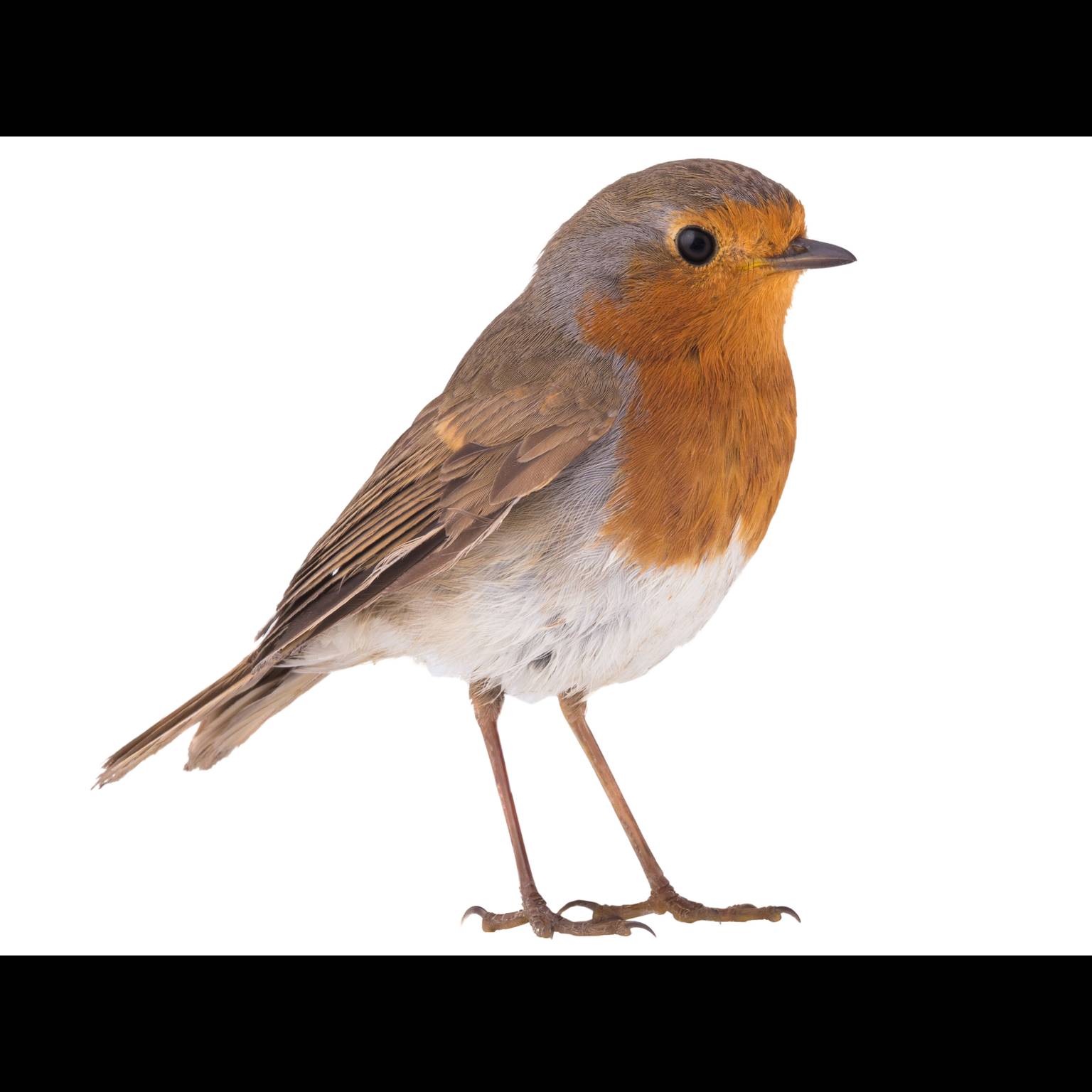
The European Robin is a small passerine bird, well-known for its distinctive orange-red breast and face, bordered by grey on the sides of the neck and chest. It is a familiar garden bird across much of Europe, often appearing bold and tame around humans. Both sexes are similar in plumage. It is insectivorous, feeding primarily on invertebrates, but also consumes fruits and seeds, especially in winter. Robins are highly territorial, with both males and females defending their territories vigorously.
Size & lifespan
- Length
- 12.5-14 cm
- Wingspan
- 20-22 cm
- Weight
- 16-22 g
- Lifespan
- 1-2 years (up to 11 years recorded in the wild)
- Diet
- Omnivore (primarily insectivore)
Physical characteristics
- Plumage
- Adults have a bright orange-red breast and face, extending from the forehead down to the upper breast, bordered by a grey band on the sides of the neck and chest. The upperparts are olive-brown, and the belly is whitish. The wings and tail are dark brown. The rump is olive-brown.
- Beak shape
- Small, slender, pointed, dark brown to black.
- Eye color
- Dark brown.
- Leg color
- Pale brown to pinkish-brown.
- Distinguishing features
- The most striking feature is the vivid orange-red breast and face. Its upright posture and frequent tail-cocking are also characteristic.
- Juvenile appearance
- Juveniles are entirely mottled brown with dark spots and streaks, lacking the orange-red breast. They gradually acquire the adult plumage after their first post-juvenile moult, typically by late summer or early autumn.
- Seasonal changes
- No significant seasonal plumage changes in adults. The orange-red breast remains year-round. Plumage may appear slightly duller when worn before moulting.
- Sexual dimorphism
- None; males and females are virtually identical in plumage. Males may be slightly larger on average, but this is not discernible in the field.
How to identify
- 1
Orange-red breast and face
This is the most unmistakable feature. Look for the bright orange-red extending from the forehead, around the eyes, and down to the upper breast, sharply delineated by grey on the sides.
- 2
Upperparts color
Note the plain olive-brown back, wings, and tail, contrasting with the bright underparts.
- 3
Posture and movement
Robins often sit upright, frequently cocking their tail. They move with quick hops on the ground, often pausing to listen for prey.
- 4
Song and calls
Learn its distinctive melancholic, warbling song and its sharp 'tic-tic-tic' alarm call. These are often heard before the bird is seen.
- 5
Juvenile plumage
Remember that juveniles are mottled brown and lack the red breast. If you see a small, brown, speckled bird with robin-like behavior, it might be a young robin.
Habitat & range
- Biomes
- Forests, woodlands, parks, gardens, hedgerows, scrubland, urban areas.
- Geographic range
- Widespread across Europe, extending east to Western Siberia and south to North Africa and the Azores. Absent from Iceland.
- Elevation range
- Sea level up to 2,000 meters, occasionally higher in mountainous regions.
- Preferred environments
- Prefers areas with dense undergrowth for nesting and foraging, often close to human habitation. Found in deciduous and coniferous woodlands, parks, large gardens, and cemeteries. Requires leaf litter for foraging.
Behavior
- Activity time
- Diurnal. Known to sing and forage in low light conditions, sometimes even at night under artificial light.
- Feeding habits
- Primarily insectivorous, feeding on insects (beetles, ants, flies), spiders, and worms. Also consumes berries, fruits, and seeds, especially in autumn and winter. Often forages on the ground, hopping and running, frequently cocking its tail. Known to follow large animals or humans to catch disturbed invertebrates. Will visit bird tables for seeds and fat.
- Social behavior
- Highly territorial, especially during the breeding season. Males and females defend separate territories in winter, though pairs may form earlier in some areas. Can be aggressive towards other robins. Generally solitary outside the breeding season.
- Flight pattern
- Short, undulating flights between perches, often low to the ground. Agile and direct over short distances.
- Migration pattern
- Partially migratory. Northern and eastern populations are largely migratory, moving south and west for winter. Western and southern European populations are mostly resident, though some individuals may undertake short-distance movements. Migrants typically move at night.
- Territoriality
- Extremely territorial. Both sexes defend territories year-round, often with aggressive displays and song. Fights can be fierce and sometimes fatal.
Song & calls
- Song
- A beautiful, warbling, liquid song, often described as melancholic or wistful. It consists of a series of high-pitched, clear, tinkling notes, often starting with a few hesitant notes before flowing into a more complex, varied melody. Sung from a prominent perch.
- Call
- Common calls include a sharp, ticking 'tic-tic-tic' or 'tsip', often given when alarmed or agitated. Also a thin, high-pitched 'seee' call.
- When they vocalize
- Sings throughout the year, though most intensely from late winter through summer. Known for singing in the evening and early morning, and sometimes at night, especially under streetlights.
Breeding & reproduction
- Breeding season
- Typically March to August, with two or three broods common.
- Nesting habits
- Nests are usually built close to the ground, often in banks, hollows, tree stumps, ivy, or even in man-made objects like sheds, flowerpots, or discarded kettles. The nest is a cup-shaped structure made of moss, leaves, and grass, lined with fine roots, hair, and feathers.
- Clutch size
- 4-6 eggs (typically 5)
- Egg description
- 4-6 eggs, smooth, glossy, white or pale buff, often finely speckled with reddish-brown, particularly at the broader end. Approximately 20 x 15 mm.
- Incubation period
- 13-14 days, primarily by the female.
- Fledging period
- 12-15 days after hatching. Young are fed by both parents.
- Parental care
- Both parents feed the nestlings and fledglings. The female often starts incubating the second clutch while the male continues to feed the first brood.
Where to find
Gardens and Parks
One of the most common garden birds across its range, often seen near bird feeders or foraging on lawns and flowerbeds.
Woodlands and Forests
Found in both deciduous and coniferous woodlands, particularly in areas with dense undergrowth and leaf litter.
Hedgerows and Scrubland
Good places to find robins, as they provide cover and foraging opportunities.
Cemeteries and Urban Green Spaces
Often thrive in these environments due to a mix of trees, shrubs, and open ground, and reduced disturbance.
Field tips
- Listen for their song. Their distinctive song is often the first indication of their presence, especially in dense vegetation. They sing year-round.
- Look for movement on the ground. Robins spend a lot of time foraging on the ground, hopping and pausing. Look for small, quick movements in leaf litter or on lawns.
- Check bird feeders. They are frequent visitors to bird tables, especially in winter, where they will eat seeds, mealworms, and fat products.
- Be patient and still. Robins are often quite tame and curious. If you remain still, they may approach quite closely, especially if you are digging or disturbing the ground.
- Look in shaded areas. They often prefer shaded, damp areas with plenty of cover, which provide good foraging for invertebrates.
Similar species
Rufous-tailed Robin
Luscinia sibilans
The Rufous-tailed Robin has a more uniform brown plumage, lacking the distinct orange-red breast. It has a prominent pale eye-ring and a rufous tail, which is often flicked. Its range is primarily East Asian.
American Robin
Turdus migratorius
Despite the similar common name, the American Robin is a much larger thrush with a brick-red breast, grey upperparts, and a dark head. It lacks the distinct grey border of the European Robin's breast and is found only in North America.
Japanese Robin
Larvivora akahige
The Japanese Robin has a similar orange-red breast but is generally darker overall, with a more extensive blackish face and throat in males. Its range is restricted to East Asia.
Quick facts
- Iconic Status:
- Often considered the national bird of the UK.
- Territoriality:
- Highly territorial, even outside the breeding season, with both sexes defending territories.
- Winter Singing:
- One of the few birds that sings regularly throughout the winter months.
- Dietary Flexibility:
- Primarily insectivorous but adapts to eat berries and seeds in colder months.
- Boldness:
- Known for its tameness and willingness to approach humans, especially when gardening.
Fun facts
- The European Robin was voted the national bird of the United Kingdom in 1960.
- During the Victorian era, postmen in Britain were nicknamed 'Robins' due to their red uniforms, which may have contributed to the bird's association with Christmas cards.
- Robins have excellent low-light vision, allowing them to forage and sing at dawn and dusk, and even at night under artificial light.
- Studies have shown that European Robins use the Earth's magnetic field for navigation during migration, and their red breast feathers may play a role in this 'magnetic sense'.
- Despite their cute appearance, robins are fiercely territorial and will fight to the death to defend their patch against rivals.
Scientific classification
- Kingdom
- Animalia
- Phylum
- Chordata
- Class
- Aves
- Order
- Passeriformes
- Family
- Muscicapidae
- Genus
- Erithacus
- Species
- Erithacus rubecula
Explore the European Robin
Identify birds anywhere
Free on iOS, Android, and Web. Photo & sound identification, full species database, and your personal life list.