
Spotted a bird? Identify it instantly with the Birdby app
Open the appAbout
The Common Waxbill is a small, gregarious passerine bird native to sub-Saharan Africa, widely introduced to various parts of the world. It is characterized by its slender build, fine bill, and distinctive red facial mask and belly patch. Known for its lively behavior and soft, high-pitched calls, it often forms large flocks outside the breeding season.
Size & lifespan
- Length
- 11-13 cm
- Wingspan
- 12-14 cm
- Weight
- 7-12 g
- Lifespan
- 3-5 years in the wild, up to 7 years in captivity
- Diet
- Granivore, primarily feeding on small grass seeds, supplemented with insects during breeding season.
Physical characteristics
- Plumage
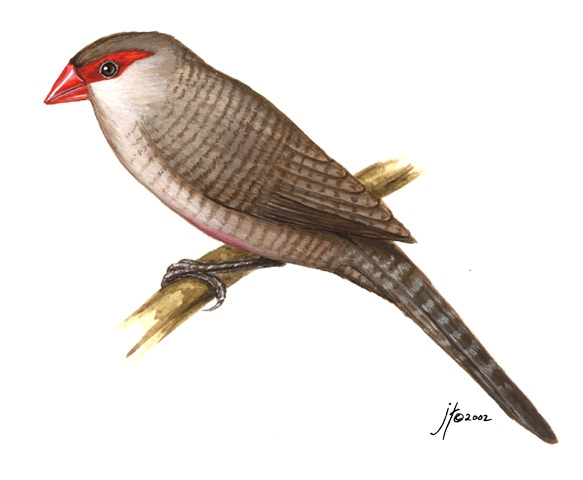
- Upperparts are finely barred grey-brown, with a reddish-brown rump. Underparts are buffy-grey with fine barring on the flanks, and a prominent crimson-red patch on the belly. The wings are short and rounded, and the tail is relatively long and pointed. The overall impression is of a finely barred, delicate bird.
- Beak shape
- Small, conical, and pointed. Bright red to reddish-orange in color.
- Eye color
- Dark brown, surrounded by a distinctive bright red mask that extends from the lores through the eye.
- Leg color
- Dark grey to blackish.
- Distinguishing features
- The most striking features are the bright red facial mask and the crimson-red belly patch. The finely barred plumage on the back and flanks is also characteristic. Its small size and active, twitching tail are good field marks.
- Juvenile appearance
- Juveniles are duller overall, lacking the bright red facial mask and belly patch. Their bill is dark, often blackish, and their plumage is more uniformly grey-brown with less distinct barring. The red coloration develops gradually as they mature.
- Seasonal changes
- No significant seasonal plumage changes. The plumage remains consistent throughout the year.
- Sexual dimorphism
- Males and females are very similar in plumage, making them difficult to distinguish visually in the field. Males may have slightly brighter red coloration on the mask and belly, and sometimes more extensive barring, but these differences are subtle and not reliable for identification.
How to identify
- 1
Size and Shape
Look for a very small, slender bird with a relatively long, pointed tail and a fine, conical bill.
- 2
Facial Markings
The most distinctive feature is the bright crimson-red mask extending through the eye. This is present in both sexes.
- 3
Belly Patch
Observe the prominent crimson-red patch on the lower belly, which contrasts with the buffy-grey underparts.
- 4
Plumage Pattern
Note the finely barred grey-brown upperparts and flanks. This 'scaly' appearance is characteristic.
- 5
Bill Color
The bill is bright red to reddish-orange in adults.
- 6
Behavior
Look for active, gregarious birds foraging on the ground or clinging to grass stems, often in flocks. Their undulating flight is also a good clue.
- 7
Vocalizations
Listen for the high-pitched 'tseet' contact call and soft, rambling song.
Habitat & range
- Biomes
- Grasslands, savannas, wetlands, agricultural areas, suburban gardens, and coastal scrub.
- Geographic range
- Native to sub-Saharan Africa, from Senegal east to Ethiopia and south to South Africa. Introduced populations are found in various regions worldwide, including Portugal, Spain, Brazil, Bermuda, St. Helena, Ascension Island, Hawaii, and Reunion Island.
- Elevation range
- Sea level up to 2,000 meters, occasionally higher.
- Preferred environments
- Prefers open grassy areas, especially near water sources, reedbeds, marshes, and areas with tall grasses and scattered bushes. It adapts well to human-modified landscapes like cultivated fields and gardens.
Behavior
- Activity time
- Diurnal, most active during the morning and late afternoon.
- Feeding habits
- Primarily ground feeders, foraging for small grass seeds. They often cling to grass stems to extract seeds directly. During the breeding season, they supplement their diet with small insects, such as termites and aphids, particularly when feeding young. They drink frequently.
- Social behavior
- Highly gregarious, especially outside the breeding season, forming large flocks that can number in the hundreds. They roost communally in dense vegetation. During breeding, they become more territorial but still often nest in loose colonies.
- Flight pattern
- Flight is typically undulating and rapid, often in tight flocks. They have a characteristic 'bouncing' flight pattern over short distances.
- Migration pattern
- Generally resident throughout their range, though some local or nomadic movements may occur in response to food availability or environmental conditions. Introduced populations are also resident.
- Territoriality
- During the breeding season, pairs establish small territories around their nest site, which they defend against rivals. Outside of breeding, they are less territorial and highly social.
Song & calls
- Song
- The song is a soft, rambling series of high-pitched trills, whistles, and buzzing notes, often delivered from a perch within dense vegetation. It is not particularly musical or complex.
- Call
- Common calls include a distinctive, high-pitched 'tseet' or 'tsip' contact call, often given in flight or when foraging. They also emit soft 'churr' or 'chick' notes when agitated or in social interactions.
- When they vocalize
- Vocalizes throughout the day, especially when foraging in flocks or during breeding displays. Calls are most frequent when birds are in contact with each other.
Breeding & reproduction
- Breeding season
- Varies geographically, typically coinciding with the rainy season when food (seeds and insects) is abundant. In southern Africa, it's usually from September to May; in West Africa, it's during the wet season (e.g., July-October).
- Nesting habits
- Nests are typically spherical or pear-shaped structures with a side entrance, built from grass stems, leaves, and other plant material. They are often placed low down in dense grass, reeds, or thorny bushes, sometimes near human habitation. A 'cock's nest' or false nest may be built on top of the actual nest, possibly to deter predators.
- Clutch size
- 4-7 eggs, typically 5-6.
- Egg description
- Eggs are small, oval, and pure white. They are smooth and non-glossy.
- Incubation period
- 11-13 days, primarily by the female, but both parents participate.
- Fledging period
- 17-21 days after hatching. Young are fed by both parents.
- Parental care
- Both male and female participate in nest building, incubation, and feeding of the chicks. The young are dependent on parents for a short period after fledging.
Where to find
Grasslands and Savannas
Look in open grassy areas, especially those with tall grasses and scattered bushes, which provide both food and cover.
Wetlands and Reedbeds
They are frequently found near water, in marshes, reedbeds, and along the edges of rivers and lakes.
Agricultural Areas
Cultivated fields, especially those with cereal crops or weedy margins, are good places to find them.
Suburban Gardens and Parks
In areas where they have been introduced, they readily adapt to gardens, parks, and other urban green spaces, particularly if there are seed-bearing plants.
Field tips
- Look for movement in grass. Common Waxbills are small and often hidden in dense vegetation. Scan grassy areas for subtle movements or the swaying of grass stems as they forage.
- Listen for calls. Their high-pitched 'tseet' calls are often the first indication of their presence, especially when they are in flocks.
- Observe near water. They frequently visit water sources to drink, so checking ponds, streams, or bird baths can be productive.
- Look for flocks. Outside the breeding season, they are almost always found in flocks, sometimes mixed with other small finches or waxbills. Look for groups rather than solitary individuals.
- Be patient. Their small size and tendency to hide in dense cover require patience. Sit quietly and observe an area with suitable habitat.
Similar species
Orange-cheeked Waxbill
Estrilda melpoda
The Orange-cheeked Waxbill has distinct orange patches on its cheeks and lacks the red belly patch of the Common Waxbill. Its bill is also red, but the overall plumage is less barred.
Fawn-breasted Waxbill
Estrilda paludicola
The Fawn-breasted Waxbill has a paler, fawn-colored breast and lacks the prominent red belly patch. It also has a red bill and a red stripe through the eye, but the barring on the flanks is less distinct than in the Common Waxbill.
Black-rumped Waxbill
Estrilda troglodytes
The Black-rumped Waxbill is smaller and has a black rump (as its name suggests), contrasting with the reddish-brown rump of the Common Waxbill. It also has a red stripe through the eye but lacks the red belly patch.
Quick facts
- Common Name:
- Common Waxbill
- Scientific Name:
- Estrilda astrild
- Family:
- Estrildidae (Estrildid Finches)
- Size:
- Small (11-13 cm)
- Diet:
- Seeds, small insects
- Habitat:
- Grasslands, wetlands, cultivated areas
- Conservation Status:
- Least Concern
- Key ID Feature:
- Red facial mask and belly patch
Fun facts
- The Common Waxbill is one of the most widely introduced bird species globally, establishing populations on several continents.
- Despite its small size, it is known for its resilience and adaptability to various habitats, including urban environments.
- The 'cock's nest' built above the actual nest is a unique architectural feature, believed to deter predators or parasitic cuckoos.
- They are popular cage birds due to their attractive appearance and lively nature, which has contributed to their global spread.
- Their diet of small grass seeds makes them important dispersers of these seeds, influencing plant communities.
Scientific classification
- Kingdom
- Animalia
- Phylum
- Chordata
- Class
- Aves
- Order
- Passeriformes
- Family
- Estrildidae
- Genus
- Estrilda
- Species
- Estrilda astrild
Explore the Common Waxbill
Identify birds anywhere
Free on iOS, Android, and Web. Photo & sound identification, full species database, and your personal life list.