
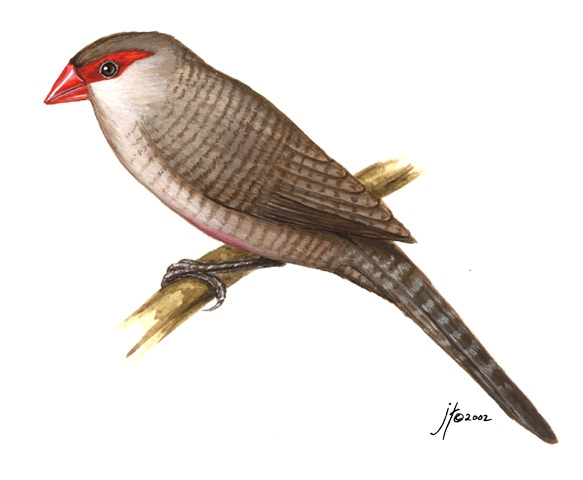
Where does the Common Waxbill live?
Estrilda astrild
Spotted a bird? Identify it instantly with the Birdby app
Open the appThe Common Waxbill lives in specific habitats and regions. Knowing where, and when, to look improves your chances of a successful sighting.
Biomes
Grasslands, savannas, wetlands, agricultural areas, suburban gardens, and coastal scrub.
Geographic range
Native to sub-Saharan Africa, from Senegal east to Ethiopia and south to South Africa. Introduced populations are found in various regions worldwide, including Portugal, Spain, Brazil, Bermuda, St. Helena, Ascension Island, Hawaii, and Reunion Island.
Preferred environments
Prefers open grassy areas, especially near water sources, reedbeds, marshes, and areas with tall grasses and scattered bushes. It adapts well to human-modified landscapes like cultivated fields and gardens.
Elevation range
Sea level up to 2,000 meters, occasionally higher.
Where to look
Grasslands and Savannas
Look in open grassy areas, especially those with tall grasses and scattered bushes, which provide both food and cover.
Wetlands and Reedbeds
They are frequently found near water, in marshes, reedbeds, and along the edges of rivers and lakes.
Agricultural Areas
Cultivated fields, especially those with cereal crops or weedy margins, are good places to find them.
Suburban Gardens and Parks
In areas where they have been introduced, they readily adapt to gardens, parks, and other urban green spaces, particularly if there are seed-bearing plants.
Field tips
- Look for movement in grass. Common Waxbills are small and often hidden in dense vegetation. Scan grassy areas for subtle movements or the swaying of grass stems as they forage.
- Listen for calls. Their high-pitched 'tseet' calls are often the first indication of their presence, especially when they are in flocks.
- Observe near water. They frequently visit water sources to drink, so checking ponds, streams, or bird baths can be productive.
- Look for flocks. Outside the breeding season, they are almost always found in flocks, sometimes mixed with other small finches or waxbills. Look for groups rather than solitary individuals.
- Be patient. Their small size and tendency to hide in dense cover require patience. Sit quietly and observe an area with suitable habitat.
Migration
Generally resident throughout their range, though some local or nomadic movements may occur in response to food availability or environmental conditions. Introduced populations are also resident.
Explore the Common Waxbill
Identify birds anywhere
Free on iOS, Android, and Web. Photo & sound identification, full species database, and your personal life list.