
How to identify the Common Waxbill
Estrilda astrild
Spotted a bird? Identify it instantly with the Birdby app
Open the appTo correctly identify the Common Waxbill (Estrilda astrild), check each of these features. Birds can be tricky: habit, habitat, and call often confirm a sighting that a single photo cannot.
Size at a glance
- Length
- 11-13 cm
- Wingspan
- 12-14 cm
- Weight
- 7-12 g
Physical features to check
- 1
Plumage
Overall feather coloration and pattern.
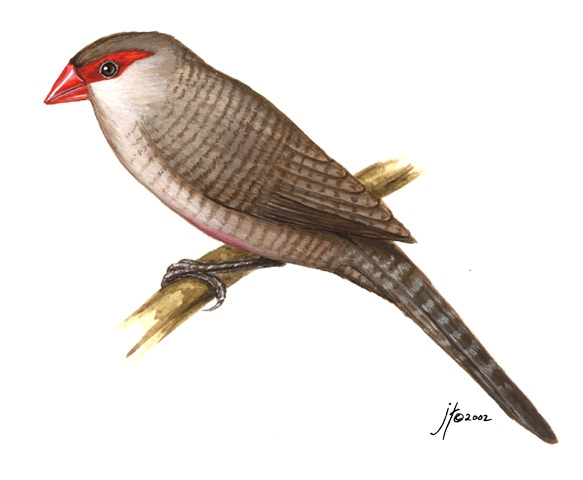
Upperparts are finely barred grey-brown, with a reddish-brown rump. Underparts are buffy-grey with fine barring on the flanks, and a prominent crimson-red patch on the belly. The wings are short and rounded, and the tail is relatively long and pointed. The overall impression is of a finely barred, delicate bird.
- 2
Beak shape
Shape and color of the bill: a key field mark.
Small, conical, and pointed. Bright red to reddish-orange in color.
- 3
Eye color
Iris color and any distinctive eye markings.
Dark brown, surrounded by a distinctive bright red mask that extends from the lores through the eye.
- 4
Leg color
Leg and foot color.
Dark grey to blackish.
- 5
Distinguishing features
Standout features that separate this species.
The most striking features are the bright red facial mask and the crimson-red belly patch. The finely barred plumage on the back and flanks is also characteristic. Its small size and active, twitching tail are good field marks.
- 6
Juvenile appearance
How young birds differ from adults.
Juveniles are duller overall, lacking the bright red facial mask and belly patch. Their bill is dark, often blackish, and their plumage is more uniformly grey-brown with less distinct barring. The red coloration develops gradually as they mature.
- 7
Seasonal changes
Plumage variation between breeding and non-breeding seasons.
No significant seasonal plumage changes. The plumage remains consistent throughout the year.
- 8
Sexual dimorphism
How males and females differ.
Males and females are very similar in plumage, making them difficult to distinguish visually in the field. Males may have slightly brighter red coloration on the mask and belly, and sometimes more extensive barring, but these differences are subtle and not reliable for identification.
Key field marks
- Size and Shape. Look for a very small, slender bird with a relatively long, pointed tail and a fine, conical bill.
- Facial Markings. The most distinctive feature is the bright crimson-red mask extending through the eye. This is present in both sexes.
- Belly Patch. Observe the prominent crimson-red patch on the lower belly, which contrasts with the buffy-grey underparts.
- Plumage Pattern. Note the finely barred grey-brown upperparts and flanks. This 'scaly' appearance is characteristic.
- Bill Color. The bill is bright red to reddish-orange in adults.
- Behavior. Look for active, gregarious birds foraging on the ground or clinging to grass stems, often in flocks. Their undulating flight is also a good clue.
- Vocalizations. Listen for the high-pitched 'tseet' contact call and soft, rambling song.
Explore the Common Waxbill
Identify birds anywhere
Free on iOS, Android, and Web. Photo & sound identification, full species database, and your personal life list.