
Spotted a bird? Identify it instantly with the Birdby app
Open the appAbout
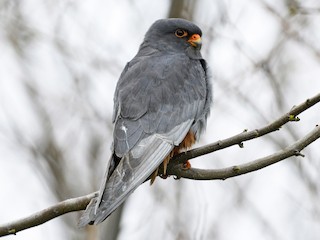
The Red-footed Falcon is a small, elegant raptor belonging to the falcon family. It is known for its distinctive reddish-orange legs and cere, and marked sexual dimorphism in plumage. This species is highly migratory, breeding across Eastern Europe and Asia and wintering in Africa. It is primarily an insectivorous falcon, often hunting in groups.
Size & lifespan
- Length
- 28-34 cm (11-13 in)
- Wingspan
- 65-76 cm (26-30 in)
- Weight
- 130-197 g (4.6-6.9 oz) for males, 136-200 g (4.8-7.1 oz) for females
- Lifespan
- Typically 5-8 years in the wild, up to 13 years recorded
- Diet
- Carnivore (primarily insectivorous, especially large insects like grasshoppers, crickets, beetles, dragonflies; also small mammals, birds, and amphibians)
Physical characteristics
- Plumage
- Adult males are uniformly dark slate-grey with chestnut-red undertail coverts and 'trousers' (thighs). Adult females have a rufous-orange head and underparts, grey upperparts with dark barring, and a distinctive dark 'mask' around the eye. Juveniles are brown above with pale streaking, buffy underparts with dark streaking, and a dark eye-stripe.
- Beak shape
- Short, hooked beak, typically greyish-blue with a yellow cere.
- Eye color
- Dark brown, surrounded by a reddish-orange eye-ring in adults.
- Leg color
- Bright reddish-orange in adults, duller orange-yellow in juveniles.
- Distinguishing features
- Adult males are unmistakable with their uniform dark grey plumage and red legs/cere. Adult females are distinguished by their rufous head and underparts, grey back, and dark eye-mask. The reddish-orange legs and cere are key identifiers for all adults.
- Juvenile appearance
- Juveniles are duller than adults. They have brown upperparts with pale feather fringes, buffy underparts with heavy dark streaking, and a prominent dark eye-stripe. Their cere and legs are duller orange-yellow.
- Seasonal changes
- No significant seasonal plumage changes in adults, beyond wear and tear. Juveniles gradually acquire adult plumage over their first year.
- Sexual dimorphism
- Pronounced. Males are dark slate-grey with chestnut undertail coverts and thighs. Females have a rufous head and underparts, grey barred upperparts, and a dark eye-mask.
How to identify
- 1
Size and Shape
Small, slender falcon with relatively long wings and tail. Appears elegant in flight.
- 2
Adult Male Plumage
Unmistakable: uniform dark slate-grey body, wings, and head, with contrasting chestnut-red undertail coverts and 'trousers' (thighs). Red legs and cere.
- 3
Adult Female Plumage
Rufous-orange head and underparts, grey upperparts with dark barring, and a distinct dark 'mask' around the eye. Red legs and cere.
- 4
Juvenile Plumage
Brown upperparts with pale streaking, buffy underparts with dark streaking, and a dark eye-stripe. Dull orange-yellow legs and cere.
- 5
Legs and Cere Color
Bright reddish-orange in adults, duller orange-yellow in juveniles. This is a key field mark.
- 6
Flight Style
Buoyant and agile, often hovering like a Kestrel, but also capable of swift, direct flight and soaring. Often hunts in groups.
- 7
Habitat
Look for them in open grasslands, steppes, and agricultural areas with scattered trees.
Habitat & range
- Biomes
- Temperate grasslands, steppes, agricultural areas, open woodlands, river valleys, and forest edges.
- Geographic range
- Breeds from Eastern Europe (e.g., Hungary, Romania, Ukraine, Russia) eastward across the steppes of Central Asia to Mongolia and northern China. Winters primarily in southern and eastern Africa, from Angola and Namibia east to South Africa.
- Elevation range
- Typically found in lowlands and plains, up to around 1,500 meters (4,900 feet) during breeding, but generally avoids high altitudes.
- Preferred environments
- Open country with scattered trees or small groves, often near water bodies. They favor areas with abundant large insects and suitable nesting sites, such as old rookeries or tree cavities.
Behavior
- Activity time
- Diurnal, most active during daylight hours, particularly in the morning and late afternoon for hunting.
- Feeding habits
- Primarily insectivorous, often hunting in flight by hawking insects or by perching and swooping. They are adept at catching insects on the wing or from the ground. They also hover frequently, similar to Kestrels, to spot prey. During migration and in wintering grounds, they can form large feeding flocks, especially around insect outbreaks.
- Social behavior
- Highly social, especially during migration and in wintering grounds, where they can form large communal roosts and feeding flocks of hundreds or even thousands of individuals. During the breeding season, they nest colonially, often in old rookeries of Rooks or other corvids.
- Flight pattern
- Graceful and agile flight, often characterized by buoyant, buoyant wingbeats and frequent hovering. They can be seen soaring on thermals or gliding. When hunting, they exhibit rapid pursuit and agile maneuvers.
- Migration pattern
- Long-distance migratory. They breed in Eurasia and undertake a significant migration to winter in southern Africa. Migration occurs in large flocks, often following specific flyways. Autumn migration is typically from August to October, and spring migration from March to May.
- Territoriality
- While they nest colonially, individual pairs defend a small area immediately around their nest. Feeding territories are less strictly defined, especially when hunting in groups.
Song & calls
- Song
- Not known for a complex song. Vocalizations are generally calls.
- Call
- Common calls include a sharp, high-pitched 'kew-kew-kew' or 'kik-kik-kik', often given in alarm or during interactions with other falcons. Also a softer 'chup-chup-chup' during courtship or when approaching the nest.
- When they vocalize
- Most vocal during the breeding season, especially around the nest site, and during social interactions within flocks.
Breeding & reproduction
- Breeding season
- May to July, with egg-laying typically in late May to early June.
- Nesting habits
- Does not build its own nest. Primarily uses old nests of other birds, especially Rooks (Corvus frugilegus), but also Hooded Crows (Corvus cornix) or Magpies (Pica pica). Nests are typically in trees, often in loose colonies.
- Clutch size
- 3-5 eggs (range 2-6)
- Egg description
- Typically 3-5 eggs, sometimes 2-6. Eggs are pale creamy-white to yellowish-white, often unmarked or with very faint reddish-brown speckles.
- Incubation period
- 22-28 days, primarily by the female, though the male may assist.
- Fledging period
- 27-30 days after hatching. Young leave the nest but remain dependent on parents for a further 1-2 weeks.
- Parental care
- Both parents participate in incubation and feeding of the young. The male typically provides food for the female during incubation and for the chicks after hatching, with the female doing most of the direct feeding.
Where to find
Breeding Grounds
Eastern Europe (e.g., Hungary, Romania, Ukraine, Russia) and across the steppes of Central Asia. Look in areas with old rookeries or scattered trees near open fields.
Wintering Grounds
Southern and eastern Africa, particularly in grasslands and savannas. They can form very large communal roosts.
Migration Routes
During spring and autumn migration, they can be seen across a wide range of Europe, the Middle East, and Africa, often in large flocks at migration bottlenecks or along major flyways.
Field tips
- Look for communal roosts. During migration and in wintering grounds, Red-footed Falcons often gather in large numbers at communal roosts, typically in trees. These can be spectacular to observe.
- Observe hunting behavior. Watch for their characteristic hovering flight over open fields, followed by a dive to catch insects. They often hunt in groups, which can be a good indicator.
- Check old corvid nests. In breeding areas, scan old rookeries or other large tree nests, as Red-footed Falcons do not build their own nests.
- Focus on leg and cere color. The reddish-orange legs and cere are a crucial identification feature, especially for distinguishing from similar species like Amur Falcon.
Similar species
Amur Falcon
Falco amurensis
Adult male Amur Falcons are very similar to Red-footed Falcons but have grey undertail coverts (not chestnut-red) and a white underwing lining (Red-footed has dark underwing). Females are very difficult to distinguish, often requiring close views of underwing pattern or subtle facial markings. Amur Falcons breed further east in Asia and have a different migration route, wintering in southern Africa but via India and the Arabian Sea.
Eurasian Kestrel
Falco tinnunculus
Eurasian Kestrels are generally larger and bulkier. Males have a rufous back with black spots and a grey head, contrasting with the Red-footed Falcon's uniform dark grey. Females are rufous-brown with heavy barring. Kestrels typically have dark claws, while Red-footed Falcons have pale claws. Kestrels also have a more prominent 'moustache' stripe.
Lesser Kestrel
Falco naumanni
Lesser Kestrels are slightly smaller and more slender. Males have an unspotted rufous back and grey head, but lack the chestnut undertail of the Red-footed Falcon. Females are paler overall with less distinct markings. Lesser Kestrels have pale claws, like Red-footed Falcons, but their flight is often more buoyant and they lack the strong sexual dimorphism in underpart coloration of Red-footed Falcons.
Quick facts
- Diet:
- Mainly large insects, also small vertebrates
- Nesting:
- Uses old nests of other birds, especially Rooks
- Migration:
- Long-distance migrant, breeding in Eurasia, wintering in Africa
- Sociality:
- Highly social, especially outside breeding season
- Conservation Status:
- Near Threatened (due to habitat loss and pesticide use)
Fun facts
- Red-footed Falcons are one of the few raptor species that regularly hunt in large groups, especially during insect outbreaks.
- They are known to follow agricultural machinery to catch insects disturbed by the activity.
- Their reliance on old corvid nests means their breeding success can be linked to the health of corvid populations in their breeding range.
- The species was formerly considered conspecific with the Amur Falcon (Falco amurensis), but they are now recognized as distinct species based on genetic and morphological differences.
Scientific classification
- Kingdom
- Animalia
- Phylum
- Chordata
- Class
- Aves
- Order
- Falconiformes
- Family
- Falconidae
- Genus
- Falco
- Species
- Falco vespertinus
Explore the Red-footed Falcon
Identify birds anywhere
Free on iOS, Android, and Web. Photo & sound identification, full species database, and your personal life list.