
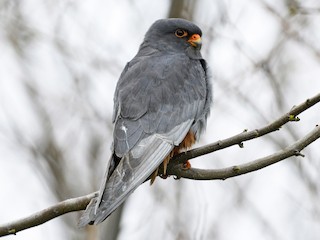
How to identify the Red-footed Falcon
Falco vespertinus
Spotted a bird? Identify it instantly with the Birdby app
Open the appTo correctly identify the Red-footed Falcon (Falco vespertinus), check each of these features. Birds can be tricky: habit, habitat, and call often confirm a sighting that a single photo cannot.
Size at a glance
- Length
- 28-34 cm (11-13 in)
- Wingspan
- 65-76 cm (26-30 in)
- Weight
- 130-197 g (4.6-6.9 oz) for males, 136-200 g (4.8-7.1 oz) for females
Physical features to check
- 1
Plumage
Overall feather coloration and pattern.
Adult males are uniformly dark slate-grey with chestnut-red undertail coverts and 'trousers' (thighs). Adult females have a rufous-orange head and underparts, grey upperparts with dark barring, and a distinctive dark 'mask' around the eye. Juveniles are brown above with pale streaking, buffy underparts with dark streaking, and a dark eye-stripe.
- 2
Beak shape
Shape and color of the bill: a key field mark.
Short, hooked beak, typically greyish-blue with a yellow cere.
- 3
Eye color
Iris color and any distinctive eye markings.
Dark brown, surrounded by a reddish-orange eye-ring in adults.
- 4
Leg color
Leg and foot color.
Bright reddish-orange in adults, duller orange-yellow in juveniles.
- 5
Distinguishing features
Standout features that separate this species.
Adult males are unmistakable with their uniform dark grey plumage and red legs/cere. Adult females are distinguished by their rufous head and underparts, grey back, and dark eye-mask. The reddish-orange legs and cere are key identifiers for all adults.
- 6
Juvenile appearance
How young birds differ from adults.
Juveniles are duller than adults. They have brown upperparts with pale feather fringes, buffy underparts with heavy dark streaking, and a prominent dark eye-stripe. Their cere and legs are duller orange-yellow.
- 7
Seasonal changes
Plumage variation between breeding and non-breeding seasons.
No significant seasonal plumage changes in adults, beyond wear and tear. Juveniles gradually acquire adult plumage over their first year.
- 8
Sexual dimorphism
How males and females differ.
Pronounced. Males are dark slate-grey with chestnut undertail coverts and thighs. Females have a rufous head and underparts, grey barred upperparts, and a dark eye-mask.
Key field marks
- Size and Shape. Small, slender falcon with relatively long wings and tail. Appears elegant in flight.
- Adult Male Plumage. Unmistakable: uniform dark slate-grey body, wings, and head, with contrasting chestnut-red undertail coverts and 'trousers' (thighs). Red legs and cere.
- Adult Female Plumage. Rufous-orange head and underparts, grey upperparts with dark barring, and a distinct dark 'mask' around the eye. Red legs and cere.
- Juvenile Plumage. Brown upperparts with pale streaking, buffy underparts with dark streaking, and a dark eye-stripe. Dull orange-yellow legs and cere.
- Legs and Cere Color. Bright reddish-orange in adults, duller orange-yellow in juveniles. This is a key field mark.
- Flight Style. Buoyant and agile, often hovering like a Kestrel, but also capable of swift, direct flight and soaring. Often hunts in groups.
- Habitat. Look for them in open grasslands, steppes, and agricultural areas with scattered trees.
Explore the Red-footed Falcon
Identify birds anywhere
Free on iOS, Android, and Web. Photo & sound identification, full species database, and your personal life list.