
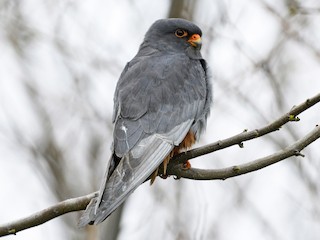
Where does the Red-footed Falcon live?
Falco vespertinus
Spotted a bird? Identify it instantly with the Birdby app
Open the appThe Red-footed Falcon lives in specific habitats and regions. Knowing where, and when, to look improves your chances of a successful sighting.
Biomes
Temperate grasslands, steppes, agricultural areas, open woodlands, river valleys, and forest edges.
Geographic range
Breeds from Eastern Europe (e.g., Hungary, Romania, Ukraine, Russia) eastward across the steppes of Central Asia to Mongolia and northern China. Winters primarily in southern and eastern Africa, from Angola and Namibia east to South Africa.
Preferred environments
Open country with scattered trees or small groves, often near water bodies. They favor areas with abundant large insects and suitable nesting sites, such as old rookeries or tree cavities.
Elevation range
Typically found in lowlands and plains, up to around 1,500 meters (4,900 feet) during breeding, but generally avoids high altitudes.
Where to look
Breeding Grounds
Eastern Europe (e.g., Hungary, Romania, Ukraine, Russia) and across the steppes of Central Asia. Look in areas with old rookeries or scattered trees near open fields.
Wintering Grounds
Southern and eastern Africa, particularly in grasslands and savannas. They can form very large communal roosts.
Migration Routes
During spring and autumn migration, they can be seen across a wide range of Europe, the Middle East, and Africa, often in large flocks at migration bottlenecks or along major flyways.
Field tips
- Look for communal roosts. During migration and in wintering grounds, Red-footed Falcons often gather in large numbers at communal roosts, typically in trees. These can be spectacular to observe.
- Observe hunting behavior. Watch for their characteristic hovering flight over open fields, followed by a dive to catch insects. They often hunt in groups, which can be a good indicator.
- Check old corvid nests. In breeding areas, scan old rookeries or other large tree nests, as Red-footed Falcons do not build their own nests.
- Focus on leg and cere color. The reddish-orange legs and cere are a crucial identification feature, especially for distinguishing from similar species like Amur Falcon.
Migration
Long-distance migratory. They breed in Eurasia and undertake a significant migration to winter in southern Africa. Migration occurs in large flocks, often following specific flyways. Autumn migration is typically from August to October, and spring migration from March to May.
Explore the Red-footed Falcon
Identify birds anywhere
Free on iOS, Android, and Web. Photo & sound identification, full species database, and your personal life list.