
Spotted a bird? Identify it instantly with the Birdby app
Open the appAbout
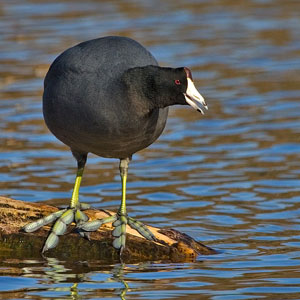
The American Coot is a medium-sized water bird, often mistaken for a duck due to its aquatic habits, but it is actually a member of the rail family. It is characterized by its dark body, white bill, and prominent white frontal shield. Coots are highly adaptable and commonly found on various freshwater bodies across North America.
Size & lifespan
- Length
- 34-43 cm (13-17 in)
- Wingspan
- 58-71 cm (23-28 in)
- Weight
- 427-848 g (15.1-29.9 oz)
- Lifespan
- 6-9 years in the wild, up to 22 years in captivity
- Diet
- Omnivore, primarily consuming aquatic vegetation, seeds, insects, small fish, and invertebrates.
Physical characteristics
- Plumage
- Adults have a sooty gray to black body plumage, with a slightly paler gray head and neck. The undertail coverts are white, often visible when the bird is swimming or walking. The wings are dark, with a narrow white trailing edge that is most noticeable in flight.
- Beak shape
- Conical, ivory-white bill with a dark band near the tip. A prominent, fleshy, white frontal shield extends from the base of the bill onto the forehead.
- Eye color
- Dark red to reddish-brown.
- Leg color
- Yellowish-green to olive-green legs and feet. The feet are large and lobed, not fully webbed like ducks, which aids in both swimming and walking on land.
- Distinguishing features
- The most distinctive features are the bright white bill and frontal shield, and the lobed feet. They also exhibit a characteristic head-pumping motion while swimming.
- Juvenile appearance
- Juveniles are paler gray-brown overall, with a whitish throat and breast. Their bill is duller, often grayish, and the frontal shield is smaller and less developed, sometimes pinkish or yellowish. They lack the reddish eye color of adults.
- Seasonal changes
- No significant seasonal plumage changes. The brightness of the frontal shield may vary slightly with breeding condition.
- Sexual dimorphism
- Males and females are generally monomorphic in plumage, though males tend to be slightly larger than females. During breeding season, the frontal shield of males may appear slightly larger and more prominent.
How to identify
- 1
Bill and Frontal Shield
Look for the distinctive ivory-white bill with a dark band near the tip, and the prominent white frontal shield extending onto the forehead. This is the most reliable field mark.
- 2
Plumage Color
Observe the overall sooty gray to black body plumage, with a slightly paler head and neck. Note the white undertail coverts, especially when the bird is swimming or preening.
- 3
Legs and Feet
If visible, note the yellowish-green legs and large, lobed (not fully webbed) feet. These are unique among common North American water birds.
- 4
Swimming Behavior
Watch for the characteristic head-pumping motion while swimming. They often dive for food, disappearing for several seconds before resurfacing.
- 5
Flight
In flight, look for the dark body, rapid wingbeats, and the narrow white trailing edge on the secondary feathers, along with the white undertail coverts.
- 6
Vocalizations
Listen for their distinctive sharp, explosive 'keks' or 'piks', especially when alarmed or interacting with other coots.
Habitat & range
- Biomes
- Freshwater wetlands, marshes, ponds, lakes, slow-moving rivers, and occasionally brackish water.
- Geographic range
- Widespread across North America, from southern Canada through the United States and Mexico, extending into Central America and parts of the Caribbean. Some populations are resident, while northern populations are migratory.
- Elevation range
- Sea level up to approximately 3,000 meters (10,000 feet) in mountainous regions.
- Preferred environments
- Shallow, open water with abundant emergent and submerged aquatic vegetation for food and cover. They prefer areas with dense cattails, reeds, or rushes for nesting and refuge.
Behavior
- Activity time
- Diurnal, most active during daylight hours for foraging and social interactions.
- Feeding habits
- Forages by dabbling, diving, and grazing on land. They often dive to retrieve submerged vegetation, or pick seeds and insects from the water surface. They also graze on grasses and other plants near the water's edge. They can be seen stealing food from ducks.
- Social behavior
- Highly social, especially outside the breeding season, forming large flocks that can number in the thousands. During breeding, they are territorial and can be aggressive towards other coots and water birds.
- Flight pattern
- Flies with rapid wingbeats, often running across the water surface to gain momentum before taking off. In flight, their dark body contrasts with the white trailing edge of the wings and white undertail coverts. They are strong, direct fliers during migration.
- Migration pattern
- Northern populations are migratory, moving south for the winter to the southern United States, Mexico, and Central America. Southern populations are largely resident. Migration occurs primarily at night.
- Territoriality
- Strongly territorial during the breeding season, defending nesting sites and foraging areas from conspecifics and other water birds. Displays include chasing, pecking, and splashing water.
Song & calls
- Song
- Coots do not have a complex song. Their vocalizations are primarily a variety of calls.
- Call
- A diverse repertoire of calls, including sharp, explosive 'keks' or 'piks', often given in alarm or during territorial disputes. They also produce softer 'clucks' and 'gurgles' while foraging or interacting. Females tend to have higher-pitched calls than males.
- When they vocalize
- Vocalize year-round, but calls are more frequent and intense during the breeding season and when disturbed.
Breeding & reproduction
- Breeding season
- Typically April to July, but can vary geographically, starting earlier in southern regions.
- Nesting habits
- Nests are bulky, floating structures made of dead and live aquatic vegetation, anchored to emergent plants or built on shallow platforms. Both sexes participate in nest building. Nests are often well-concealed within dense marsh vegetation.
- Clutch size
- Typically 6-12 eggs, but can range from 2 to 15. They may lay multiple clutches in a season.
- Egg description
- Eggs are buff to pale olive-buff, speckled with fine dark brown or black spots and blotches. They are oval to subelliptical in shape.
- Incubation period
- 21-25 days, primarily by the female, though the male may assist.
- Fledging period
- Chicks are precocial and leave the nest shortly after hatching, but remain with parents for feeding and protection for 50-70 days until they can fly.
- Parental care
- Both parents care for the young, feeding them and protecting them from predators. Young coots are often seen riding on the backs of their parents.
Where to find
Freshwater Ponds and Lakes
Commonly found on open water bodies, especially those with emergent vegetation along the edges.
Marshes and Wetlands
Look in areas with dense cattails, reeds, and other aquatic plants, which provide cover and nesting sites.
Slow-moving Rivers and Canals
Can be found in calmer sections of rivers and canals, particularly where vegetation is abundant.
Urban Parks and Golf Courses
Often habituate to human presence and can be seen on ponds and water features in urban and suburban settings.
Field tips
- Scan Open Water. Coots often forage in open water, so scan the surface of ponds and lakes. Look for their distinctive head-pumping motion.
- Check Vegetated Edges. They frequently hide and nest in dense emergent vegetation, so check the edges of marshes and wetlands carefully.
- Listen for Calls. Their sharp calls can often alert you to their presence, especially if they are hidden in vegetation or disturbed.
- Observe Behavior. Watch for their unique diving and dabbling feeding behaviors, and their tendency to graze on land near the water.
- Look for Flocks. Outside of breeding season, they often gather in large flocks, making them easier to spot on larger bodies of water.
Similar species
Eurasian Coot
Fulica atra
The Eurasian Coot has a pure white bill and frontal shield, lacking the dark band on the bill seen in the American Coot. Its frontal shield is also typically more rounded and less pointed than that of the American Coot. Very rare vagrant to North America.
Common Gallinule (formerly Common Moorhen)
Gallinula galeata
The Common Gallinule has a red bill with a yellow tip and a red frontal shield, contrasting sharply with the American Coot's white bill and shield. Gallinules also have a prominent white stripe along their flanks, which coots lack.
Purple Gallinule
Porphyrio martinica
The Purple Gallinule is much more colorful, with iridescent purple-blue plumage, a red bill with a yellow tip, and a pale blue frontal shield. Its legs are bright yellow. It is also generally found in more tropical and subtropical wetlands.
Quick facts
- Family:
- Rallidae (Rails, Gallinules, and Coots)
- Diet:
- Omnivorous (aquatic vegetation, seeds, insects, small invertebrates)
- Distinguishing Feature:
- White bill and frontal shield, lobed feet
- Habitat:
- Freshwater wetlands, ponds, lakes
- Conservation Status:
- Least Concern
- Migration:
- Partial migrant (northern populations migrate south)
Fun facts
- Despite their duck-like appearance and aquatic lifestyle, American Coots are more closely related to cranes than to ducks.
- Their lobed feet, which are not fully webbed, allow them to walk more easily on land and through dense vegetation than ducks, while still providing efficient propulsion in water.
- American Coots are known for their aggressive territorial displays during breeding season, often engaging in fights with other coots and even larger water birds.
- They are sometimes called 'mud hens' due to their dark plumage and preference for muddy, vegetated waters.
- Young coots are born with bright orange-red down on their heads, which is thought to stimulate parental feeding.
- Coots have been observed 'kleptoparasitizing' other birds, meaning they steal food from ducks and other diving birds as they surface.
Scientific classification
- Kingdom
- Animalia
- Phylum
- Chordata
- Class
- Aves
- Order
- Gruiformes
- Family
- Rallidae
- Genus
- Fulica
- Species
- F. americana
Explore the American Coot
Identify birds anywhere
Free on iOS, Android, and Web. Photo & sound identification, full species database, and your personal life list.