
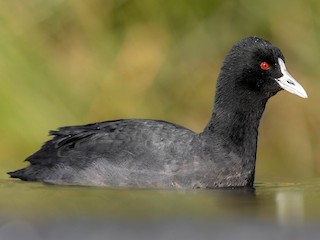
Where does the Eurasian Coot live?
Fulica atra
Spotted a bird? Identify it instantly with the Birdby app
Open the appThe Eurasian Coot lives in specific habitats and regions. Knowing where, and when, to look improves your chances of a successful sighting.
Biomes
Freshwater wetlands, lakes, ponds, slow-moving rivers, reservoirs, gravel pits, and estuaries.
Geographic range
Widespread across Europe, Asia, Australia, New Zealand, and parts of North Africa. Absent from the Americas.
Preferred environments
Shallow, still or slow-moving freshwater bodies with abundant emergent vegetation (reeds, rushes) for nesting and cover, and open water for feeding. They can tolerate some brackish water.
Elevation range
Primarily lowlands, but can be found at moderate altitudes where suitable water bodies exist.
Where to look
Lakes and Ponds
Commonly found on freshwater lakes, large ponds, and reservoirs, especially those with emergent vegetation along the edges.
Slow-moving Rivers and Canals
Can be seen on wider, slow-flowing rivers and canals, particularly in areas with reeds and other aquatic plants.
Wetlands and Marshes
Abundant in various wetland habitats, including marshes, fens, and gravel pits, where there is a mix of open water and dense vegetation.
Estuaries (winter)
In winter, some populations may move to coastal estuaries and sheltered bays, especially during harsh weather conditions inland.
Field tips
- Look for movement on water. Coots are almost always on the water, either swimming, diving, or dabbling. Their head-pumping motion is a good indicator.
- Scan for white frontal shields. The white frontal shield and bill are highly conspicuous against the dark body, even at a distance. This is often the first thing to catch the eye.
- Listen for calls. Their sharp, metallic calls are quite distinctive and can often alert you to their presence before you see them.
- Check vegetated edges. While they feed in open water, they often retreat to dense emergent vegetation for cover, nesting, and roosting. Check these areas carefully.
- Observe social behavior. Outside the breeding season, look for large rafts of coots on open water. During breeding, look for pairs defending territories.
Migration
Northern populations are migratory, moving south to warmer regions for winter. Southern and western European populations are largely resident or undertake short-distance movements. Migration occurs mainly at night.
Explore the Eurasian Coot
Identify birds anywhere
Free on iOS, Android, and Web. Photo & sound identification, full species database, and your personal life list.