
How to identify the Eurasian Coot
Fulica atra
Spotted a bird? Identify it instantly with the Birdby app
Open the appTo correctly identify the Eurasian Coot (Fulica atra), check each of these features. Birds can be tricky: habit, habitat, and call often confirm a sighting that a single photo cannot.
Size at a glance
- Length
- 32-42 cm
- Wingspan
- 65-80 cm
- Weight
- 585-1200 g
Physical features to check
- 1
Plumage
Overall feather coloration and pattern.
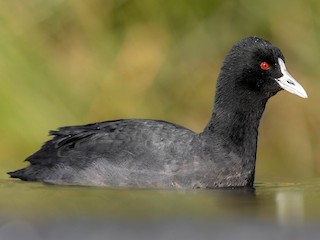
Adults are uniformly dull black over the entire body, including the head, neck, and underparts. The wings are also black, with a faint paler trailing edge visible in flight. There are no significant plumage variations between breeding and non-breeding seasons.
- 2
Beak shape
Shape and color of the bill: a key field mark.
The bill is conical, short, and stout, entirely white. It extends into a prominent, smooth, white frontal shield on the forehead.
- 3
Eye color
Iris color and any distinctive eye markings.
The iris is typically bright red, providing a striking contrast against the black head.
- 4
Leg color
Leg and foot color.
Legs and feet are dark grey to greenish-grey. The feet are large and strong, with lobed toes (semipalmate) rather than fully webbed, which aid in both swimming and walking on soft ground.
- 5
Distinguishing features
Standout features that separate this species.
The most distinctive features are the pure white frontal shield and bill, contrasting sharply with the black plumage and red eyes. The lobed feet are also characteristic, though often not visible unless the bird is out of water or preening.
- 6
Juvenile appearance
How young birds differ from adults.
Juveniles are paler than adults, with greyish-brown plumage, a whitish throat and breast, and a duller, greyish bill and frontal shield. Their eyes are also duller, often brownish. They gradually acquire adult plumage over their first year.
- 7
Seasonal changes
Plumage variation between breeding and non-breeding seasons.
There are no significant seasonal plumage changes in adults. The frontal shield may appear slightly larger or more prominent during the breeding season due to hormonal influences, but the color remains white.
- 8
Sexual dimorphism
How males and females differ.
Males and females are generally monomorphic in plumage. Males tend to be slightly larger and have a marginally larger frontal shield, but these differences are subtle and not reliable for field identification.
Key field marks
- Plumage. Look for an entirely dull black body, head, and neck. There should be no other significant colors on the body.
- Head and Bill. The most crucial identification feature is the pure white bill and the prominent, smooth, white frontal shield on the forehead. This contrasts sharply with the black head.
- Eyes. Observe the eyes; they are typically bright red in adults, providing another distinctive mark.
- Legs and Feet. If visible, note the dark grey to greenish-grey legs and the large, lobed (not fully webbed) feet, which are characteristic of coots.
- Behavior on Water. Coots spend most of their time swimming, often diving frequently for food. They have a characteristic head-pumping motion while swimming. They are often seen in groups, especially outside the breeding season.
- Flight. When flying, they have a heavy, direct flight with rapid wingbeats and often a long, splashing run-up from the water. A faint pale trailing edge on the wing may be visible.
- Vocalizations. Listen for their distinctive sharp, explosive, and metallic 'kewk' or 'psiss' calls.
Explore the Eurasian Coot
Identify birds anywhere
Free on iOS, Android, and Web. Photo & sound identification, full species database, and your personal life list.