
Spotted a bird? Identify it instantly with the Birdby app
Open the appAbout
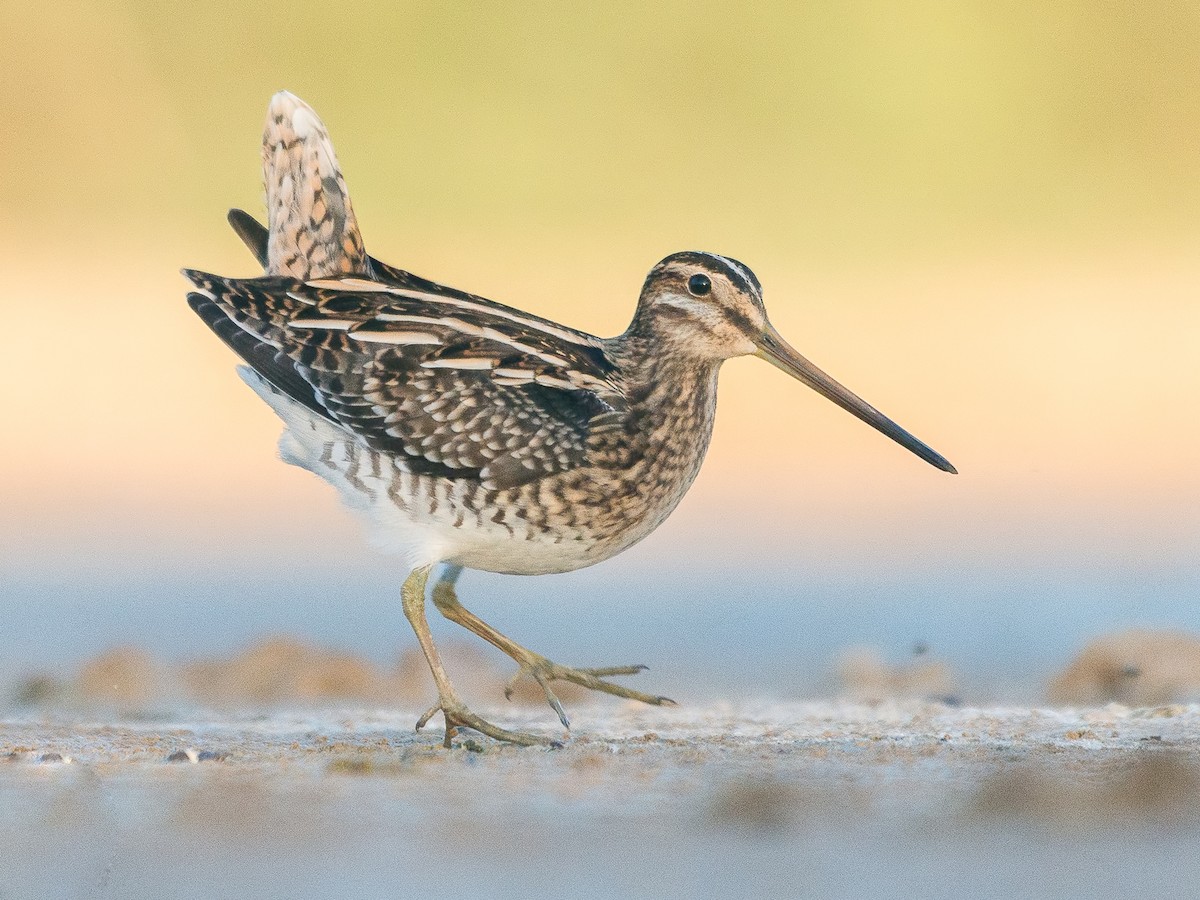
The Eurasian Snipe is a medium-sized, cryptically plumaged wading bird known for its long, straight bill and erratic, zig-zagging flight when flushed. It is a widespread species found across Eurasia and parts of Africa, typically inhabiting wetlands, bogs, and wet grasslands. Its distinctive 'drumming' display flight, produced by vibrating tail feathers, is a key characteristic during the breeding season.
Size & lifespan
- Length
- 23-28 cm
- Wingspan
- 39-45 cm
- Weight
- 80-140 g (males), 100-180 g (females)
- Lifespan
- Up to 10-12 years in the wild
- Diet
- Invertebrates (worms, insect larvae, crustaceans), some plant material
Physical characteristics
- Plumage
- Upperparts are mottled brown, black, and buff, providing excellent camouflage. Distinctive buffy-white stripes run along the back (mantle stripes) and crown. Underparts are whitish with streaking on the flanks and breast. The tail is short, wedge-shaped, and has rufous-orange outer feathers, visible in flight.
- Beak shape
- Very long (6-7 cm), straight, and slender, dark at the tip and paler, often yellowish-green, at the base.
- Eye color
- Dark brown.
- Leg color
- Greenish-grey to yellowish-green.
- Distinguishing features
- Long bill, cryptic brown plumage with prominent buffy-white mantle stripes, dark eye-stripe, and pale supercilium. The rufous outer tail feathers are a key identification feature in flight.
- Juvenile appearance
- Juveniles resemble adults but have narrower, less distinct buffy mantle stripes and often show more prominent pale fringes to their upperpart feathers, giving a slightly scaly appearance. The bill may be slightly shorter.
- Seasonal changes
- No significant seasonal plumage changes. Plumage remains consistent year-round, optimized for camouflage.
- Sexual dimorphism
- Males and females are generally monomorphic in plumage, though females tend to be slightly larger and heavier on average.
How to identify
- 1
Overall Plumage
Look for the cryptic brown, black, and buff mottling on the upperparts, providing excellent camouflage against wetland vegetation.
- 2
Mantle Stripes
Identify the two prominent buffy-white stripes running down the back (mantle), which are a key distinguishing feature from Great Snipe and Jack Snipe.
- 3
Bill Length
Note the exceptionally long, straight, and slender bill, which is characteristic of the species and used for probing.
- 4
Head Pattern
Observe the dark eye-stripe contrasting with a pale supercilium (eyebrow stripe) and a pale central crown stripe.
- 5
Flight Pattern (when flushed)
Listen for the explosive 'scaap' call and watch for the characteristic erratic, zig-zagging flight as it takes off, before it settles into a more direct path.
- 6
Tail in Flight
Look for the rufous-orange outer tail feathers, which are often visible when the bird is in flight, especially during turns.
- 7
Drumming Display
During the breeding season, listen for the distinctive 'drumming' or 'bleating' sound produced by the male's tail feathers during its aerial display.
Habitat & range
- Biomes
- Wetlands, bogs, marshes, wet grasslands, fens, tundra, and damp meadows.
- Geographic range
- Breeds across northern and temperate Eurasia, from Iceland and the UK eastward through Scandinavia, Russia, and Siberia to the Pacific. Winters in southern Europe, Africa, the Middle East, and South Asia.
- Elevation range
- Typically found from sea level up to 2,000 meters, occasionally higher in some mountainous regions.
- Preferred environments
- Areas with dense, low vegetation for cover, soft muddy ground for probing, and shallow water. Requires a mosaic of open and vegetated areas.
Behavior
- Activity time
- Primarily crepuscular and nocturnal, especially when feeding, but can be active during the day, particularly during the breeding season.
- Feeding habits
- Probes soft mud and shallow water with its long bill, using sensitive nerve endings at the bill tip to detect invertebrates. Feeds primarily on earthworms, insect larvae (especially dipteran larvae), small crustaceans, mollusks, and occasionally seeds or other plant material. Forages by walking slowly and methodically.
- Social behavior
- Generally solitary or found in loose aggregations outside the breeding season. During migration, they may form small flocks. Males are territorial during breeding.
- Flight pattern
- When flushed, it takes off with a characteristic explosive, zig-zagging flight, often accompanied by a harsh 'scaap' call, before settling into a more direct flight path. During display, males perform high-altitude circles, then dive steeply, producing a 'drumming' sound with their outer tail feathers.
- Migration pattern
- Mostly migratory, with northern populations moving south for the winter. Some western European populations may be resident or undertake shorter movements. Migrates at night, often in small groups.
- Territoriality
- Males establish and defend breeding territories, primarily through aerial displays and vocalizations.
Song & calls
- Song
- The 'song' is primarily the mechanical 'drumming' or 'bleating' sound produced by vibrating outer tail feathers during the male's display flight. It sounds like a rapid, pulsating 'hoo-hoo-hoo-hoo'.
- Call
- A harsh, explosive 'scaap' or 'ketch' call, often given when flushed. Also a softer 'chip-chip-chip' call when disturbed or in flight.
- When they vocalize
- Calls are given year-round, especially when flushed. Drumming display is primarily heard during the breeding season (spring and early summer).
Breeding & reproduction
- Breeding season
- April to July, varying geographically.
- Nesting habits
- Nests are well-concealed depressions on the ground, typically in dense vegetation (e.g., tussocks of grass, sedges) in wet areas. Lined with grass and leaves.
- Clutch size
- Usually 4 eggs.
- Egg description
- Typically 4 eggs, olive-buff to greenish-brown, heavily blotched and spotted with dark brown or black, especially at the broader end. Pyriform (pear-shaped).
- Incubation period
- 18-21 days, primarily by the female.
- Fledging period
- Chicks are precocial and leave the nest shortly after hatching. They are able to fly at about 19-20 days old.
- Parental care
- Mainly by the female, though males may sometimes assist. Chicks are fed by the female initially, but quickly learn to forage for themselves.
Where to find
Wetlands and Marshes
Look in areas with shallow water, dense sedges, rushes, and tall grasses. These provide both cover and rich feeding grounds.
Bogs and Fens
Peaty, waterlogged areas are prime habitat, especially during the breeding season.
Wet Grasslands and Meadows
Damp fields and meadows, particularly those with tussocks or uneven ground, are often frequented.
Sewage Farms and Water Treatment Works
These managed wetlands can attract snipe, especially during migration or in winter.
Field tips
- Walk slowly and quietly. Snipe are incredibly camouflaged and will often remain motionless until you are very close. Walking slowly increases your chances of flushing one.
- Listen for the 'scaap' call. The explosive 'scaap' call is often the first indication of a snipe's presence as it takes flight.
- Look for movement. Scan areas of suitable habitat for subtle movements, such as a head bobbing or a bill probing the mud.
- Visit at dawn or dusk. Snipe are often more active and visible during crepuscular hours, especially when feeding.
- Use binoculars. Even after flushing, a snipe may land some distance away. Binoculars are essential for observing its cryptic plumage and identifying features.
- Observe display flights. During the breeding season, watch the sky above suitable habitats for the male's distinctive drumming display flight.
Similar species
Great Snipe
Gallinago media
Larger and heavier than Eurasian Snipe. Has a shorter bill, more barred flanks, and lacks the prominent buffy mantle stripes. The white trailing edge to the wing is more noticeable, and it has more white in the tail. Flight is straighter and less erratic when flushed. Does not 'drum'.
Jack Snipe
Lymnocryptes minimus
Significantly smaller and shorter-billed. Lacks the prominent buffy mantle stripes; instead, it has two yellowish stripes on the back that converge to form a 'V'. The head pattern is different, lacking a central crown stripe. When flushed, it flies low and slowly, often dropping quickly back into cover, without the zig-zagging flight or 'scaap' call of the Eurasian Snipe.
Wilson's Snipe
Gallinago delicata
Formerly considered a subspecies of Eurasian Snipe. Very similar in appearance, but generally has 8 pairs of tail feathers (Eurasian typically has 7), and the outer tail feathers are narrower. The drumming sound is slightly different, often described as more 'whistling' or 'winnowing'. Found in North America.
Quick facts
- Scientific Name:
- Gallinago gallinago
- Family:
- Scolopacidae
- Diet:
- Invertebrates (worms, insect larvae)
- Habitat:
- Wetlands, bogs, wet grasslands
- Conservation Status:
- Least Concern
- Distinguishing Feature:
- Long bill, buffy mantle stripes, zig-zag flight, drumming display
Fun facts
- The term 'sniper' originated from hunters who were skilled enough to shoot the elusive and fast-flying snipe.
- The 'drumming' sound produced by the male during its display flight is not vocal but mechanical, created by air rushing through specially modified outer tail feathers.
- Eurasian Snipe have eyes set far back on their heads, giving them a wide field of vision (almost 360 degrees) to detect predators while their bill is buried in the mud.
- Their long bill has a flexible tip, allowing them to open just the tip to grasp prey while the rest of the bill remains closed in the mud.
Scientific classification
- Kingdom
- Animalia
- Phylum
- Chordata
- Class
- Aves
- Order
- Charadriiformes
- Family
- Scolopacidae
- Genus
- Gallinago
- Species
- Gallinago gallinago
Explore the Eurasian Snipe
Identify birds anywhere
Free on iOS, Android, and Web. Photo & sound identification, full species database, and your personal life list.