
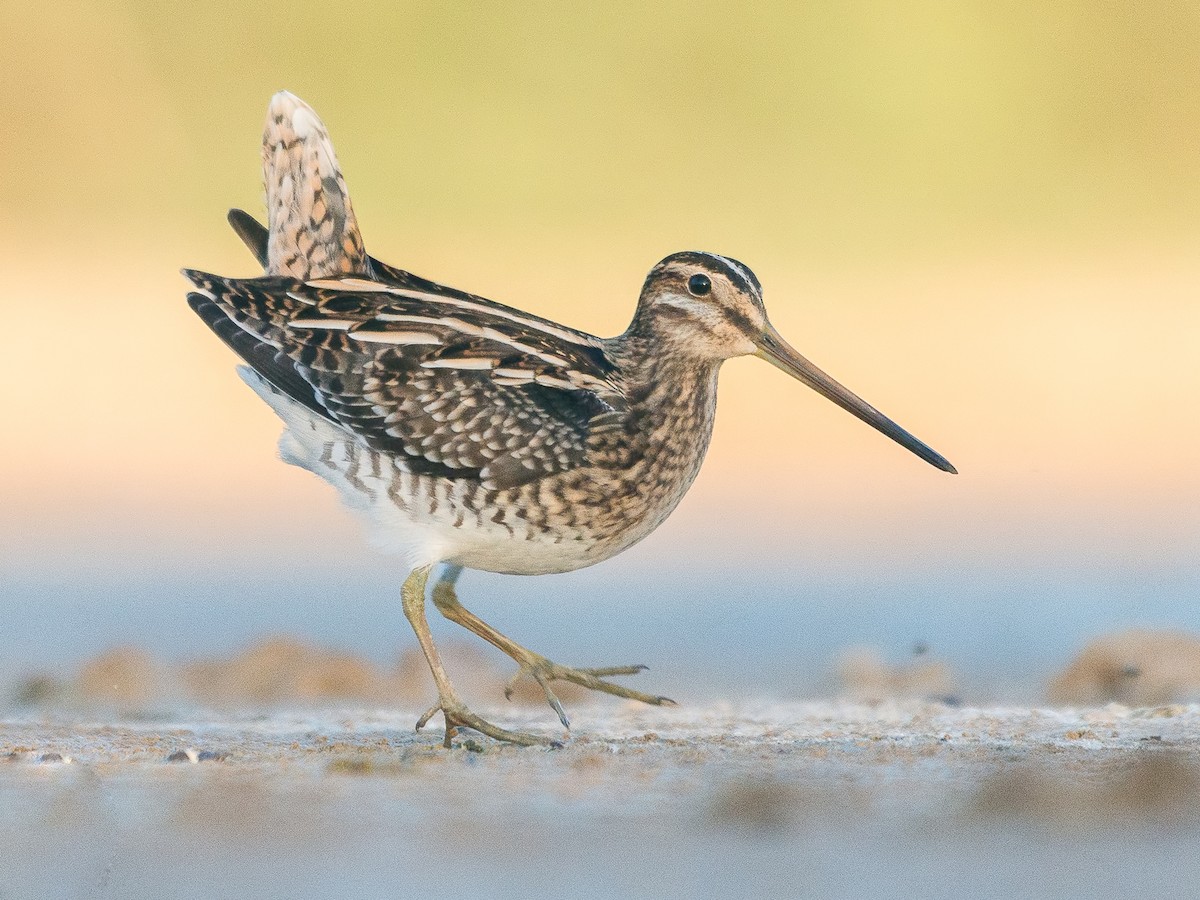
How to identify the Eurasian Snipe
Gallinago gallinago
Spotted a bird? Identify it instantly with the Birdby app
Open the appTo correctly identify the Eurasian Snipe (Gallinago gallinago), check each of these features. Birds can be tricky: habit, habitat, and call often confirm a sighting that a single photo cannot.
Size at a glance
- Length
- 23-28 cm
- Wingspan
- 39-45 cm
- Weight
- 80-140 g (males), 100-180 g (females)
Physical features to check
- 1
Plumage
Overall feather coloration and pattern.
Upperparts are mottled brown, black, and buff, providing excellent camouflage. Distinctive buffy-white stripes run along the back (mantle stripes) and crown. Underparts are whitish with streaking on the flanks and breast. The tail is short, wedge-shaped, and has rufous-orange outer feathers, visible in flight.
- 2
Beak shape
Shape and color of the bill: a key field mark.
Very long (6-7 cm), straight, and slender, dark at the tip and paler, often yellowish-green, at the base.
- 3
Eye color
Iris color and any distinctive eye markings.
Dark brown.
- 4
Leg color
Leg and foot color.
Greenish-grey to yellowish-green.
- 5
Distinguishing features
Standout features that separate this species.
Long bill, cryptic brown plumage with prominent buffy-white mantle stripes, dark eye-stripe, and pale supercilium. The rufous outer tail feathers are a key identification feature in flight.
- 6
Juvenile appearance
How young birds differ from adults.
Juveniles resemble adults but have narrower, less distinct buffy mantle stripes and often show more prominent pale fringes to their upperpart feathers, giving a slightly scaly appearance. The bill may be slightly shorter.
- 7
Seasonal changes
Plumage variation between breeding and non-breeding seasons.
No significant seasonal plumage changes. Plumage remains consistent year-round, optimized for camouflage.
- 8
Sexual dimorphism
How males and females differ.
Males and females are generally monomorphic in plumage, though females tend to be slightly larger and heavier on average.
Key field marks
- Overall Plumage. Look for the cryptic brown, black, and buff mottling on the upperparts, providing excellent camouflage against wetland vegetation.
- Mantle Stripes. Identify the two prominent buffy-white stripes running down the back (mantle), which are a key distinguishing feature from Great Snipe and Jack Snipe.
- Bill Length. Note the exceptionally long, straight, and slender bill, which is characteristic of the species and used for probing.
- Head Pattern. Observe the dark eye-stripe contrasting with a pale supercilium (eyebrow stripe) and a pale central crown stripe.
- Flight Pattern (when flushed). Listen for the explosive 'scaap' call and watch for the characteristic erratic, zig-zagging flight as it takes off, before it settles into a more direct path.
- Tail in Flight. Look for the rufous-orange outer tail feathers, which are often visible when the bird is in flight, especially during turns.
- Drumming Display. During the breeding season, listen for the distinctive 'drumming' or 'bleating' sound produced by the male's tail feathers during its aerial display.
Explore the Eurasian Snipe
Identify birds anywhere
Free on iOS, Android, and Web. Photo & sound identification, full species database, and your personal life list.