
Spotted a bird? Identify it instantly with the Birdby app
Open the appAbout
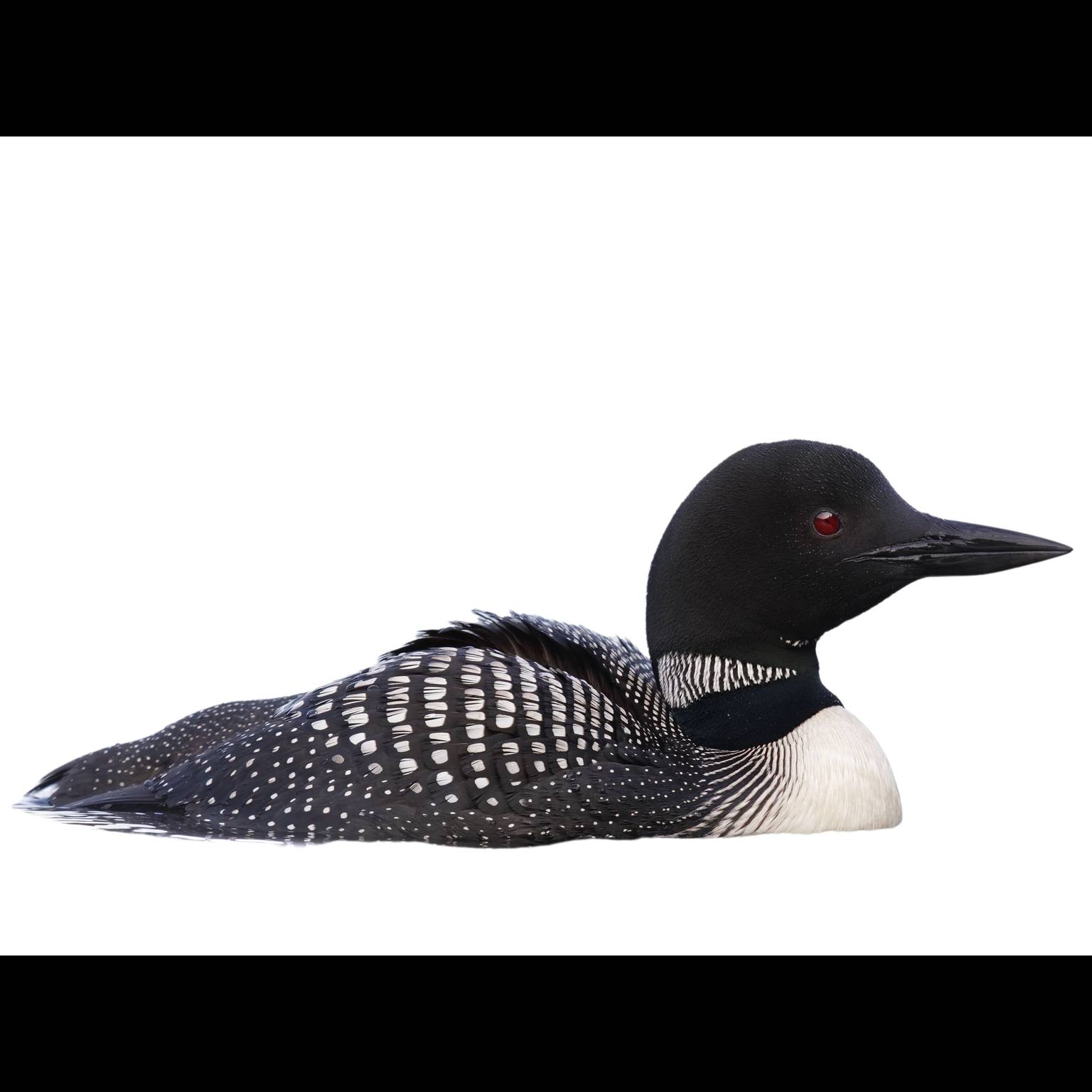
The Common Loon is a large, diving waterbird known for its striking black and white breeding plumage and haunting calls. It is an iconic species of northern lakes and coastal waters, renowned for its exceptional swimming and diving abilities.
Size & lifespan
- Length
- 61-100 cm (24-39 in)
- Wingspan
- 122-152 cm (48-60 in)
- Weight
- 2.4-8.0 kg (5.3-17.6 lbs), with males generally larger than females.
- Lifespan
- Up to 30 years in the wild, with an average of 15-20 years.
- Diet
- Carnivore, primarily piscivorous (fish-eating).
Physical characteristics
- Plumage
- Breeding adults have a striking black head and neck with a distinctive black-and-white striped 'necklace' on the throat and a checkered black-and-white back. The belly is white. Non-breeding adults and juveniles are duller, with a gray-brown back, white belly, and a pale throat and face.
- Beak shape
- Large, dagger-like, and straight bill, typically black in breeding plumage and grayish in non-breeding plumage.
- Eye color
- Bright red in breeding adults, duller red or brownish in non-breeding adults and juveniles.
- Leg color
- Dark gray to black, positioned far back on the body, ideal for propulsion underwater but making walking on land awkward.
- Distinguishing features
- Distinctive black-and-white breeding plumage, large size, low-riding profile on water, and unique vocalizations. The red eyes are particularly striking.
- Juvenile appearance
- Juveniles resemble non-breeding adults, with a duller gray-brown back, white underparts, and a pale throat. Their eyes are typically brownish, not red.
- Seasonal changes
- Adults undergo a complete molt after breeding, transitioning from their striking black-and-white breeding plumage to a duller gray-brown and white non-breeding (winter) plumage. This molt occurs primarily on their wintering grounds.
- Sexual dimorphism
- Males and females are outwardly similar in plumage, but males are generally larger and heavier than females.
How to identify
- 1
Size and Shape
Look for a large, heavy-bodied waterbird with a long body, short tail, and a thick neck. It sits low in the water.
- 2
Breeding Plumage (Adult)
Observe the striking black head and neck, the distinctive black-and-white striped 'necklace' on the throat, and the checkered black-and-white back. The belly is pure white.
- 3
Non-breeding/Juvenile Plumage
Note the duller gray-brown back, white belly, and pale throat/face. The bill is often grayish. Look for the overall loon shape and behavior.
- 4
Bill
Identify the large, straight, dagger-like bill. Black in breeding adults, grayish in non-breeding and juveniles.
- 5
Eyes
Look for bright red eyes in breeding adults, which can appear dark at a distance or in poor light. Juveniles and non-breeding adults have duller eyes.
- 6
Behavior on Water
Observe its low-riding profile, frequent diving, and powerful underwater propulsion. It rarely comes ashore except to nest.
- 7
Vocalizations
Listen for its distinctive calls: the mournful 'wail', the territorial 'yodel', and the agitated 'tremolo'. These are often the first indication of a loon's presence.
- 8
Flight
Note the powerful, direct flight with rapid wingbeats, neck outstretched, and feet trailing behind. Requires a long 'runway' for takeoff.
Habitat & range
- Biomes
- Freshwater lakes, large rivers, and coastal marine environments.
- Geographic range
- Breeds across Canada, Alaska, Greenland, Iceland, and parts of the northern United States (primarily New England, Great Lakes region, and Pacific Northwest). Winters along the Atlantic and Pacific coasts of North America, and the Gulf of Mexico.
- Elevation range
- Primarily low to moderate elevations, associated with large bodies of water.
- Preferred environments
- During breeding, prefers large, clear, deep freshwater lakes with abundant fish, emergent vegetation for nesting, and secluded coves. During winter, found in coastal marine waters, estuaries, and large, ice-free freshwater bodies.
Behavior
- Activity time
- Diurnal, active during daylight hours for foraging and other activities.
- Feeding habits
- Primarily fish-eaters, diving underwater to pursue and catch prey. They use their powerful webbed feet for propulsion and their dagger-like bill to spear or grasp fish. They also consume crustaceans, aquatic insects, and amphibians. Dives typically last 30-60 seconds, but can extend to several minutes.
- Social behavior
- Generally solitary or found in pairs during the breeding season. During migration and winter, they can gather in loose flocks on large bodies of water, though they maintain individual distances.
- Flight pattern
- Powerful, direct flight with rapid wingbeats. Requires a long 'runway' on water to take off, pattering across the surface. Once airborne, they fly with their neck outstretched and feet trailing behind, often at considerable altitudes during migration.
- Migration pattern
- Long-distance migrant. Breeds in northern freshwater lakes and migrates to coastal marine waters or large, ice-free freshwater bodies for the winter. Migration occurs primarily at night, often in small groups or individually.
- Territoriality
- Highly territorial during the breeding season, defending their nesting lake or a portion of it against other loons. They use vocalizations and aggressive displays to deter intruders.
Song & calls
- Song
- The Common Loon's vocalizations are iconic and complex. The 'yodel' is a loud, wavering call, typically given by males to defend territory or in response to intruders. It can last several seconds and is often described as wild or mournful.
- Call
- Other calls include the 'wail' (a long, mournful, wolf-like sound, often given at night or in fog, used for long-distance communication), the 'tremolo' (a rapid, laughing-like call, often given when alarmed or agitated, or in flight), and the 'hoot' (a soft, short call used between mates or parents and chicks).
- When they vocalize
- Most vocal during the breeding season, particularly at dawn, dusk, and throughout the night. Calls are less frequent on wintering grounds.
Breeding & reproduction
- Breeding season
- Late April to early June, depending on latitude and ice melt.
- Nesting habits
- Nests are typically built on small islands, hummocks, or sheltered shorelines with emergent vegetation, often very close to the water's edge. They are usually a shallow depression lined with mud, grass, and other plant material. Both parents participate in nest building.
- Clutch size
- 1-3 eggs, most commonly 2.
- Egg description
- Typically 1-3 (most commonly 2) olive-brown to dark brown eggs, often speckled with darker spots. Eggs are oval-shaped and relatively large.
- Incubation period
- 27-31 days, shared by both parents.
- Fledging period
- Chicks are precocial, able to swim and dive shortly after hatching. They are cared for by both parents for 8-10 weeks until they can fly and forage independently.
- Parental care
- Both parents share incubation duties and care for the young. Chicks often ride on the parents' backs for warmth and protection from predators, especially when very young.
Where to find
Breeding Lakes
Large, clear, deep freshwater lakes in northern forests of North America. Look for lakes with islands or secluded coves for nesting.
Coastal Waters (Winter)
Along the Atlantic and Pacific coasts of North America, and the Gulf of Mexico. Look in bays, estuaries, and nearshore ocean waters.
Large Rivers
Occasionally found on large, slow-moving rivers, especially during migration or in winter if ice-free.
Field tips
- Listen for Calls. Common Loons are often heard before they are seen. Learn their distinctive wails, yodels, and tremolos, especially during the breeding season.
- Scan Open Water. Use binoculars or a spotting scope to scan large expanses of water. Loons often appear as dark, low-riding shapes on the surface.
- Look for Diving Behavior. Observe their characteristic diving behavior. If a loon dives, keep watching the area, as they can resurface quite a distance from where they went down.
- Visit Breeding Grounds in Spring/Summer. The best time to see loons in their striking breeding plumage and hear their full repertoire of calls is during the breeding season on northern lakes.
- Check Coastal Areas in Winter. During winter, look for them in coastal marine environments, often in non-breeding plumage, where they may be mixed with other diving ducks or seabirds.
- Maintain Distance. Loons are sensitive to disturbance, especially during nesting. Observe from a respectful distance to avoid stressing the birds.
Similar species
Pacific Loon
Gavia pacifica
Smaller size, thinner bill, and in breeding plumage, the Pacific Loon has a gray head and a purple sheen on the throat patch, lacking the Common Loon's distinct black-and-white striped 'necklace'. In non-breeding plumage, Pacific Loons show a distinct 'chinstrap' and a sharper demarcation between dark and light on the neck.
Arctic Loon
Gavia arctica
Similar to Pacific Loon, but with a more restricted range in Eurasia and western Alaska. Shares the gray head and purple throat sheen in breeding plumage, distinguishing it from the Common Loon's striped neck.
Red-throated Loon
Gavia stellata
Significantly smaller, with a thinner, often upturned bill. In breeding plumage, it has a distinctive red throat patch (which can be hard to see at a distance) and a gray head, lacking the Common Loon's black-and-white patterns. It also takes off more easily from water, often without a long run.
Yellow-billed Loon
Gavia adamsii
Larger than the Common Loon, with a distinctive pale yellow or ivory-colored bill that is often held slightly upturned. Breeding plumage is similar to Common Loon but lacks the distinct 'necklace' and has a more extensive white flank patch. Its range is primarily Arctic.
Quick facts
- Primary Diet:
- Fish
- Habitat (Breeding):
- Large freshwater lakes
- Habitat (Winter):
- Coastal marine waters
- Distinctive Feature:
- Black-and-white breeding plumage, red eyes, haunting calls
- Locomotion:
- Excellent swimmer and diver, awkward on land
- Migration:
- Long-distance migrant
Fun facts
- The Common Loon is the provincial bird of Ontario, Canada, and the state bird of Minnesota, USA.
- Their bones are solid, not hollow like most birds, which helps them dive to impressive depths (up to 75 meters or 250 feet) and stay submerged for extended periods.
- Loon chicks often ride on their parents' backs, especially when very young, for warmth, protection from predators, and to conserve energy.
- The Common Loon's calls are so distinctive and evocative that they are often used in movies and television to signify wilderness or a remote northern setting.
- They are highly sensitive to environmental contaminants like mercury and lead, making them important bioindicators of ecosystem health.
Scientific classification
- Kingdom
- Animalia
- Phylum
- Chordata
- Class
- Aves
- Order
- Gaviiformes
- Family
- Gaviidae
- Genus
- Gavia
- Species
- Gavia immer
Explore the Common Loon
Identify birds anywhere
Free on iOS, Android, and Web. Photo & sound identification, full species database, and your personal life list.