
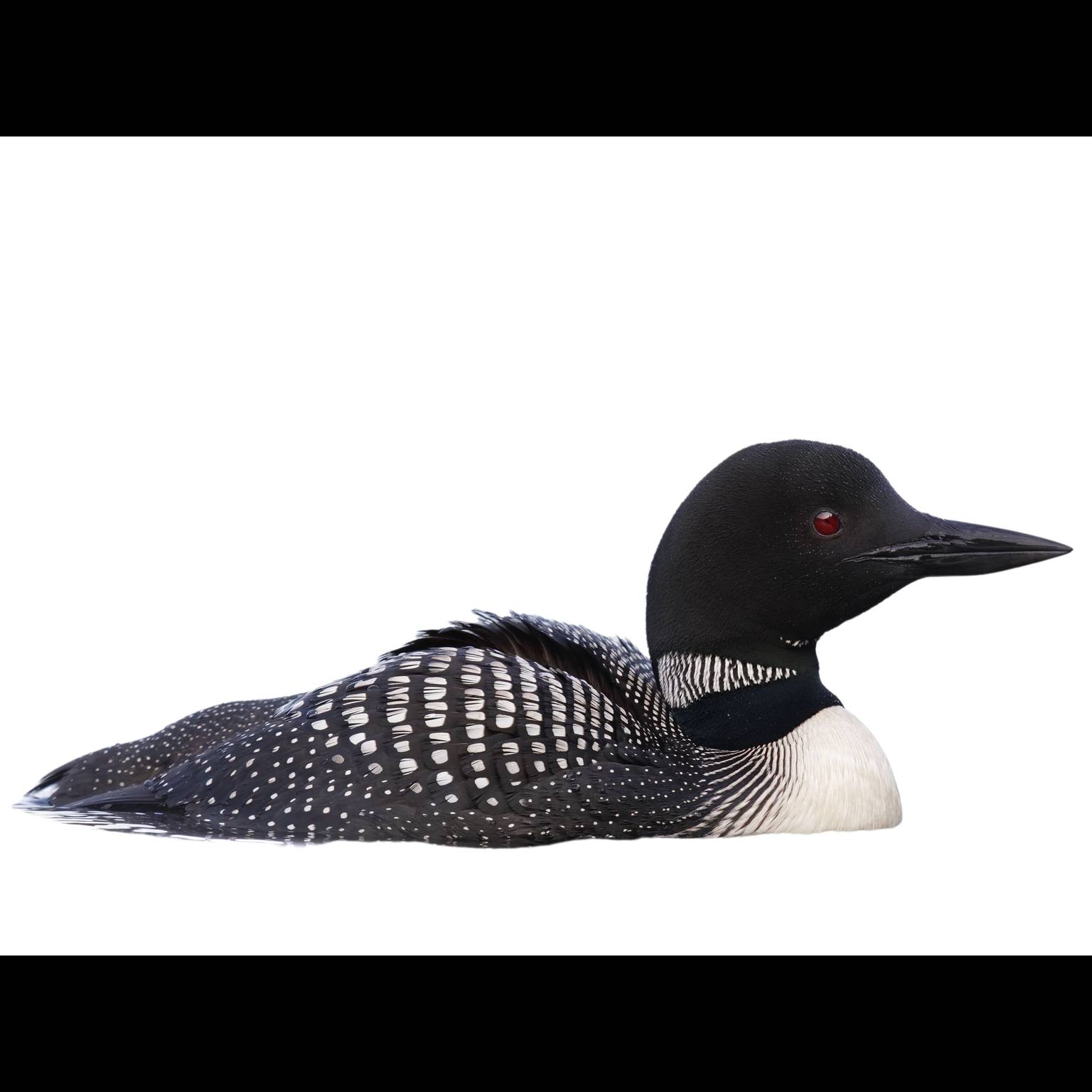
How to identify the Common Loon
Gavia immer
Spotted a bird? Identify it instantly with the Birdby app
Open the appTo correctly identify the Common Loon (Gavia immer), check each of these features. Birds can be tricky: habit, habitat, and call often confirm a sighting that a single photo cannot.
Size at a glance
- Length
- 61-100 cm (24-39 in)
- Wingspan
- 122-152 cm (48-60 in)
- Weight
- 2.4-8.0 kg (5.3-17.6 lbs), with males generally larger than females.
Physical features to check
- 1
Plumage
Overall feather coloration and pattern.
Breeding adults have a striking black head and neck with a distinctive black-and-white striped 'necklace' on the throat and a checkered black-and-white back. The belly is white. Non-breeding adults and juveniles are duller, with a gray-brown back, white belly, and a pale throat and face.
- 2
Beak shape
Shape and color of the bill: a key field mark.
Large, dagger-like, and straight bill, typically black in breeding plumage and grayish in non-breeding plumage.
- 3
Eye color
Iris color and any distinctive eye markings.
Bright red in breeding adults, duller red or brownish in non-breeding adults and juveniles.
- 4
Leg color
Leg and foot color.
Dark gray to black, positioned far back on the body, ideal for propulsion underwater but making walking on land awkward.
- 5
Distinguishing features
Standout features that separate this species.
Distinctive black-and-white breeding plumage, large size, low-riding profile on water, and unique vocalizations. The red eyes are particularly striking.
- 6
Juvenile appearance
How young birds differ from adults.
Juveniles resemble non-breeding adults, with a duller gray-brown back, white underparts, and a pale throat. Their eyes are typically brownish, not red.
- 7
Seasonal changes
Plumage variation between breeding and non-breeding seasons.
Adults undergo a complete molt after breeding, transitioning from their striking black-and-white breeding plumage to a duller gray-brown and white non-breeding (winter) plumage. This molt occurs primarily on their wintering grounds.
- 8
Sexual dimorphism
How males and females differ.
Males and females are outwardly similar in plumage, but males are generally larger and heavier than females.
Key field marks
- Size and Shape. Look for a large, heavy-bodied waterbird with a long body, short tail, and a thick neck. It sits low in the water.
- Breeding Plumage (Adult). Observe the striking black head and neck, the distinctive black-and-white striped 'necklace' on the throat, and the checkered black-and-white back. The belly is pure white.
- Non-breeding/Juvenile Plumage. Note the duller gray-brown back, white belly, and pale throat/face. The bill is often grayish. Look for the overall loon shape and behavior.
- Bill. Identify the large, straight, dagger-like bill. Black in breeding adults, grayish in non-breeding and juveniles.
- Eyes. Look for bright red eyes in breeding adults, which can appear dark at a distance or in poor light. Juveniles and non-breeding adults have duller eyes.
- Behavior on Water. Observe its low-riding profile, frequent diving, and powerful underwater propulsion. It rarely comes ashore except to nest.
- Vocalizations. Listen for its distinctive calls: the mournful 'wail', the territorial 'yodel', and the agitated 'tremolo'. These are often the first indication of a loon's presence.
- Flight. Note the powerful, direct flight with rapid wingbeats, neck outstretched, and feet trailing behind. Requires a long 'runway' for takeoff.
Explore the Common Loon
Identify birds anywhere
Free on iOS, Android, and Web. Photo & sound identification, full species database, and your personal life list.