
Spotted a bird? Identify it instantly with the Birdby app
Open the appAbout
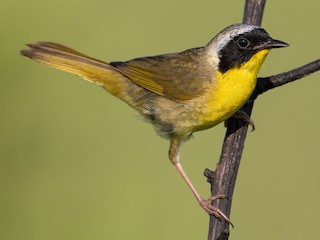
The Common Yellowthroat is a small, active New World warbler known for the male's distinctive black mask and bright yellow throat. It is a widespread and common species across North America, typically found in dense, low vegetation near water.
Size & lifespan
- Length
- 11-13 cm (4.3-5.1 in)
- Wingspan
- 15-19 cm (5.9-7.5 in)
- Weight
- 8-15 g (0.28-0.53 oz)
- Lifespan
- Typically 2-3 years in the wild, with records up to 8 years.
- Diet
- Insectivore, primarily consuming small insects and spiders.
Physical characteristics
- Plumage
- Males have a striking black mask bordered by a white band above, extending from the forehead to behind the eye. The throat and breast are bright yellow, fading to olive-brown on the back, wings, and tail, and whitish on the belly. Females lack the black mask, having an olive-brown head with a yellowish wash, especially around the face and throat, and a duller yellow breast. Both sexes have a relatively short, rounded tail.
- Beak shape
- Small, slender, pointed, and dark (blackish to dark gray).
- Eye color
- Dark brown.
- Leg color
- Dark gray to blackish.
- Distinguishing features
- Male's black mask with white border, bright yellow throat and breast. Female's yellowish face and throat without a mask. Constantly active, often flicking its tail.
- Juvenile appearance
- Juveniles resemble females but are duller, with less distinct yellow on the throat and a more brownish-olive overall coloration. The black mask of young males begins to emerge in late summer/early fall.
- Seasonal changes
- Plumage remains largely consistent between breeding and non-breeding seasons, though colors may appear slightly duller or more worn outside of the breeding period. Males retain their black mask year-round.
- Sexual dimorphism
- Pronounced. Males have a distinct black mask and brighter yellow plumage. Females lack the mask and are duller overall.
How to identify
- 1
Male Plumage
Look for the unmistakable black mask across the eyes, bordered by a thin white band above, contrasting sharply with the bright yellow throat and breast. The back is olive-green.
- 2
Female Plumage
Identify females by their overall olive-brown upperparts and yellowish underparts, with a distinct yellowish wash on the face and throat, but no black mask. They often have a faint, broken eye-ring.
- 3
Behavior
Observe their active, skulking behavior in dense, low vegetation. They are constantly moving, hopping, and creeping through thickets, often flicking their tails.
- 4
Song
Listen for the characteristic 'wichity-wichity-wichity' song, which is loud, clear, and often repeated. This is one of the most reliable identification cues.
- 5
Habitat
Common Yellowthroats are almost exclusively found in dense, low, often wet, shrubby habitats. If you're in such an environment and hear the song, it's likely a Common Yellowthroat.
Habitat & range
- Biomes
- Wetlands, grasslands, shrublands, open woodlands, agricultural lands.
- Geographic range
- Breeds across most of North America, from southern Canada through the United States. Winters from the southern United States, Mexico, Central America, and the Caribbean.
- Elevation range
- From sea level up to approximately 2,500 meters (8,200 feet), depending on geographic location and habitat availability.
- Preferred environments
- Dense, low, tangled vegetation, especially near water. This includes marshes, swamps, wet meadows, overgrown fields, riparian thickets, shrubby borders of ponds and streams, and clearings with dense undergrowth.
Behavior
- Activity time
- Diurnal.
- Feeding habits
- Forages actively in dense low vegetation, gleaning insects and spiders from leaves and stems. It often hops and creeps through thickets, occasionally making short aerial sallies to catch flying insects. It typically stays close to the ground.
- Social behavior
- Solitary or in pairs during the breeding season. During migration and winter, they may join mixed-species foraging flocks, though often remain somewhat independent within the flock.
- Flight pattern
- Short, undulating flights between patches of dense cover. When migrating, flight is direct and sustained.
- Migration pattern
- Neotropical migrant. Most populations are migratory, moving south for the winter. Northern populations migrate further south than southern populations. Spring migration occurs from April to May, and fall migration from August to October.
- Territoriality
- Males are highly territorial during the breeding season, defending their breeding grounds with songs and displays.
Song & calls
- Song
- A distinctive, rapid, and emphatic 'wichity-wichity-wichity' or 'witchety-witchety-witchety' song, often described as 'I want to be with you'. The rhythm and number of 'wichity' phrases can vary geographically and individually.
- Call
- A sharp 'chip' or 'chick' call, often given when agitated or as a contact call. Also a softer 'tseet' or 'tzip'.
- When they vocalize
- Males sing frequently from prominent perches within their territory during the breeding season (spring and early summer). Calls are given year-round.
Breeding & reproduction
- Breeding season
- Typically May to July, varying by latitude.
- Nesting habits
- Nests are well-concealed, usually on or very near the ground, often in dense grasses, sedges, or low shrubs. The female builds a cup-shaped nest of grasses, leaves, bark strips, and plant fibers, lined with fine grasses and hair.
- Clutch size
- 3-5 eggs, typically 4.
- Egg description
- 3-5 (occasionally 6) eggs, white to creamy white, speckled and spotted with reddish-brown, purplish-brown, or black, often concentrated at the larger end. Approximately 17 x 13 mm.
- Incubation period
- 12-13 days, primarily by the female.
- Fledging period
- 8-10 days after hatching, young leave the nest but are still fed by parents for a period.
- Parental care
- Both parents feed the nestlings and fledglings, though the female does most of the incubation. Males may feed the first brood while the female starts a second clutch.
Where to find
Marshes and Swamps
Look along the edges of freshwater marshes, cattail stands, and wooded swamps where dense undergrowth is present.
Wet Meadows and Fields
Check overgrown fields, wet meadows, and areas with tall grasses and scattered shrubs, especially near water sources.
Riparian Thickets
Explore shrubby borders of rivers, streams, ponds, and lakes. They prefer the dense vegetation along these waterways.
Disturbed Areas
They can also be found in clearings, powerline cuts, and other disturbed areas that have regenerated with dense, low shrubby growth.
Field tips
- Listen for the song. The 'wichity-wichity-wichity' song is very distinctive and often given from a hidden perch. Learning this song is key to finding them.
- Be patient and observe. Common Yellowthroats are skulkers. Find a suitable habitat, stand still, and listen. They will often pop up briefly to sing or forage before disappearing back into cover.
- Scan low vegetation. Focus your binoculars on the lower parts of shrubs, tall grasses, and dense thickets. They rarely venture high into trees.
- Look for movement. Their constant activity and tail-flicking can give away their presence even when they are mostly hidden.
- Visit early morning. They are most active and vocal during the early morning hours, especially during the breeding season.
Similar species
Hooded Warbler
Setophaga citrina
Male Hooded Warblers have a complete black hood surrounding a yellow face, whereas Common Yellowthroats have a black mask. Female Hooded Warblers are duller but still show a yellowish face and olive back, lacking the distinct yellowthroat pattern. Hooded Warblers also tend to hold their tails up and flick them more frequently.
Mourning Warbler
Geothlypis philadelphia
Male Mourning Warblers have a gray hood and a black 'bib' on the breast, lacking the black mask and white border of the Common Yellowthroat. Females are duller but still show a grayish wash on the head and breast. Mourning Warblers also have a broken eye-ring, which Common Yellowthroats lack.
Connecticut Warbler
Oporornis agilis
Connecticut Warblers are larger and stockier, with a complete white eye-ring and a gray hood (males) or grayish-brown head (females). They are much shyer and typically found in denser, often drier, undergrowth. Their song is also distinctly different.
Quick facts
- Distinctive Feature (Male):
- Black mask with white border
- Song:
- 'wichity-wichity-wichity'
- Preferred Habitat:
- Dense, low vegetation near water
- Diet:
- Insects and spiders
- Migration Status:
- Neotropical migrant
Fun facts
- The Common Yellowthroat is one of the most widespread and abundant warblers in North America.
- Despite their bright colors, they are often difficult to see due to their preference for dense cover and skulking behavior.
- There are numerous subspecies of Common Yellowthroat, showing slight variations in plumage and size across their vast range.
- Males often sing from a slightly elevated perch, such as a tall weed stalk or the top of a shrub, making them briefly visible.
- They are frequent victims of brood parasitism by Brown-headed Cowbirds, but their deep, well-concealed nests offer some protection.
Scientific classification
- Kingdom
- Animalia
- Phylum
- Chordata
- Class
- Aves
- Order
- Passeriformes
- Family
- Parulidae
- Genus
- Geothlypis
- Species
- Geothlypis trichas
Explore the Common Yellowthroat
Identify birds anywhere
Free on iOS, Android, and Web. Photo & sound identification, full species database, and your personal life list.