
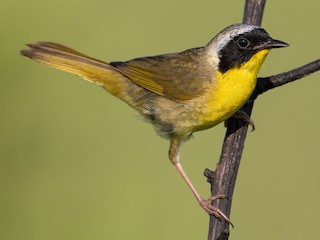
How to identify the Common Yellowthroat
Geothlypis trichas
Spotted a bird? Identify it instantly with the Birdby app
Open the appTo correctly identify the Common Yellowthroat (Geothlypis trichas), check each of these features. Birds can be tricky: habit, habitat, and call often confirm a sighting that a single photo cannot.
Size at a glance
- Length
- 11-13 cm (4.3-5.1 in)
- Wingspan
- 15-19 cm (5.9-7.5 in)
- Weight
- 8-15 g (0.28-0.53 oz)
Physical features to check
- 1
Plumage
Overall feather coloration and pattern.
Males have a striking black mask bordered by a white band above, extending from the forehead to behind the eye. The throat and breast are bright yellow, fading to olive-brown on the back, wings, and tail, and whitish on the belly. Females lack the black mask, having an olive-brown head with a yellowish wash, especially around the face and throat, and a duller yellow breast. Both sexes have a relatively short, rounded tail.
- 2
Beak shape
Shape and color of the bill: a key field mark.
Small, slender, pointed, and dark (blackish to dark gray).
- 3
Eye color
Iris color and any distinctive eye markings.
Dark brown.
- 4
Leg color
Leg and foot color.
Dark gray to blackish.
- 5
Distinguishing features
Standout features that separate this species.
Male's black mask with white border, bright yellow throat and breast. Female's yellowish face and throat without a mask. Constantly active, often flicking its tail.
- 6
Juvenile appearance
How young birds differ from adults.
Juveniles resemble females but are duller, with less distinct yellow on the throat and a more brownish-olive overall coloration. The black mask of young males begins to emerge in late summer/early fall.
- 7
Seasonal changes
Plumage variation between breeding and non-breeding seasons.
Plumage remains largely consistent between breeding and non-breeding seasons, though colors may appear slightly duller or more worn outside of the breeding period. Males retain their black mask year-round.
- 8
Sexual dimorphism
How males and females differ.
Pronounced. Males have a distinct black mask and brighter yellow plumage. Females lack the mask and are duller overall.
Key field marks
- Male Plumage. Look for the unmistakable black mask across the eyes, bordered by a thin white band above, contrasting sharply with the bright yellow throat and breast. The back is olive-green.
- Female Plumage. Identify females by their overall olive-brown upperparts and yellowish underparts, with a distinct yellowish wash on the face and throat, but no black mask. They often have a faint, broken eye-ring.
- Behavior. Observe their active, skulking behavior in dense, low vegetation. They are constantly moving, hopping, and creeping through thickets, often flicking their tails.
- Song. Listen for the characteristic 'wichity-wichity-wichity' song, which is loud, clear, and often repeated. This is one of the most reliable identification cues.
- Habitat. Common Yellowthroats are almost exclusively found in dense, low, often wet, shrubby habitats. If you're in such an environment and hear the song, it's likely a Common Yellowthroat.
Explore the Common Yellowthroat
Identify birds anywhere
Free on iOS, Android, and Web. Photo & sound identification, full species database, and your personal life list.