
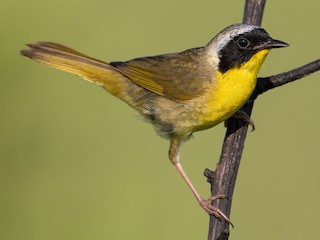
Where does the Common Yellowthroat live?
Geothlypis trichas
Spotted a bird? Identify it instantly with the Birdby app
Open the appThe Common Yellowthroat lives in specific habitats and regions. Knowing where, and when, to look improves your chances of a successful sighting.
Biomes
Wetlands, grasslands, shrublands, open woodlands, agricultural lands.
Geographic range
Breeds across most of North America, from southern Canada through the United States. Winters from the southern United States, Mexico, Central America, and the Caribbean.
Preferred environments
Dense, low, tangled vegetation, especially near water. This includes marshes, swamps, wet meadows, overgrown fields, riparian thickets, shrubby borders of ponds and streams, and clearings with dense undergrowth.
Elevation range
From sea level up to approximately 2,500 meters (8,200 feet), depending on geographic location and habitat availability.
Where to look
Marshes and Swamps
Look along the edges of freshwater marshes, cattail stands, and wooded swamps where dense undergrowth is present.
Wet Meadows and Fields
Check overgrown fields, wet meadows, and areas with tall grasses and scattered shrubs, especially near water sources.
Riparian Thickets
Explore shrubby borders of rivers, streams, ponds, and lakes. They prefer the dense vegetation along these waterways.
Disturbed Areas
They can also be found in clearings, powerline cuts, and other disturbed areas that have regenerated with dense, low shrubby growth.
Field tips
- Listen for the song. The 'wichity-wichity-wichity' song is very distinctive and often given from a hidden perch. Learning this song is key to finding them.
- Be patient and observe. Common Yellowthroats are skulkers. Find a suitable habitat, stand still, and listen. They will often pop up briefly to sing or forage before disappearing back into cover.
- Scan low vegetation. Focus your binoculars on the lower parts of shrubs, tall grasses, and dense thickets. They rarely venture high into trees.
- Look for movement. Their constant activity and tail-flicking can give away their presence even when they are mostly hidden.
- Visit early morning. They are most active and vocal during the early morning hours, especially during the breeding season.
Migration
Neotropical migrant. Most populations are migratory, moving south for the winter. Northern populations migrate further south than southern populations. Spring migration occurs from April to May, and fall migration from August to October.
Explore the Common Yellowthroat
Identify birds anywhere
Free on iOS, Android, and Web. Photo & sound identification, full species database, and your personal life list.