
Spotted a bird? Identify it instantly with the Birdby app
Open the appAbout
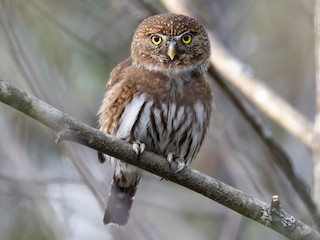
The Northern Pygmy-Owl is a small, diurnal owl species found in western North America. Despite its diminutive size, it is a fierce and effective predator, known for its bold hunting behavior during daylight hours. It possesses distinct 'false eyes' on the back of its head, an adaptation believed to deter predators. Its rapid, undulating flight and characteristic calls make it a charismatic inhabitant of coniferous and mixed forests.
Size & lifespan
- Length
- 16-18 cm (6.3-7.1 in)
- Wingspan
- 38-43 cm (15-17 in)
- Weight
- 50-75 g (1.8-2.6 oz)
- Lifespan
- Typically 3-5 years in the wild, with some individuals living up to 7-8 years.
- Diet
- Primarily small birds (including juncos, chickadees, kinglets, and even larger prey like doves), small mammals (voles, shrews, mice), and large insects (grasshoppers, beetles).
Physical characteristics
- Plumage
- Adults are typically grayish-brown to reddish-brown on the upperparts, heavily streaked with white on the underparts. The head is rounded with no ear tufts. Two prominent black patches bordered with white on the nape create 'false eyes' (ocelli). The tail is relatively long for an owl, with 5-6 narrow white bars.
- Beak shape
- Small, sharply hooked, and dark (blackish).
- Eye color
- Bright yellow.
- Leg color
- Yellowish-orange with dark talons.
- Distinguishing features
- Small size, diurnal hunting habits, lack of ear tufts, bright yellow eyes, 'false eyes' on the back of the head, and a relatively long tail compared to other small owls.
- Juvenile appearance
- Juveniles resemble adults but often have a somewhat fluffier appearance, less distinct streaking on the underparts, and fewer, broader white bars on the tail.
- Seasonal changes
- No significant seasonal plumage changes. Plumage color variation (grayish vs. reddish morphs) is independent of season and likely genetic, often correlated with local conifer species.
- Sexual dimorphism
- Females are typically slightly larger and heavier than males, but plumage is essentially identical.
How to identify
- 1
Size and Shape
Very small for an owl, with a relatively long tail (often cocked), small rounded head (no ear tufts), and bright yellow eyes. Appears stocky but agile.
- 2
Plumage
Grayish-brown to reddish-brown back with white spots, heavily streaked white underparts. Look for the distinct black 'false eyes' on the nape.
- 3
Behavior
Often perches conspicuously on exposed branches during the day, frequently twitches or bobs its tail, and is an active diurnal hunter. Will quickly dart after prey.
- 4
Vocalization
Listen for its distinctive, monotonous series of equally spaced, whistled toots: 'hoo-hoo-hoo...' approximately two per second. This is the most reliable identification feature.
Habitat & range
- Biomes
- Coniferous forests, mixed coniferous-deciduous forests, riparian woodlands.
- Geographic range
- Western North America, from southeastern Alaska and British Columbia southward through the western United States, extending into Mexico (specifically the Sierra Madre Occidental).
- Elevation range
- Sea level up to 3,000 meters (10,000 ft), depending on latitude, typically found in montane forests.
- Preferred environments
- Mature and old-growth forests with a mix of coniferous and deciduous trees, often near riparian areas or forest edges that provide a varied prey base. Requires snags or dead trees for nesting cavities.
Behavior
- Activity time
- Mainly diurnal and crepuscular (dawn and dusk), making it more readily observed than most owls. Occasionally hunts at night.
- Feeding habits
- A classic 'sit-and-wait' predator, often perching conspicuously on an exposed branch, scanning for prey. Hunts mainly during the day, particularly dawn and dusk, but also throughout the morning and afternoon. Darts out with rapid, undulating flight to catch prey in mid-air or off branches/ground. Known for taking prey almost its own size or larger.
- Social behavior
- Primarily solitary, especially outside the breeding season. Pairs form for breeding.
- Flight pattern
- Rapid, direct, and undulating flight over short distances. Can be very agile through dense forest. Often makes quick, darting sallies when hunting.
- Migration pattern
- Generally resident throughout its range. Some elevational migration may occur in mountainous regions, moving to lower elevations during harsh winters.
- Territoriality
- Territorial, especially during the breeding season. Males use their calls to advertise and defend their territories. Territories can be relatively large for such a small bird, covering several hectares.
Song & calls
- Song
- The primary song is a distinctive series of evenly spaced, whistled toots: 'hoo-hoo-hoo-hoo...' or 'poop-poop-poop...'. These toots are delivered at a rate of about 2 per second, often continuing for many seconds or even minutes. The pitch is relatively low for such a small bird.
- Call
- Calls include a rapid, ascending trill or 'whinny' (often by the female or in alarm), and various scolding or chattering notes when agitated or mobbing. Contact calls are softer, single toots.
- When they vocalize
- Most vocal at dawn and dusk, but can call throughout the day, especially during the breeding season (late winter through spring) to attract mates and defend territory.
Breeding & reproduction
- Breeding season
- April to July, with peak nesting activity in May and June.
- Nesting habits
- Nests in abandoned cavities of woodpeckers (especially Northern Flickers) or natural tree hollows in snags or live trees. They do not excavate their own cavities. Nests are typically 2-15 meters (6-50 ft) above the ground.
- Clutch size
- 4-6 eggs, though ranges from 2 to 7.
- Egg description
- 2-7 (usually 4-6) pure white, elliptical eggs. Smooth with no markings.
- Incubation period
- 28-30 days, primarily by the female.
- Fledging period
- 27-34 days after hatching. Young birds remain dependent on parents for several weeks after fledging.
- Parental care
- Female incubates and broods, male provides food. Both parents feed the young after they hatch. Fledglings are fed by parents for several weeks before becoming independent.
Where to find
Forests
Active in coniferous or mixed forests, particularly mature stands near clearings, riparian zones, or forest edges. Look in mountains and foothills throughout its western North American range.
Snags/Dead Trees
These owls require old woodpecker cavities for nesting. Search areas with standing dead trees or trees with large natural hollows.
Bird Feeders (indirect)
While they don't eat seeds, these owls are often attracted to areas with high concentrations of small songbirds (e.g., feeders) as prey.
Field tips
- Listen for Calls. The most effective way to find a Northern Pygmy-Owl is by listening for its distinct hooting song, especially at dawn and dusk, or even during the day from late winter through spring.
- Look for Mobbing Birds. Small songbirds (e.g., chickadees, jays, nuthatches) often mob and scold perched pygmy-owls. Follow the commotion to locate the owl.
- Scan Conspicuous Perches. These owls frequently perch in the open on exposed branches, often at mid-story height or higher, to scan for prey. Use binoculars to carefully scan such perches.
- Check Tree Cavities. During the breeding season, look for activity around old woodpecker holes in snags or mature trees, which they use for nesting.
Similar species
Ferruginous Pygmy-Owl
Glaucidium brasilianum
The Ferruginous Pygmy-Owl is found further south and typically has a rufous (reddish-brown) plumage more consistently, especially on the undertail coverts, and less distinct streaking on the breast. Its false eyes are often less prominent. Its call is a faster, often rising series of hoots, distinct from the even-paced toots of the Northern Pygmy-Owl.
Elf Owl
Micrathene whitneyi
The Elf Owl is even smaller, has a much shorter tail, and is primarily nocturnal. It has a more desert and arid habitat preference and lighter, warmer brown plumage, often with a prominent white supercilium. Its calls are quite different, typically a series of chittering or barking notes.
Boreal Owl
Aegolius funereus
The Boreal Owl is larger with a much larger, rounded head, more prominent facial disc, and dark streaking on the crown. It is strictly nocturnal and lacks 'false eyes'. Its call is a series of soft, rapid hoots, but the overall appearance and behavior are very different.
Quick facts
- Smallest Owl in its Range:
- One of the smallest owls in North America, often mistaken for a songbird at first glance.
- Diurnal Predator:
- Unusual among owls for its primarily daytime hunting activity.
- 'False Eyes':
- Unique black and white patches on the nape are thought to deter predators from approaching from behind.
- Bold Hunter:
- Known for its aggressive hunting style, often taking prey nearly its own size or larger.
- Tail-Wagging:
- Frequently bobs or twitches its tail when perched, a useful identification clue.
Fun facts
- Despite its small size, the Northern Pygmy-Owl is a formidable predator, capable of taking down prey much larger than itself, including birds like American Robins or Steller's Jays.
- The 'false eyes' on the back of its head are a clever adaptation. They make the owl appear to be looking in two directions at once, possibly confusing potential predators or prey.
- They are often mobbed by flocks of small songbirds. This behavior, known as 'mobbing', is an alarm signal and a way for smaller birds to drive away a predator.
- Their habitat preferences often put them in high-elevation coniferous forests, making them a welcome sight for hikers and campers who are lucky enough to spot them.
Scientific classification
- Kingdom
- Animalia
- Phylum
- Chordata
- Class
- Aves
- Order
- Strigiformes
- Family
- Strigidae
- Genus
- Glaucidium
- Species
- Glaucidium gnoma
Explore the Northern Pygmy-Owl
Identify birds anywhere
Free on iOS, Android, and Web. Photo & sound identification, full species database, and your personal life list.