
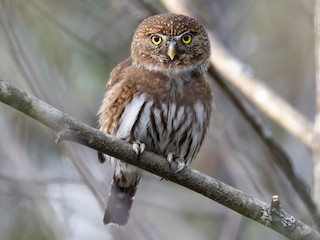
How to identify the Northern Pygmy-Owl
Glaucidium gnoma
Spotted a bird? Identify it instantly with the Birdby app
Open the appTo correctly identify the Northern Pygmy-Owl (Glaucidium gnoma), check each of these features. Birds can be tricky: habit, habitat, and call often confirm a sighting that a single photo cannot.
Size at a glance
- Length
- 16-18 cm (6.3-7.1 in)
- Wingspan
- 38-43 cm (15-17 in)
- Weight
- 50-75 g (1.8-2.6 oz)
Physical features to check
- 1
Plumage
Overall feather coloration and pattern.
Adults are typically grayish-brown to reddish-brown on the upperparts, heavily streaked with white on the underparts. The head is rounded with no ear tufts. Two prominent black patches bordered with white on the nape create 'false eyes' (ocelli). The tail is relatively long for an owl, with 5-6 narrow white bars.
- 2
Beak shape
Shape and color of the bill: a key field mark.
Small, sharply hooked, and dark (blackish).
- 3
Eye color
Iris color and any distinctive eye markings.
Bright yellow.
- 4
Leg color
Leg and foot color.
Yellowish-orange with dark talons.
- 5
Distinguishing features
Standout features that separate this species.
Small size, diurnal hunting habits, lack of ear tufts, bright yellow eyes, 'false eyes' on the back of the head, and a relatively long tail compared to other small owls.
- 6
Juvenile appearance
How young birds differ from adults.
Juveniles resemble adults but often have a somewhat fluffier appearance, less distinct streaking on the underparts, and fewer, broader white bars on the tail.
- 7
Seasonal changes
Plumage variation between breeding and non-breeding seasons.
No significant seasonal plumage changes. Plumage color variation (grayish vs. reddish morphs) is independent of season and likely genetic, often correlated with local conifer species.
- 8
Sexual dimorphism
How males and females differ.
Females are typically slightly larger and heavier than males, but plumage is essentially identical.
Key field marks
- Size and Shape. Very small for an owl, with a relatively long tail (often cocked), small rounded head (no ear tufts), and bright yellow eyes. Appears stocky but agile.
- Plumage. Grayish-brown to reddish-brown back with white spots, heavily streaked white underparts. Look for the distinct black 'false eyes' on the nape.
- Behavior. Often perches conspicuously on exposed branches during the day, frequently twitches or bobs its tail, and is an active diurnal hunter. Will quickly dart after prey.
- Vocalization. Listen for its distinctive, monotonous series of equally spaced, whistled toots: 'hoo-hoo-hoo...' approximately two per second. This is the most reliable identification feature.
Explore the Northern Pygmy-Owl
Identify birds anywhere
Free on iOS, Android, and Web. Photo & sound identification, full species database, and your personal life list.